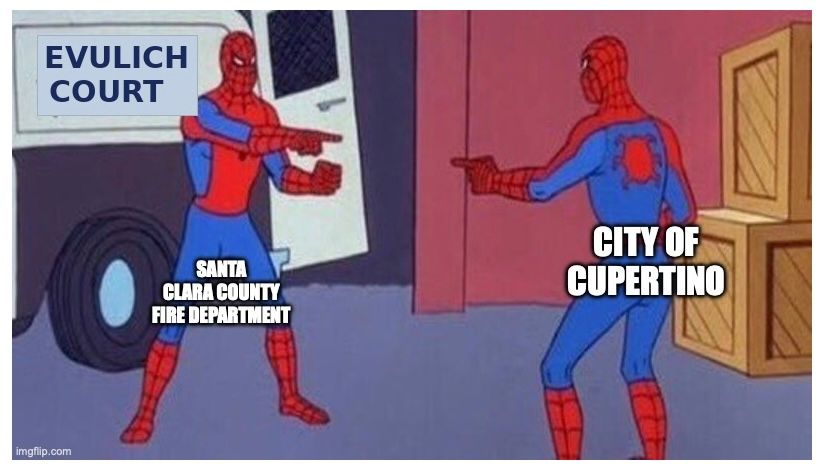
The Evulich Court project proposes 51 townhomes in a Very High Fire Hazard Severity Zone. To fit the oversized units (~2700 sf) on the site, the developer requested — and received — a reduction of the mandatory 30-foot wildfire setback to just 10 feet along the boundaries facing existing single-family homes. Somebody had to take responsibility for that decision. As it turns out, nobody did.
The Accountability Gap
David Yan’s op-ed in the San Jose Spotlight (March 16, 2026) highlights the evacuation side of this problem: the City of Cupertino commissioned an evacuation capacity study that found roadways in this area already exceed 200% of capacity during a wildfire event — and then never entered that study into the record for the Planning Commission hearing that approved the project.
This article examines the other side: the fire department’s own review of the setback reduction, and the gap in accountability between the Santa Clara County Fire Department (SCCFD) and the City of Cupertino.
The SCCFD says its review is not an approval of a code violation. The City of Cupertino says fire safety review is SCCFD’s domain and relies entirely on the AMMR as evidence of fire safety compliance. Neither entity has produced a documented technical analysis demonstrating that the reduced setback provides equivalent protection for the surrounding neighborhood.
The residents — and the firefighters who will respond to this address — are the ones left in the middle.
What Was Approved
The project at 10857 Linda Vista Drive is a 51-unit townhome development by SummerHill Homes. The site is designated as a Very High Fire Hazard Severity Zone (VHFHSZ).
Under the Board of Forestry Fire Safe Regulations (California Code of Regulations, Title 14, §1276.01), all parcels in a VHFHSZ must provide a minimum 30-foot setback from property lines. This is not a building code technicality — it is a wildfire safety standard designed to protect the surrounding neighborhood or community from fire spreading between structures (14 CCR §1270.01).
SummerHill filed an Alternative Means and Methods Request (AMMR) to reduce this setback:
- Northern property line (facing single-family homes): reduced to 10 feet
- Southern property line (facing single-family homes): reduced to 10 feet
- Western property line (the wildland-urban interface): reduced to 20 feet
Filed, Accepted, and Done: The One-Day Timeline
The AMMR was filed on January 5, 2026. It was accepted by the Fire Official on January 6. The Fire Prevention Plan Review was completed on January 7.
The administrative record contains no documentation of what technical analysis was performed during this one-day period to support the determination that a 10-foot setback provides the same practical fire-safety effect as the 30-foot standard.
This matters because the standard is not trivial. Research by the National Institute of Standards and Technology (NIST TN 2205) has found that intense radiant heat from a fully involved structure can ignite another structure at distances of approximately 30 feet, and that increasing spacing from 10 meters to 30 meters increases resistance to fire spread by a factor of ten. Post-disaster analysis of the 2023 Lahaina fire by the Insurance Institute for Business and Home Safety (IBHS) identified structure spacing as the single most critical factor in structure-to-structure fire spread.
The SCCFD plan review itself describes the reduced setbacks as “deficiencies to non-conforming 30′ setback requirements” to be mitigated. This is the language of a known shortfall — not a finding that the proposed alternative achieves equivalent protection.
SCCFD Says It’s Not an Approval. The City Treats It as One.
This is where the accountability gap becomes clear.
The SCCFD’s own Fire Prevention Plan Review includes a bold-face disclaimer:
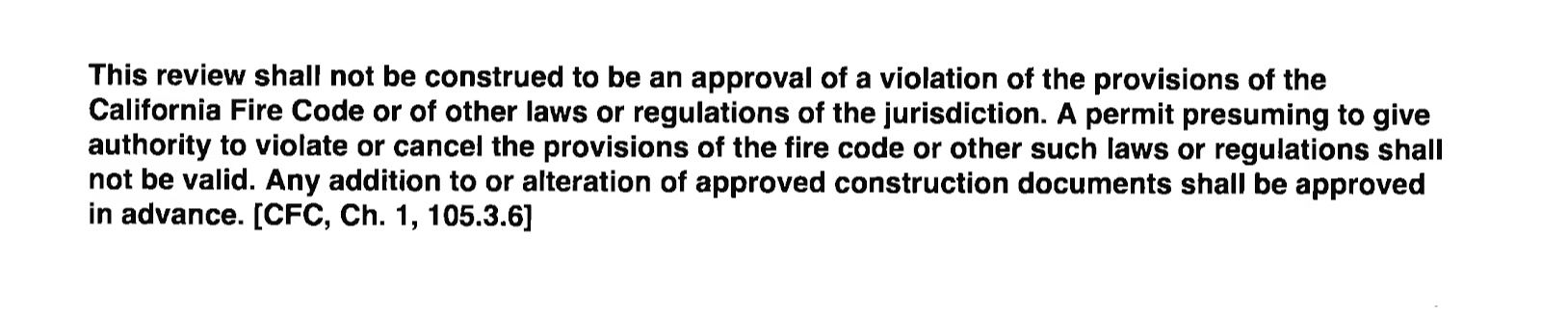
Read that again. The fire department is explicitly saying: this document is not a determination that the fire code has been satisfied.
Meanwhile, the City of Cupertino’s staff report and AB 130 qualification memo treat the AMMR as the definitive proof that fire safety has been addressed. The City has delegated fire-related review to SCCFD and has not conducted its own independent fire safety analysis.
SCCFD says: “Our review is not an approval of compliance.”
The City says: “Fire safety is SCCFD’s responsibility, and they approved it.”
Result: No entity has taken ownership of the determination that the 10-foot setback is safe for the surrounding community.
The Missing Signature
The AMMR form requires dual review. Under the California Fire Code (CFC 104.10), the Fire Official must find that the proposed alternative is “not less than the equivalent” of the code standard. Under the California Building Code (CBC 104.11), the Building Official has the identical obligation. The SCCFD’s own AMMR form reflects this, with signature lines for both officials.
The Fire Official — SCCFD — has signed.
The Building Official line — which corresponds to the City of Cupertino’s building authority — is blank.
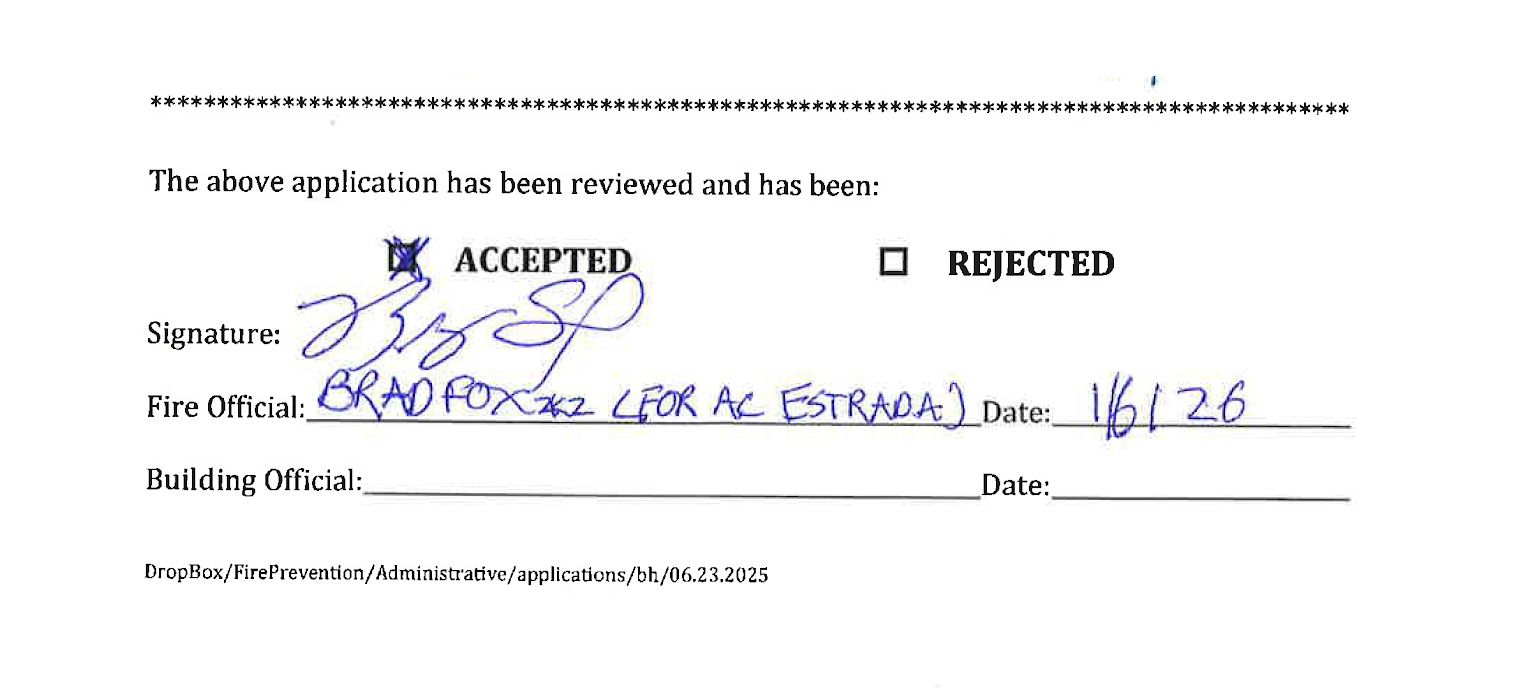
Without the Building Official’s evaluation and signature, the AMMR has not completed the dual review required by the fire department’s own approval form and by both the California Building Code and the California Fire Code.
The AMMR Was Not in the Planning Commission Agenda
The Planning Commission voted 3-2 on February 24, 2026 to recommend the project to City Council.
The AMMR document — the entire basis for the project’s fire safety compliance claim — was not included in the Planning Commission agenda packet. The commissioners and the public were asked to evaluate the project’s fire safety without access to the fire safety determination itself.
The document that the City relies on to demonstrate fire safety compliance was not available for public review at the hearing where fire safety was supposed to be evaluated.
The Mitigations Protect the Developer’s Buildings — Not the Neighborhood
The AMMR approval identifies several mitigation measures: 1-hour fire-rated exterior walls, sprinkler heads on covered patios, non-combustible landscaping extending 5 feet from structures, and code-compliant wall penetrations.
Every one of these measures is designed to protect the new townhomes from fire. None of them address the impact on the surrounding neighborhood.
Radiant heat exposure to existing homes. The neighboring single-family homes were built between 1947 and 1957 — decades before modern Wildland-Urban Interface (WUI) building standards. They have combustible exterior materials, older window assemblies, and minimal ember-resistant features. Fire-hardening the new townhomes does not reduce the radiant heat those neighboring homes would receive from a fully involved structure across a 10-foot gap.
Combustible fencing at the property line. Wooden fencing along the property boundary is standard in this neighborhood. At 10 feet, a burning fence would create extreme heat flux in the corridor. SCCFD has no authority to regulate fencing on neighboring parcels. The HOA has no authority over it either.
ADU construction on adjacent parcels. State law allows Accessory Dwelling Units to be built with setbacks as small as 4 feet from the property line. Combined with the project’s 10-foot setback, actual structure-to-structure spacing could shrink to 14 feet — less than half the required 30 feet.
Absent defensible space zones. The project’s own Defensible Space Fire Zone Plan (Sheet L7.1) shows Zone 2 — the 30-to-100-foot fuel management band — is effectively absent along the north and south boundaries where the setback reduction applies.
The Fire Safe Regulations define defensible space as protection for the “neighborhood or community” — not just the developer’s buildings. The mitigations do not address this standard.
The Window Openings Contradiction
SummerHill’s AMMR narrative claims compliance with CRC R302.1(2), the fire separation distance requirements for residential construction at reduced setbacks.
The same narrative explicitly states: “we are not proposing modifications to the Openings (Windows) in Walls.”
R302.1(2) is the standard that governs protected openings at reduced separation distances. You cannot invoke the standard while exempting one of its central requirements. Unprotected glazing can fail early under radiant heat exposure, allowing flame and heat transmission across the reduced 10-foot separation — precisely the scenario the 30-foot standard is designed to prevent.
The AMMR approval does not address this contradiction. SCCFD accepted it without comment.
The Ladder Access Problem
SCCFD’s own Fire Prevention Plan Review (Comment 7) requires ground ladder access at a 75-degree climbing angle for second and third-floor rescue operations.
The geometry does not work in 10 feet. A 35-foot ladder at 75° requires approximately 9 feet of horizontal clearance. The firefighter at the base needs approximately 2.5 feet of standing room. That is approximately 11.5 feet minimum — before accounting for any fence or wall at the property boundary.
The setback is 10 feet. The site plan shows bio-retention pads in these areas — not firm, level surfaces suitable for ladder placement.
A burning wooden fence in the 10-foot corridor would make the space untenable for firefighters, negating any possibility of ground ladder rescue from the building faces that need it most — the longest sides of the perimeter, perpendicular to the wildland-urban interface.
The CEQA Exemption Depends on This Gap
The project claims a CEQA exemption under AB 130 (PRC §21080.66). This exemption is available in a VHFHSZ only if the project adopts fire hazard mitigation measures “pursuant to existing building standards.”
The City’s AB 130 qualification memo points to the AMMR as proof of fire safety compliance.
But the AMMR is an explicit departure from the existing standard — the 30-foot setback. A departure from a standard cannot simultaneously serve as proof of compliance with it.
This circularity enabled the project to bypass the environmental review that would have surfaced the evacuation capacity data David Yan’s article calls attention to.
What Residents Are Asking
The residents of the Linda Vista neighborhood are not asking to stop housing. The site was part of Cupertino’s Housing Element and they support housing here.
They are asking a simple question:
Where is the documented technical analysis demonstrating that the 10-foot setback provides the same practical fire-safety effect as the 30-foot standard — not only for the new development, but for the surrounding neighborhood?
The SCCFD’s own disclaimer says the review is not an approval of compliance. The City’s Building Official has not signed the form. The AMMR was not in the Planning Commission agenda packet. The mitigations address fire spread to the new buildings but not from them.
Both entities are pointing at each other. Neither has produced the analysis.
The City Council votes on March 17, 2026. Before finalizing this project, the Council should be able to identify a single document in the administrative record that answers the question above.
The firefighters who will respond to Evulich Court deserve that answer. So do the neighbors.
Leave a Reply