Category: Height Limits

  • Who Is Responsible for Fire Safety at Evulich Court? Nobody, Apparently.

    Who Is Responsible for Fire Safety at Evulich Court? Nobody, Apparently.

    The Evulich Court project proposes 51 townhomes in a Very High Fire Hazard Severity Zone. To fit the oversized units (~2700 sf) on the site, the developer requested — and received — a reduction of the mandatory 30-foot wildfire setback to just 10 feet along the boundaries facing existing single-family homes. Somebody had to take responsibility for that decision. As it turns out, nobody did.

    The Accountability Gap

    David Yan’s op-ed in the San Jose Spotlight (March 16, 2026) highlights the evacuation side of this problem: the City of Cupertino commissioned an evacuation capacity study that found roadways in this area already exceed 200% of capacity during a wildfire event — and then never entered that study into the record for the Planning Commission hearing that approved the project.

    This article examines the other side: the fire department’s own review of the setback reduction, and the gap in accountability between the Santa Clara County Fire Department (SCCFD) and the City of Cupertino.

    The SCCFD says its review is not an approval of a code violation. The City of Cupertino says fire safety review is SCCFD’s domain and relies entirely on the AMMR as evidence of fire safety compliance. Neither entity has produced a documented technical analysis demonstrating that the reduced setback provides equivalent protection for the surrounding neighborhood.

    The residents — and the firefighters who will respond to this address — are the ones left in the middle.

    What Was Approved

    The project at 10857 Linda Vista Drive is a 51-unit townhome development by SummerHill Homes. The site is designated as a Very High Fire Hazard Severity Zone (VHFHSZ).

    Under the Board of Forestry Fire Safe Regulations (California Code of Regulations, Title 14, §1276.01), all parcels in a VHFHSZ must provide a minimum 30-foot setback from property lines. This is not a building code technicality — it is a wildfire safety standard designed to protect the surrounding neighborhood or community from fire spreading between structures (14 CCR §1270.01).

    SummerHill filed an Alternative Means and Methods Request (AMMR) to reduce this setback:

    • Northern property line (facing single-family homes): reduced to 10 feet
    • Southern property line (facing single-family homes): reduced to 10 feet
    • Western property line (the wildland-urban interface): reduced to 20 feet

    Filed, Accepted, and Done: The One-Day Timeline

    The AMMR was filed on January 5, 2026. It was accepted by the Fire Official on January 6. The Fire Prevention Plan Review was completed on January 7.

    The administrative record contains no documentation of what technical analysis was performed during this one-day period to support the determination that a 10-foot setback provides the same practical fire-safety effect as the 30-foot standard.

    This matters because the standard is not trivial. Research by the National Institute of Standards and Technology (NIST TN 2205) has found that intense radiant heat from a fully involved structure can ignite another structure at distances of approximately 30 feet, and that increasing spacing from 10 meters to 30 meters increases resistance to fire spread by a factor of ten. Post-disaster analysis of the 2023 Lahaina fire by the Insurance Institute for Business and Home Safety (IBHS) identified structure spacing as the single most critical factor in structure-to-structure fire spread.

    The SCCFD plan review itself describes the reduced setbacks as “deficiencies to non-conforming 30′ setback requirements” to be mitigated. This is the language of a known shortfall — not a finding that the proposed alternative achieves equivalent protection.

    SCCFD Says It’s Not an Approval. The City Treats It as One.

    This is where the accountability gap becomes clear.

    The SCCFD’s own Fire Prevention Plan Review includes a bold-face disclaimer:
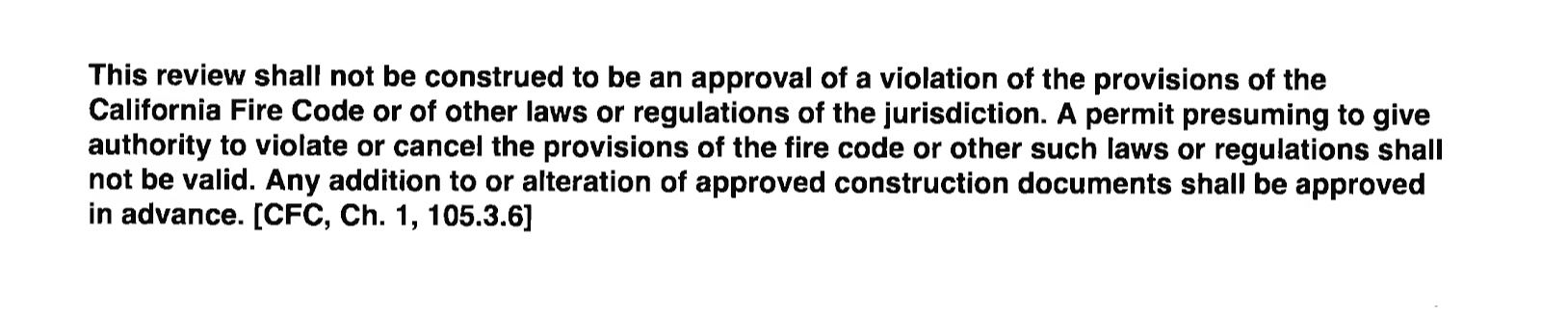
    The SCCFD disclaimer on the Evulich Court fire safety review
    The SCCFD disclaimer on the Evulich Court fire safety review — from their own approval document.

    Read that again. The fire department is explicitly saying: this document is not a determination that the fire code has been satisfied.

    Meanwhile, the City of Cupertino’s staff report and AB 130 qualification memo treat the AMMR as the definitive proof that fire safety has been addressed. The City has delegated fire-related review to SCCFD and has not conducted its own independent fire safety analysis.

    SCCFD says: “Our review is not an approval of compliance.”

    The City says: “Fire safety is SCCFD’s responsibility, and they approved it.”

    Result: No entity has taken ownership of the determination that the 10-foot setback is safe for the surrounding community.

    The Missing Signature

    The AMMR form requires dual review. Under the California Fire Code (CFC 104.10), the Fire Official must find that the proposed alternative is “not less than the equivalent” of the code standard. Under the California Building Code (CBC 104.11), the Building Official has the identical obligation. The SCCFD’s own AMMR form reflects this, with signature lines for both officials.

    The Fire Official — SCCFD — has signed.

    The Building Official line — which corresponds to the City of Cupertino’s building authority — is blank.
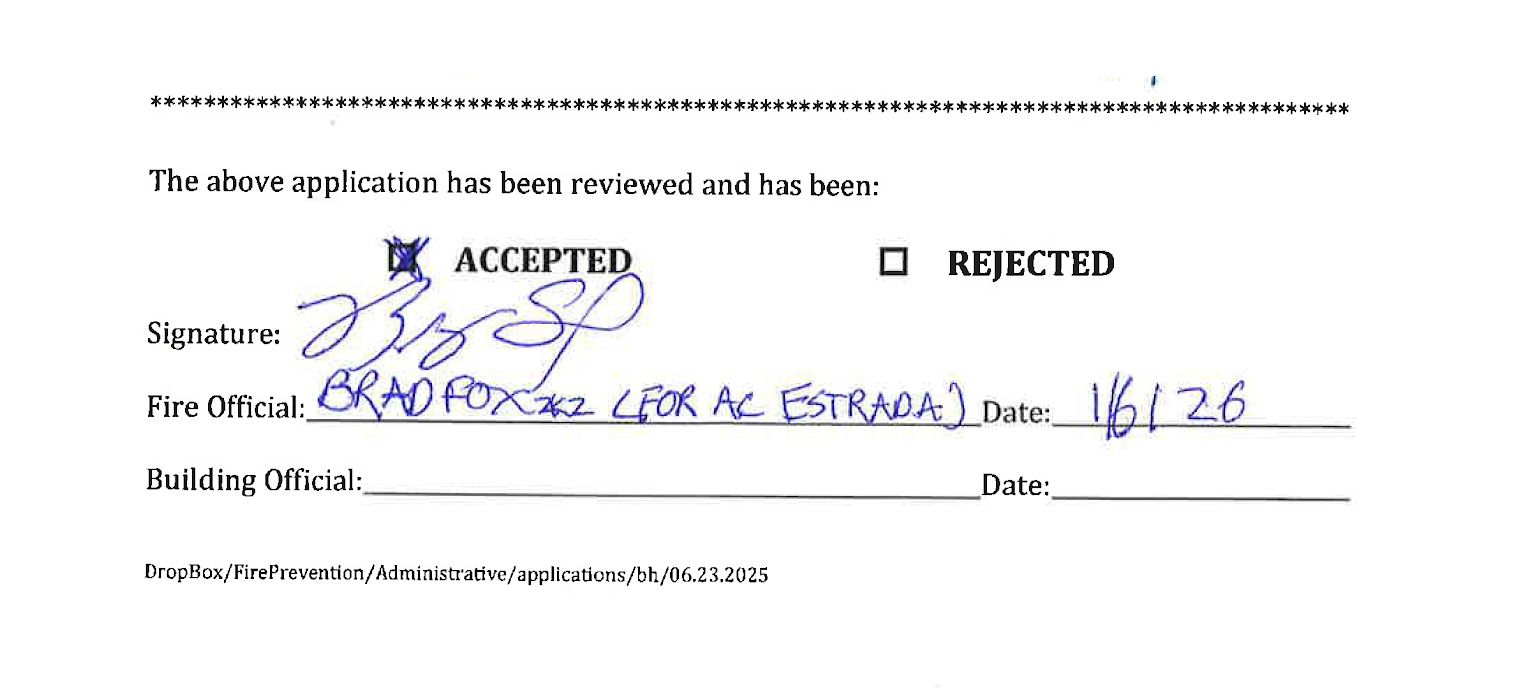
    AMMR signature lines
    The Fire Official signed. The Building Official signature line — the City of Cupertino’s building authority — remains blank.

    Without the Building Official’s evaluation and signature, the AMMR has not completed the dual review required by the fire department’s own approval form and by both the California Building Code and the California Fire Code.

    The AMMR Was Not in the Planning Commission Agenda

    The Planning Commission voted 3-2 on February 24, 2026 to recommend the project to City Council.

    The AMMR document — the entire basis for the project’s fire safety compliance claim — was not included in the Planning Commission agenda packet. The commissioners and the public were asked to evaluate the project’s fire safety without access to the fire safety determination itself.

    The document that the City relies on to demonstrate fire safety compliance was not available for public review at the hearing where fire safety was supposed to be evaluated.

    The Mitigations Protect the Developer’s Buildings — Not the Neighborhood

    The AMMR approval identifies several mitigation measures: 1-hour fire-rated exterior walls, sprinkler heads on covered patios, non-combustible landscaping extending 5 feet from structures, and code-compliant wall penetrations.

    Every one of these measures is designed to protect the new townhomes from fire. None of them address the impact on the surrounding neighborhood.

    Radiant heat exposure to existing homes. The neighboring single-family homes were built between 1947 and 1957 — decades before modern Wildland-Urban Interface (WUI) building standards. They have combustible exterior materials, older window assemblies, and minimal ember-resistant features. Fire-hardening the new townhomes does not reduce the radiant heat those neighboring homes would receive from a fully involved structure across a 10-foot gap.

    Combustible fencing at the property line. Wooden fencing along the property boundary is standard in this neighborhood. At 10 feet, a burning fence would create extreme heat flux in the corridor. SCCFD has no authority to regulate fencing on neighboring parcels. The HOA has no authority over it either.

    ADU construction on adjacent parcels. State law allows Accessory Dwelling Units to be built with setbacks as small as 4 feet from the property line. Combined with the project’s 10-foot setback, actual structure-to-structure spacing could shrink to 14 feet — less than half the required 30 feet.

    Absent defensible space zones. The project’s own Defensible Space Fire Zone Plan (Sheet L7.1) shows Zone 2 — the 30-to-100-foot fuel management band — is effectively absent along the north and south boundaries where the setback reduction applies.

    The Fire Safe Regulations define defensible space as protection for the “neighborhood or community” — not just the developer’s buildings. The mitigations do not address this standard.

    The Window Openings Contradiction

    SummerHill’s AMMR narrative claims compliance with CRC R302.1(2), the fire separation distance requirements for residential construction at reduced setbacks.

    The same narrative explicitly states: “we are not proposing modifications to the Openings (Windows) in Walls.”

    R302.1(2) is the standard that governs protected openings at reduced separation distances. You cannot invoke the standard while exempting one of its central requirements. Unprotected glazing can fail early under radiant heat exposure, allowing flame and heat transmission across the reduced 10-foot separation — precisely the scenario the 30-foot standard is designed to prevent.

    The AMMR approval does not address this contradiction. SCCFD accepted it without comment.

    The Ladder Access Problem

    SCCFD’s own Fire Prevention Plan Review (Comment 7) requires ground ladder access at a 75-degree climbing angle for second and third-floor rescue operations.

    The geometry does not work in 10 feet. A 35-foot ladder at 75° requires approximately 9 feet of horizontal clearance. The firefighter at the base needs approximately 2.5 feet of standing room. That is approximately 11.5 feet minimum — before accounting for any fence or wall at the property boundary.

    The setback is 10 feet. The site plan shows bio-retention pads in these areas — not firm, level surfaces suitable for ladder placement.

    A burning wooden fence in the 10-foot corridor would make the space untenable for firefighters, negating any possibility of ground ladder rescue from the building faces that need it most — the longest sides of the perimeter, perpendicular to the wildland-urban interface.

    The CEQA Exemption Depends on This Gap

    The project claims a CEQA exemption under AB 130 (PRC §21080.66). This exemption is available in a VHFHSZ only if the project adopts fire hazard mitigation measures “pursuant to existing building standards.”

    The City’s AB 130 qualification memo points to the AMMR as proof of fire safety compliance.

    But the AMMR is an explicit departure from the existing standard — the 30-foot setback. A departure from a standard cannot simultaneously serve as proof of compliance with it.

    This circularity enabled the project to bypass the environmental review that would have surfaced the evacuation capacity data David Yan’s article calls attention to.

    What Residents Are Asking

    The residents of the Linda Vista neighborhood are not asking to stop housing. The site was part of Cupertino’s Housing Element and they support housing here.

    They are asking a simple question:

    Where is the documented technical analysis demonstrating that the 10-foot setback provides the same practical fire-safety effect as the 30-foot standard — not only for the new development, but for the surrounding neighborhood?

    The SCCFD’s own disclaimer says the review is not an approval of compliance. The City’s Building Official has not signed the form. The AMMR was not in the Planning Commission agenda packet. The mitigations address fire spread to the new buildings but not from them.

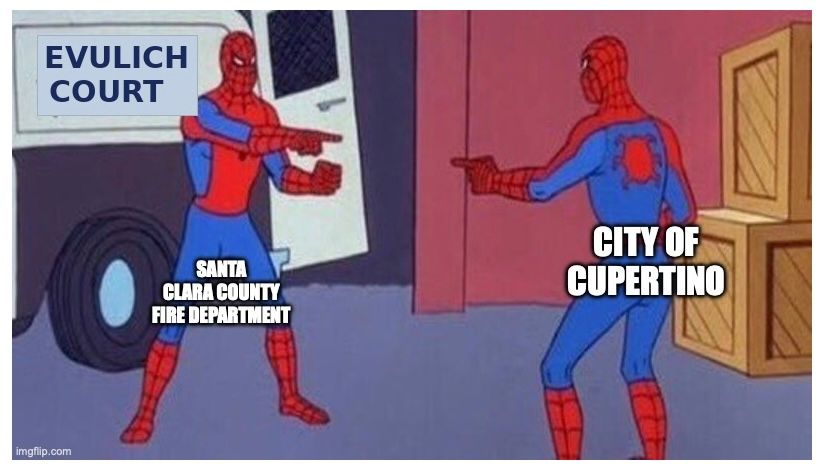
    Both entities are pointing at each other. Neither has produced the analysis.

    The City Council votes on March 17, 2026. Before finalizing this project, the Council should be able to identify a single document in the administrative record that answers the question above.

    The firefighters who will respond to Evulich Court deserve that answer. So do the neighbors.

  • YIMBY Takeover of Cupertino City Council

    YIMBY Takeover of Cupertino City Council

    In this post we want to shed light on how YIMBY groups are dictating Cupertino’s future.


    YIMBY is an acronym for “Yes in My Back Yard”. It refers to groups who support in-fill redevelopment in urban areas. Over the past decade they have gained a lot of prominence, as they leverage the housing affordability concerns in California, to drive their political agenda.

    But who are the YIMBY? And who sponsors them? Are they truly focused towards improving the affordability of housing and housing justice? Or are they simply interested in helping developers maximize their profits by building bigger in existing high cost housing areas?

    Housing Justice Advocates Views on YIMBYs

    Housing Is A Human Right, is a housing justice group which is focused on ensuring basic housing access for all. They studied how the CA politicians are impacting the housing situation. In 2022, they published a book titled Selling Off California: The Untold Story which uncovers what key politicians (eg: Senator Scott Weiner), YIBMYs, and Big Real Estate are achieving by their policies.

    In the 1st Chapter, the author, Patrick Range McDonald,  writes:

    When I joined Housing Is A Human Right as an advocacy journalist, I wrote extensively about Big Real Estate, Wiener, and YIMBYs, who also advance the real estate industry’s scheme to make billions, probably trillions, at the expense of hard-working people.I’ve learned many things about them all. Things they don’t want you to know.

    The Progressive Elements of the Democratic Party have also expressed concern. Dean Preston, a member of the San Francisco Board of Supervisors, and a member of the Democratic Socialist of America (DSA) stated an interview that:

    The so-called YIMBY folks have redefined a “NIMBY” to be anyone that doesn’t just jump when the real estate industry says jump, and they’ve become a very toxic force. They have been attacking me for years, attacking pretty much anyone who demands things that actually help a community as part of development—either investments in transit or investments in affordable housing. They have evolved over the years into what is now just a complete disinformation campaign.

    Cupertino For All: Cupertino’s Hometown YIMBY Org

    Cupertino For All (C4A), is a YIMBY group incubated by current Cupertino City Council Member, JR Fruen. JR Fruen’s relationship with the Real Estate Lobby is well documented.

    In 2018, he ran a PAC which received tens of thousands of dollars from real-estate interests to support City Council candidates aligned with real-estate interests. His 2020 and 2022 campaigns for city council also received similar support (Read More). He has also served as a lawyer for a YIMBY orgs.

    Other leaders of Cupertino For All include Jean Bedord and Connie Cunningham who act as Information Officers advocating for high density developments across all of Cupertino with reduced parking requirements .

    Cupertino Housing Element: JR Fruen’s Letter to City Council (August 2022)

    As regular readers may be aware, Cupertino’s Housing Element (HE) was delayed by the City Council elected in November 2022, with the final plan approved in September 2024.

    After multiple quarters of effort, the City Staff had developed a HE plan. The plan was discussed at multiple Planning Commission & City Council meetings in 2022, with draft being ready by October 2022. JR Fruen, representing himself as the Policy Director for Cupertino For All, wrote to the City Council demanding:

    1. To not count pipeline projects towards meeting the housing unit requirements
    2. To increase the buffer of additional housing from 17% in the city’s draft proposal
    3. To increase the size of the homes allowed in different zones (without attention to aesthetics or impact on neighbors), upzoning to increase the number of homes allowed, and eliminating parking requirements.

    Council Behavior after Nov 2022 Elections

    JR Fruen was elected to the Cupertino City Council in the Nov 2022 election, along with Sheila Mohan, replacing the incumbent Darcy Paul (term out) and John Willey (did not run).

    For the December 20, 2022 City Council meeting, Cupertino For All submitted multiple communications (same form letter) expressing concern with Cupertino’s HE Plan draft (link here). The letter included endorsements from Jean Bedord, Connie Cunningham & Louise Saadatti, asking for a comprehensive redo of the Housing Element draft.

    Delaying HE Filing Resulting in Automatic Default

    The new city council did not submit the housing element created by the City Staff for almost three months after the election. The deadline for a compliant HE was Jan 31, 2023, and the City did not submit the draft approved on August 30, 2022 until February 3,2023. This put the city in automatic default, opening the flood-gates to Builder’s Remedy projects and YIMBY lawsuits.

    Lobbying HCD to Not Approve Cupertino’s HE Draft

    After delaying the draft to miss the Jan 31, 2023 deadline, Cupertino For All, and other YIMBY groups also wrote to the HCD asking for more changes in Cupertino’s draft submission. In response HCD  wrote back to the city on May 4, 2023 noting that:

    HCD considered comments from South Bay YIMBY,YIMBY Law and Greenbelt Alliance, YIMBY Law, David Kellogg, Cupertino For All, and several residents pursuant to Government Code section 65585, subdivision (c) The draft housing element addresses most statutory requirements; however, revisions will be necessary to comply with State Housing Element Law (Article 10.6 of the Gov. Code).

    Back to the Drawing Board

    Even though the HCD letter clearly stated that the housing element addresses most statutory requirements the City Council decided to completely redo the housing element. The final draft was submitted more than a year after the original deadline, with approval coming in September 2024, more than two years after the August 2022 meeting where the city council discussed the original draft.

    While redoing the HE, the elements asked for by YIMBY groups as exemplified by JR Fruen’s letter were incorporated in the HE. 

    1. About 1316 homes in the pipeline were removed and not counted against the 4588 required
    2. The buffer to the 4588 requirement was increased substantially from 787 (17%) to 1293 (28%). This forced the city  to identify locations to build approximately 1822 more homes than the original plan.
    3. There were extensive modifications to the city ordinances and building guidelines to increase the size of the houses permitted, along with a reduction in parking requirements. This included change the zoning of around 1600 single family lots (R1) on corner lots or those close to retail or major arteries to R3-condo standards which would have allowed big bulk buildings with just 5 ft setbacks and height restrictions relaxed.

    Downgrade in Compliance from “addresses most” to “addresses many”

    The 2nd draft submitted by JR Fruen led council in October 2023, was judged by HCD as “addresses many statutory requirements”. This was a downgrade in compliance with how the first draft was evaluated by HCD, and led to the settlement of the YIMBY lawsuit.

    YIMBY Lawsuit Settlement: Builder’s Remedy Plans Welcome

    In January 2024, the city decided to settle a lawsuit filed by YIMBY organizations, allowing Builder’s Remedy projects and also exempting Housing Element sites from CEQA (Environmental Review). Note that the settlement of this lawsuit gave a green light to Builder’s Remedy projects including the giant condominium on Scofied Drive on a single family lot.

    Increasing Permitted Home Size: June 18, 2024 Letter from Cupertino For All


    JR Fruen’s group, Cupertino For All, also wrote to the City asking for more changes in a letter dated June 18, 2024 (on agenda for July 2, 2024 City Council meeting (File # 24-13102). We are including key excerpts from the letter at the end of this post.

    The City Council of Cupertino, decided to adopt most of the demands by Cupertino For All which impact how large buildings can be in different zones of the city (height limits, number of stories, floor area coverage, setbacks from property line) and also reduced parking requirements. Sheila Mohan and Hung Wei voted YES in support of JR Fruen’s proposals, while Liang Chao and Kitty Moore typically voted NO.

    YIMBY Sponsored Council

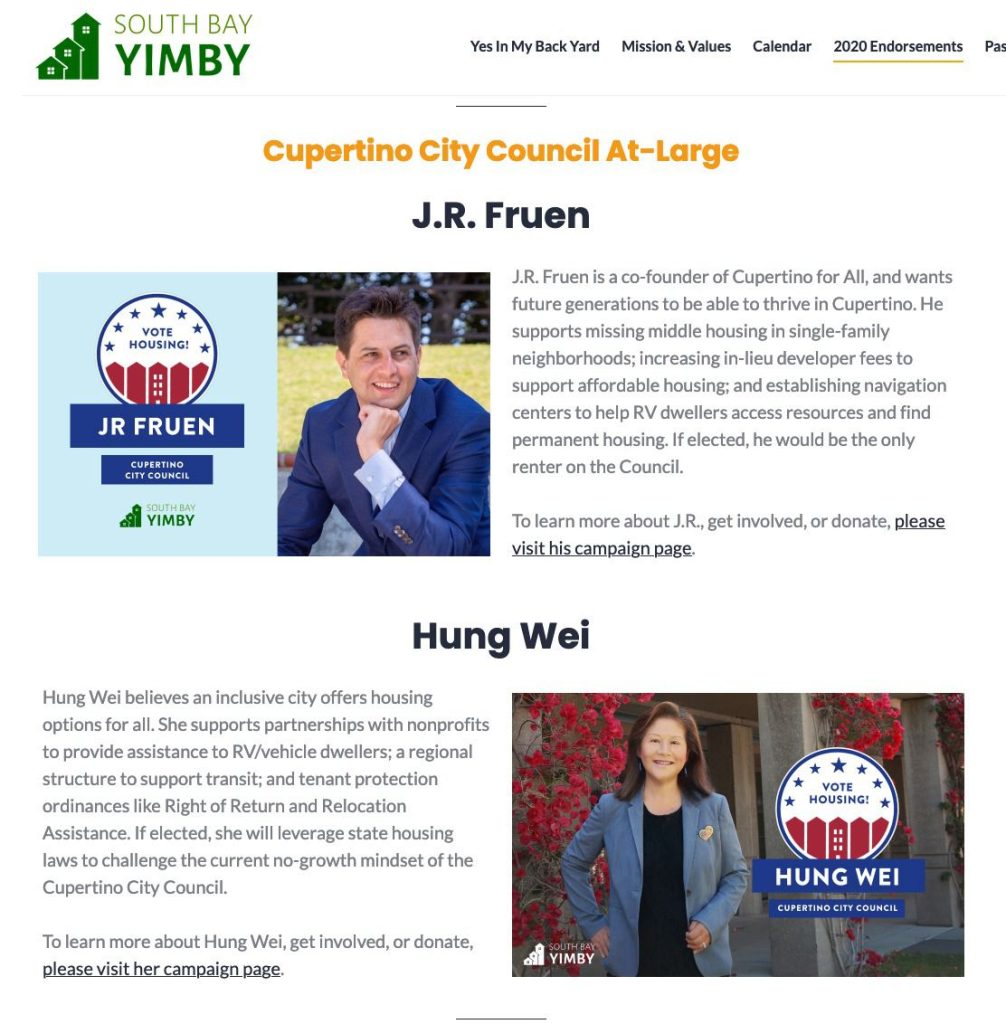
    Hung Wei and Sheila Mohan’s support for YIMBY sponsored changes to increase building size, is not surprising. Both of them have been endorsed by YIMBY groups (eg: Sheila in 2022) and Hung Wei in 2020.

    Kitty Moore and Liang Chiao opposed the motions since these changes were not recommended by staff or public input, and bigger units are against the mandate for affordable housing. However, since the City Council majority is controlled by YIMBY sponsored candidates, their NO vote did not make a difference.

    What does that mean for Builders?

    Note that the latest demands by Cupertino For All, have little to do with the number of housing units, but are designed to allow buildings with bigger footprint. In Cupertino, where the average price per square feet (~ $1350) is almost 4X the cost of construction (~$350 sq/ft), every incremental sq. ft. a builder adds about $1000 to their profit.

    The very group claiming to champion affordable housing is, in fact, contributing to the inflation of housing prices by changing building regulations to allow much bigger homes than before.

    What does that mean for Existing Residents?

    We will consider the Evulich Ct development on Linda Vista Drive, which is in the middle of a single family neighborhood, with one or two story homes. The site was up zoned from an R1 site with a maximum density of 5 homes/acre, to R3/TH requiring a minimum housing unit density of 20 homes/acre to a maximum of 35 homes/acre.

    Though the R3 zone has a height limit of 30 ft, density bonus laws allow the builders to waive those requirements. Initial designs submitted by Summerhill, are asking for a density bonus waiver for various city requirements including the 30ft height limit.

    Note that these exemptions are on top of the home-size enlarging changes demanded by Cupertino For All, many of which have been incorporated in the City’s Code.


    Take our City Back from YIMBYs

    It’s clear that YIMBY groups like Cupertino For All, are a front to enable builders to make huge profits, without any regard to the quality of life of existing residents. With the backing of the powerful Real Estate lobby, and lawmakers beholden to them (eg Scott Wiener), they misuse affordable housing as an excuse to bypass zoning guidelines in the most expensive neighborhoods in the country.

    We have the choice to elect City Council members who are not beholden to these Real Estate interests, and will also consider the interests of the existing residents of the city in their decision framework.


    Extracts from Cupertino For All Demands to allow Bigger Homes (June 2024)

    Note: The article was updated to reflect new information we unovered about the city’s second HE draft submitted in October 2023. on October 25, 2024.

  • Cupertino: It is a Lot More Than Vallco!


    This is going to be our last email before the elections.

    1. The Vallco Obsession

    2. Opt-In Email List


    The Vallco Obsession


    The coterie of ex-mayors sent out another email showing the Vallco lot. We wanted to set the record straight.


    Vallco SB35 Plan: Stuck due to Toxic Contamination


    The SB35 plan approved by the previous city council (Rod Sinks, Barry Chang and Savita Vaidhyanathan) after firing the City Attorney is still valid


    However, the Vallco site is contaminated, and the County of Santa Clara Department of Environment Health (SCC-DEH) is supervising the cleanup. The City of Cupertino or the City Council is not involved. The city will issue the permits after SCC-DEH gives clearance.


    The developer knew of the contamination as far as 2016, but neither they, nor the previous City Councils listened to the residents who expressed concern about the potential impact on the workers who are working on the  contaminated site, and nearby residents, without adequate mitigation efforts.


    No Height Limits: The Empire State Building


    We also wanted to reiterate that the previous councils removed height limits at Vallco in 2014 and refused to put them back in 2017 when Steven Scharf and Darcy Paul requested them, due to the upcoming  SB35 legislation. In principle, the developer could have built something as high as the Empire State Building at that development since there were no restrictions in place. 

    The resident focused city council, in place after the 2018 election, put reasonable limitson the development for any future plans which come up.


    Cupertino Top Issues:


    We feel that the top issues facing Cupertino are the CUSD school closures and the potential of 14 units being permitted on a single lot in our single family neighborhoods under SB10.


    While we would all like to see Vallco developed, it is up to the developer to clean up the site, and start construction on the SB35 plan or discuss an alternative with the City if they prefer.

    VOTE WISELY


    To save our schools and preserve home values, please VOTE for Govind Tatachari, Liang Chao, and Steven Scharf for Cupertino City Council, and Darcy Paul, Satheesh Madhathil & Jerry Liu for CUSD Board. They have taken a public stand to keep school closure off the table and roll back past mistakes. These city council candidates are opposed to SB10 becoming a law in Cupertino.  They are not funded by external special-interests and will keep the interests of residents foremost.


    Please do NOT vote for JR Fruen, Sheila Mohan for Cupertino City Council, and Ava Chiao (CUSD).  They have been supportive of school closure and giving the land to developers, and have strong endorsements from the three CUSD trustees who closed the schools.  They have also received extensive funding from construction interests, who covet the land our schools stand on, and have not signed the City of Cupertino voluntary spending limit on election expenses.

    .

    Sign up for our Email List


    With the election season coming to an end, we are going to move to an opt-in subscription list. Our goal would be to send quarterly or as needed (without exceeding once a month) updates on issues of importance to our fellow residents, and also dispel any new FUD (Fear, Uncertainty, Doubt) being shared by vested interests.


    You can also contribute to help us inform our residents. The financial declaration about us is available here


    We end with a video showing how the previous council gave the Vallco owner a carte-blanche to build as high as they want at Vallco; a reminder of what can happen if the investors backed candidates take control again.

  • Debunking more Misinformation

    In this email, we cover the following topics:


    1. The financial condition of the City

    2. Debunking the “redevelopment needs office space to break even” myth

    3. An update on the campaign spending by various candidates

    4. A note from a fellow resident about the Bullying of our Treasurer Minna Xu

    That is the line of a mailer sent by the coterie of ex-mayors claiming financial ruin in the city.


    We would like to reassure the residents that the city is doing great financially, and your Harvard & Princeton educated councilperson (aka “bums”) are strengthening its governance.


    The city has also instituted an internal audit function, instituted better financial processes & controls as recommended by Moss-Adams, and has created a Fraud, Waste, and Abuse Program to allow whistle-blowers to report concerns anonymously to prevent embezzlement like the multi-year scam (2000-2014) which cost the city $800K. The City Manager has the following to say in his introduction to the city budget for 2022-2023

    “The City is on solid financial footing in FY 2022-23 with a balanced budget. The budget is balanced with ongoing revenues meeting or exceeding expenditures, and fund balance is being used to fund one-time projects”


    “Redevelopment Need Office Space to Break Even”: Not True


    Another myth propagated by the investors’ proxies is that redevelopment needs a huge amount of office space to break even. This was the reason given to grant up to 2M sq ft of office space allocation at Vallco, in spite of intense multi-year opposition by the residents. Residents oppose it since it increases traffic, and does not improve the jobs to housing ratio.

    The Westport development (Oaks) has zero office space. Later this month, the Marina Plaza redevelopment project is coming for review with the City’s Planning Commission, including commissioners Steven Scharf, Muni Madhdhipatla, and Ray Wang. It’s a 5.1 acre development with 206 condos and 41K sq ft of commercial space.

    These two projects clearly establish that redevelopment does NOT need millions of sq ft of office space to be viable, just a City Council which considers the wishes of the residents and the needs of the city, while working with property owners to revitalize our city.


    Campaign Spending Update (10/31/2022)

    The resident focused candidates for the Cupertino City Council, Govind Tatchari, Liang Chao and Steven Scharf  have raised/spent under $25,000 honoring the voluntary limit they agreed to for the election.


    JR Fruen and Sheila Mohan have breached the $80,000 mark and are racing towards the $100,000 milestone with investor backed elements and unions pouring money into their campaigns. Claudio Bono is in the middle, near $50,000 (his campaign has a large loan amount)

    From Cupertino.org

    Bullying of our Treasurer Minna Xu: A note from a fellow resident


    Minna is a long time Cupertino resident who is warm-hearted and volunteers a lot in our local community. She has helped with school Yosemite trip fundraising, with boy scouts’ activities, and coordinating several Chinese and Asian events in the past. Whenever friends’ ask for help, if she can, she will help. 


    Why is she suddenly famous this campaign season? It’s because her friends asked her to help with their accounting. This organization’s name is Cupertino Facts. She read their article drafts and believed they were doing the right thing. They work to deliver the truth. So, she helped just like she did, so many times in the past. 

    But this time her simple act has resulted in this kind and innocent Asian lady being attacked by an old boys network with a Big Title: the Council of Mayors. 


    It’s because what Cupertino Facts provides is not something this group of ex-Mayors want the residents to hear. They pick on the weak one, intimidate and threaten, and hope the weak person would back off and never dare to do anything they don’t like. Do you feel disturbed by seeing this? Can you imagine such things happening in Cupertino nowadays? 


    Our beautiful city belongs to all the residents who love it. Our city belongs to all the people like Minna who believe in kindness, caring, selfless contribution with no return. If you believe that everyone in Cupertino has the right to speak the truth, unite and stand up, protect our fellow residents. Don’t let any of our residents be bullied by those snobbish old-boys network of Mayors.

    VOTE WISELY


    To save our schools and preserve home valuesplease VOTE for Govind Tatachari, Liang Chao, and Steven Scharf for Cupertino City Council, and Darcy Paul, Satheesh Madhathil & Jerry Liu for CUSD Board. They have taken a public stand to keep school closure off the table and roll back past mistakes. They are not funded by external special-interests and will keep the interests of residents foremost.

    Please do NOT vote for JR Fruen, Sheila Mohan for Cupertino City Council, and Ava Chiao (CUSD).  They have been supportive of school closure and giving the land to developers, and have strong endorsements from the three CUSD trustees who closed the schools.  They have also received extensive funding from construction interests, who covet the land our schools stand on, and have not signed the City of Cupertino voluntary spending limit on election expenses.

    .

    Your fellow neighbors from Cupertino

    We became aware of another group of CUSD residents who have formed a group called “Voice of CUSD Residents for Better Education”.  You can learn more about them here.

    We finish with a video with Mayor Darcy Paul who is now running to help fix CUSD.

  • SB10: 10 (+4) Units on Single Family Lot

    What does SB10 Permit?

    The SB10 law allows a 10 unit apartment building (upto 14 units including ADUs/JADUs) [1] on a single family lot located within half a mile of transit. Most of Cupertino is within half mile of public transit (VTA) on Stevens Creek Blvd, De Anza Blvd, Foothill Blvd etc.
    Unlike other laws like SB9 and SB35, SB10 is not mandatory. Local cities can chose to implement it or not.

    City Council Ordinance

    To permit the construction of 14 unit buildings on single family lots, all the City Council needs to do is to pass an ordinance permitting such construction. The ordinance will override any restriction due to voter approved resolutions.

    SB10 effectively allows the City Council to enable construction of multi-story, 14 unit buildings in a lot currently occupied by a single family home. [2]

    Flashback: Height Limits at Vallco

    During the Fall of 2017, Cupertino Council Members Darcy Paul and Steven Scharf had proposed that the city enact height limits on buildings in commercial areas. The proposal was welcomed by Rod Sinks.

    However, when it came to vote two weeks later Rod, Savita & Barry voted against it.
    You can watch the video below to understand how, in November 2017, the City Council ignored residents’ interest to permit buildings without height limits.

    That failure to not put any height limits, allowed Vallco investors to propose a design with 26 story high towers in their SB35 proposal. [3]

    Why does it Matter: History Can Repeat Itself

    Like the Vallco case, an investor friendly council can also relax height and Floor Area Ratio limits in our  single family neighborhoods, 

    That would allow the construction of multi-storied buildings with 14 residential units, on the lot next to your single family home!
    For investors buying a lot for $2M and building up to 14 units, each selling for $1-$1.5M+ is a windfall.

    JR Fruen: Whose Interests do you think he will represent?

    Endorsed by the Author of SB10
    Senator Scott Weiner, who gets the highest amount of funding from real estate interests, and is the author or co-author of SB9, SB10 and SB35 bills has endorsed JR Fruen.
    Note that Cupertino is well ahead of most nearby cities when it comes to housing obligations; something  Scott Wiener failed to mention.

    Funded by Vallco

    J R Fruen, used to run a PAC which received $29,000 [4] from Vallco investors in 2018. He represents the same investor interests’ who influenced the city to not put any reasonable height limit on the Vallco property.


    Cupertino For All: Support for SB Laws

    JR Fruen is the co-founder of Cupertino for All.

    Cupertino For All is very supportive of state laws like SB9/SB35 which take away local control. How do you think he will vote on SB10 approval related ordinances?


    Please do not vote for candidates like JR Fruen, who will be inclined to permit SB10 projects; it can mean the end of Cupertino’s Single Family Home Districts.