The Architecture of Approval: How Summerhill’s Lawyers Built a Compliance Narrative That Didn’t Exist
The developer’s legal team stretched a limited fire safety review into claims of comprehensive compliance that went far beyond what the Fire Department had actually evaluated. City staff echoed those claims without verification, the state relied on the staff report to instruct the city to assume compliance, and the same attorneys then cited the state’s letter to threaten the City Council — even after quietly shifting their own claims once residents identified the misrepresentation.
Cupertino Facts • April 2026
This is Part 3 of a three-part investigation into the Evulich Court project approval.
- Part 1: The Paper Trail — The full story of how incomplete information flowed from city staff to HCD to the developer’s lawyers, and how the Fire Chief’s straightforward testimony exposed the gap.
- Part 2: The Risks Residents Face — Evacuation gridlock, flawed studies, and what the city’s own data says about the danger to Linda Vista families.
- Part 3: The Architecture of Approval — The developer’s legal strategy to stretch the record, the staff omissions that enabled it, and the circular argument that silenced safety concerns. (You are here)
The Strategy: Build the Narrative, Then Weaponize It
The approval of 51 townhomes in a Very High Fire Hazard Severity Zone with reduced wildfire setbacks did not happen because the City Council determined the project was safe. It happened because the developer’s legal team at Cox, Castle & Nicholson LLP built a self-reinforcing chain of compliance claims that no one in city government bothered to check:
The strategy unfolded in stages, each building on the last, each taking the Fire Department’s limited but professionally rendered review and stretching it further than the underlying work supported. It succeeded because city staff chose not to verify the attorney’s claims before passing them to the Planning Commission — and because HCD accepted the staff report at face value.
The Rules That Were Supposed to Apply
The regulatory framework governing the Evulich Court project is detailed in Part 1. The key point for understanding the developer’s strategy: AB 130 allows qualifying projects to bypass CEQA environmental review, but draws a hard line at wildfire zones.
Under AB 130, projects in a Very High Fire Hazard Severity Zone are excluded from the CEQA exemption unless the developer demonstrates compliance with the state’s fire safety regulations. This is not a discretionary judgment call — it is a statutory prerequisite. Those regulations have two distinct components, each addressing a different aspect of wildfire protection:
PRC § 4290 — State Minimum Fire Safe Regulations. These govern the structural and site design standards for new construction in fire hazard areas: road widths, water supply, signage, and critically, a mandatory 30-foot defensible space setback between new structures and adjacent property lines. The 30-foot setback is designed to prevent structure-to-structure fire spread — to ensure that if a new building ignites, the radiant heat does not reach neighboring homes, and vice versa. The regulations do allow for exceptions through an Alternative Means and Methods Request (AMMR), where a developer can propose alternative mitigations — such as enhanced sprinklers, fire-rated walls, or non-combustible materials — that provide the “same practical effect” as the standard setback. Such exceptions require approval from the fire authority and the Building Official.
PRC § 4291 and Government Code § 51182 — Defensible Space. These statutes require up to 100 feet of defensible space clearance around structures in fire hazard areas. PRC § 4291 applies in State Responsibility Areas (SRAs — typically unincorporated wildland). Government Code § 51182 is its equivalent for Very High Fire Hazard Severity Zones in Local Responsibility Areas (LRAs — cities and counties). Since Cupertino is a city, § 51182 is the directly applicable statute for the Evulich Court site. Both statutes establish the same framework of graduated defensible space zones:
- Zone 0 (0–5 feet): The ember-resistant zone. All materials within 5 feet of the structure must be non-combustible or ember-resistant — hardscape, gravel, concrete. This is the last line of defense against ember showers.
- Zone 1 (5–30 feet): The lean, clean, and green zone. Flammable materials are minimized, vegetation is maintained and spaced to slow fire spread. In urban infill settings near the wildland-urban interface, this 30-foot buffer is the recommended on-property defensible space perimeter — and it aligns directly with the 30-foot safe setback required under PRC § 4290.
- Zone 2 (30–100 feet): The reduced fuel zone. Vegetation is thinned and managed to reduce the volume of combustible material that could carry a wildfire toward structures.
The alignment between the § 4290 setback and the Zone 1 defensible space boundary is not a coincidence — both are designed to create the same 30-foot protective buffer. This is why reducing the setback to 10 feet has consequences beyond § 4290 alone: if the setback is reduced to 10 feet at the planning stage, there is no physical way to maintain 30 feet of Zone 1 defensible space on the property.
AB 130 specifically requires that measures under § 4291 (and by extension § 51182 in LRAs) have been “adopted” for the CEQA exemption to apply. This is not a post-approval checklist item — it is a condition precedent. The defensible space evaluation must exist at the time the exemption is claimed.
The Evulich Court site sits in the VHFHSZ, just a few hundred feet from the Monta Vista-Shannon Fault (magnitude 6.5–7.1) — close enough that a seismic event could rupture gas and water lines serving the neighborhood.
To qualify for the AB 130 CEQA exemption and bypass environmental review, Summerhill needed to demonstrate compliance with both the setback requirements and the defensible space requirements.
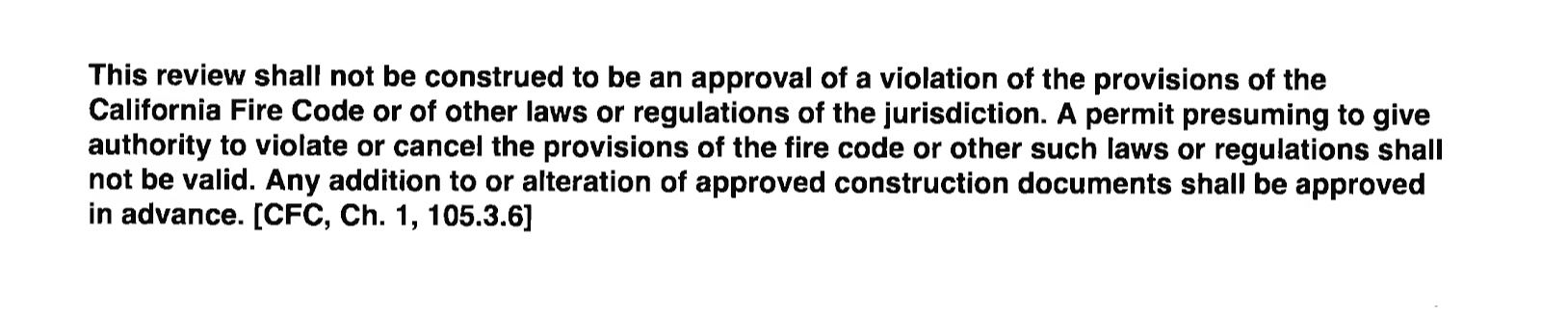
What the developer actually obtained was something far narrower: an AMMR exception to § 4290 that reduced the 30-foot setback to 10 feet. This was not compliance with § 4290 — it was a regulatory exception to it, approved based on the Fire Department’s professional judgment that alternative mitigations provided the “same practical effect.” And the defensible space requirements — whether under § 4291 or § 51182 — were never evaluated at all.
The developer then took this single, narrow exception and represented it as the comprehensive fire safety compliance that AB 130 requires — using it as the basis to bypass the very environmental review that would have examined evacuation capacity, seismic compound risk, neighbor impact, and every other safety concern that residents raised and that the Fire Department confirmed it had never been asked to evaluate.
Stage 1: The Limited Review Gets a Broad Label
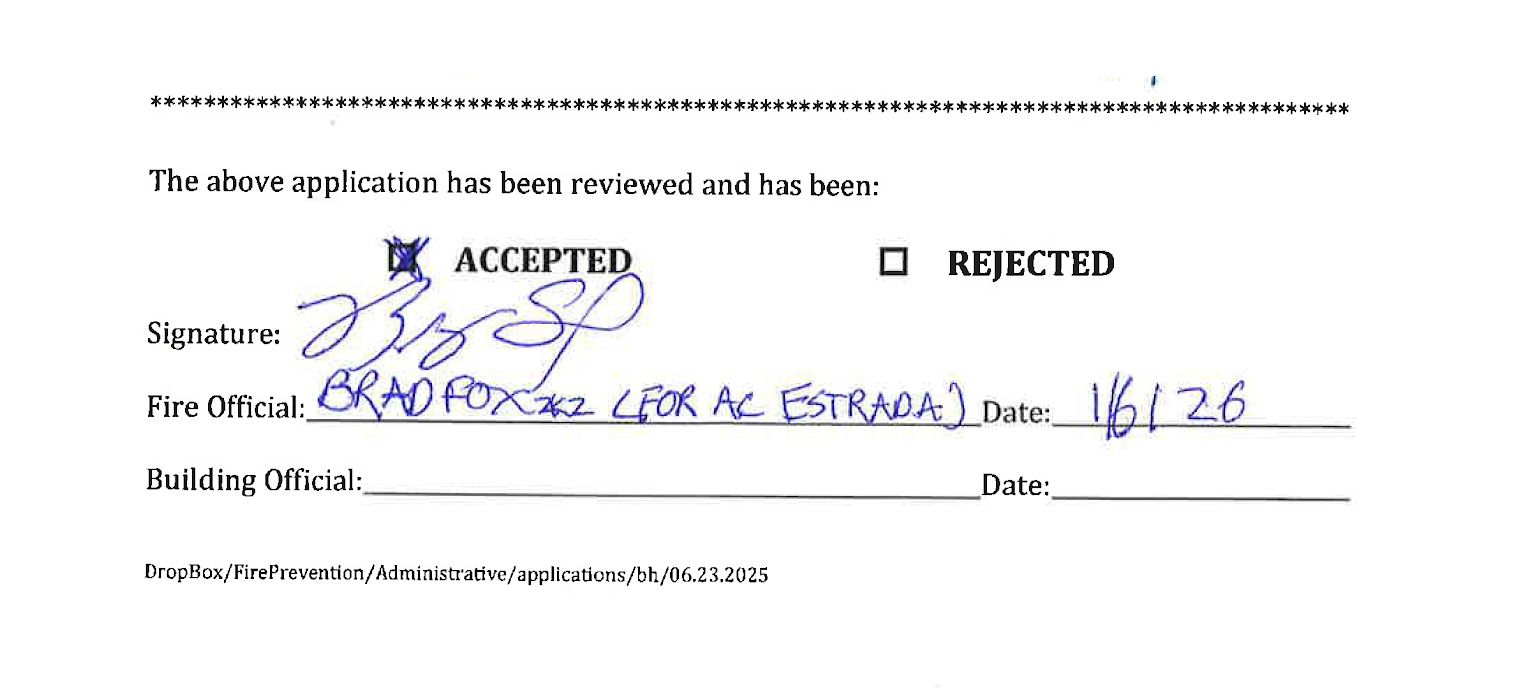
The foundation of everything that followed was the Santa Clara County Fire Department’s AMMR approval, issued January 5–7, 2026. The AMMR allowed the project to reduce the mandatory 30-foot wildfire setback to 10 feet, based on alternative fire mitigations including sprinklers and fire-rated walls.
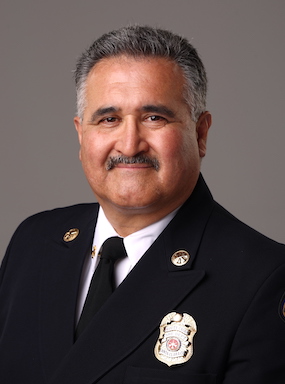
As Assistant Fire Chief Estrada testified on April 1: the AMMR was narrow in scope. It evaluated PRC § 4290 only — the state minimum fire safe regulations related to setbacks. It did not evaluate PRC § 4291 (defensible space), did not assess impacts on neighboring homes, did not assess evacuation, and the “same practical effect” finding was based on professional judgment rather than objective quantitative standards. As Estrada put it: “The exception request application was for 4290, not 4291.”
The AMMR form itself reflected this limited scope — the Building Official signature line, required by the regulations, was left blank.
City staff, in the February 24 Planning Commission staff report, summarized this review by stating the Fire Department “has demonstrated consistency with these requirements.” Staff had consistently deferred to the Fire Department on fire safety questions — a reasonable practice in general.
This imprecise characterization became the seed from which the developer’s lawyers grew a much larger claim.
Stage 2: The Developer’s Lawyers Stretch the Record
Summerhill’s legal team took the staff report’s characterization and built an aggressive legal argument on top of it. In their February 12, 2026, letter to planning staff, and again in their April 1 letter to the City Council, Cox, Castle & Nicholson made a series of claims that went well beyond what the Fire Department had actually reviewed.
Lawyer’s claim: “The Project is eligible for the AB 130 CEQA statutory exemption for infill housing projects.”
The record: AB 130 requires that fire hazard mitigation measures under PRC § 4291 have been “adopted.” Estrada confirmed the Fire Department was never asked to evaluate § 4291 and did not sign off on it.
When Council Member Wang pressed on this point, Estrada confirmed plainly that the Fire Department did not evaluate the project for purposes of the CEQA exemption the developer was claiming: “The exception request application was for 4290, not 4291.” Without a § 4291 evaluation, the statutory basis for the CEQA exemption does not exist. (See Part 1 for the full exchange.)
Lawyer’s claim: The Fire Department found the Alternative Means provide “appropriate alternative methods to reduce the risk of structure-to-structure ignition.”
The record: Estrada confirmed that the impact on existing neighboring homes was “outside of scope” for the evaluation. The Fire Department assessed the new structures; it did not assess whether the mitigations protected the 1950s-era homes next door.
Lawyer’s claim: “Neither the City nor the Fire Department have identified any applicable, objective standards related to evacuation routes.”
The record: The city’s own Fehr & Peers study, received in September–October 2025, contained detailed, quantitative evacuation capacity data showing routes at 360–420% of capacity. This data was in city files at the time the lawyer wrote these words.
Lawyer’s claim: The project “is consistent with applicable, objective public health and safety standards” under the Housing Accountability Act.
The record: Estrada confirmed the “same practical effect” finding was based on “professional judgment” and “experience” — not objective, quantitative standards. The HAA defines “objective” as “involving no personal or subjective judgment.” A finding based on professional judgment is, by the HAA’s own definition, subjective.
Lawyer’s claim: The reduced setback is justified by “practical reasons” including “development density requirements.”
The record: Estrada agreed with Vice Mayor Chao that the reduced setback is “a design choice” — not a site constraint: “I don’t disagree with anything you said. This is a design choice. This is for the applicant and the builder to answer.” Comparable projects — Vida in Sunnyvale (50 units, 53–65 ft setbacks) and Westport in Cupertino (88 units, code-compliant setbacks) — demonstrate the density can be achieved without reducing the safety buffer. The Evulich units average 2,369 sq ft with 4-bedroom luxury floor plans. The setback was reduced to accommodate unit size, not to meet density. The AMMR exception was used to backfill a safety gap created by the developer’s own design choices — not a site constraint necessitating a regulatory workaround. (See Part 1 for the full Chao-Estrada exchange.)
A detailed analysis submitted by Linda Vista residents further documents that 30-foot setbacks are achievable on this site. The Evulich units average 2,369 sq ft, with some reaching 2,779 sq ft with 4 bedrooms and 2-car garages. The setback was reduced to accommodate luxury unit sizes, not to meet density.
Stage 3: Obtaining the HCD Letter
On March 30, 2026 — two days before the Council vote — HCD issued a “Letter of Support and Technical Assistance” to Community Development Director Ben Fu. (For the full context of this letter, see Part 1.) The letter’s factual basis and its enforcement implications are what matter for understanding the strategy.
The letter’s factual foundation is traceable. Footnote 2 cites the Planning Commission staff report. Footnote 4, the critical fire safety reference, cites page 9 of that same staff report — the passage claiming the Fire Department “has demonstrated consistency with these requirements.”
HCD’s letter advised the city to “assume compliance with local building codes” and defer verification to the “post-entitlement phase.” But this advice was predicated on the assumption that the project was undergoing a standard ministerial approval.
The developer was actually seeking a CEQA exemption under AB 130 — which requires that fire safety compliance exist at the time of the exemption, not at some future date. HCD’s advice to defer was legally incompatible with the specific approval pathway the developer had chosen.
Most critically, the letter informed the city that AB 712 had taken effect, creating financial penalties for jurisdictions that denied housing after being “advised in writing” of a potential violation. The letter itself was that written advice — a trigger mechanism that made denial financially punishable.
The question HCD should be asked: Was HCD aware, at the time it issued its letter, that the Fire Department had not evaluated PRC § 4291? That neighbor impact and evacuation were “outside of scope”? That the fire safety finding rested on subjective professional judgment? That the city possessed a Fehr & Peers evacuation study showing routes at four times capacity?
The Tell: How the Attorney’s Own Claims Built — Then Undermined — the Approval Chain
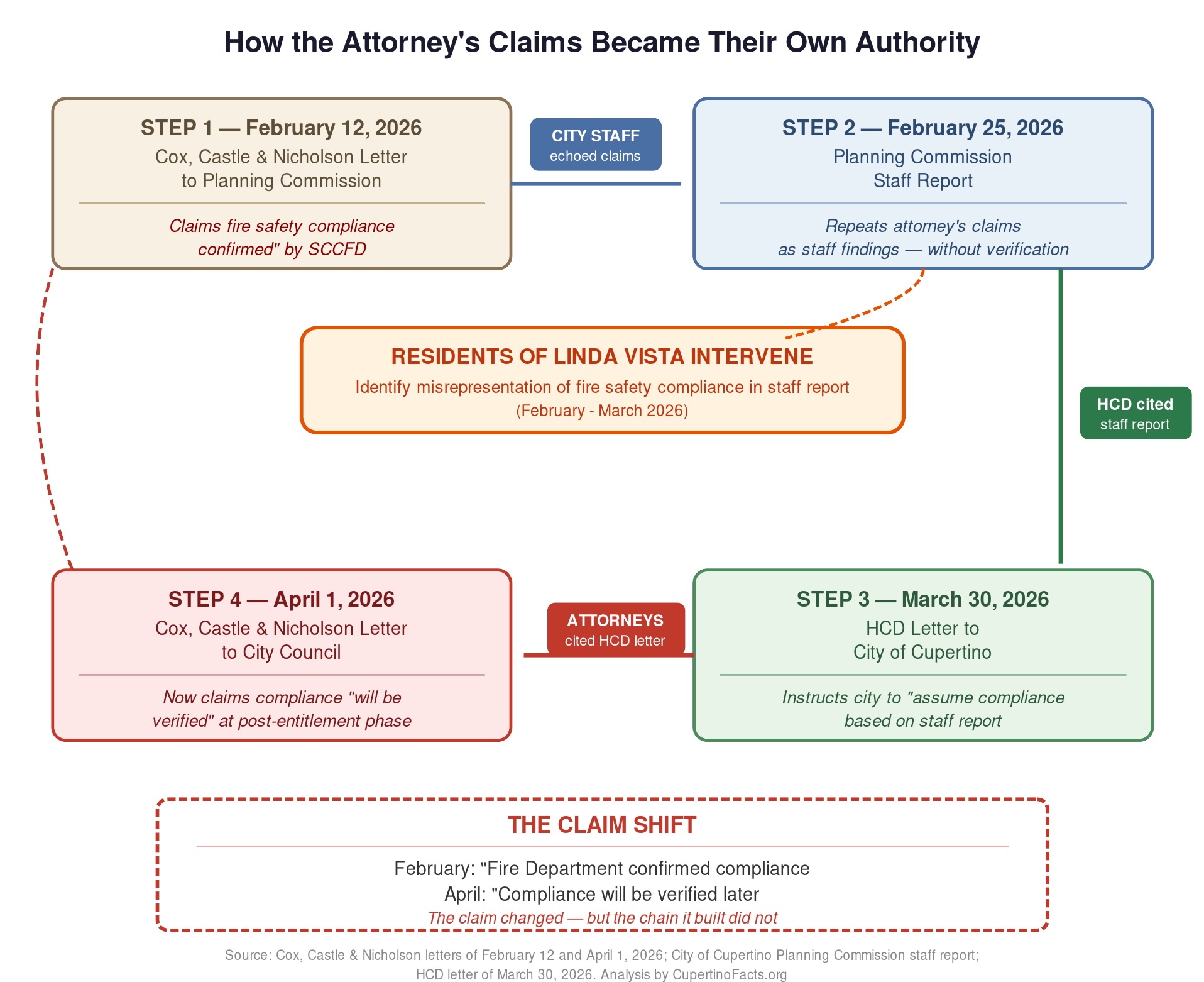
A side-by-side reading of the developer’s two Cox, Castle & Nicholson letters reveals something more than a change in legal posture. It reveals the architecture of a circular argument — one where the attorney’s own claims became the foundation for the very authority they later cited to threaten the city.
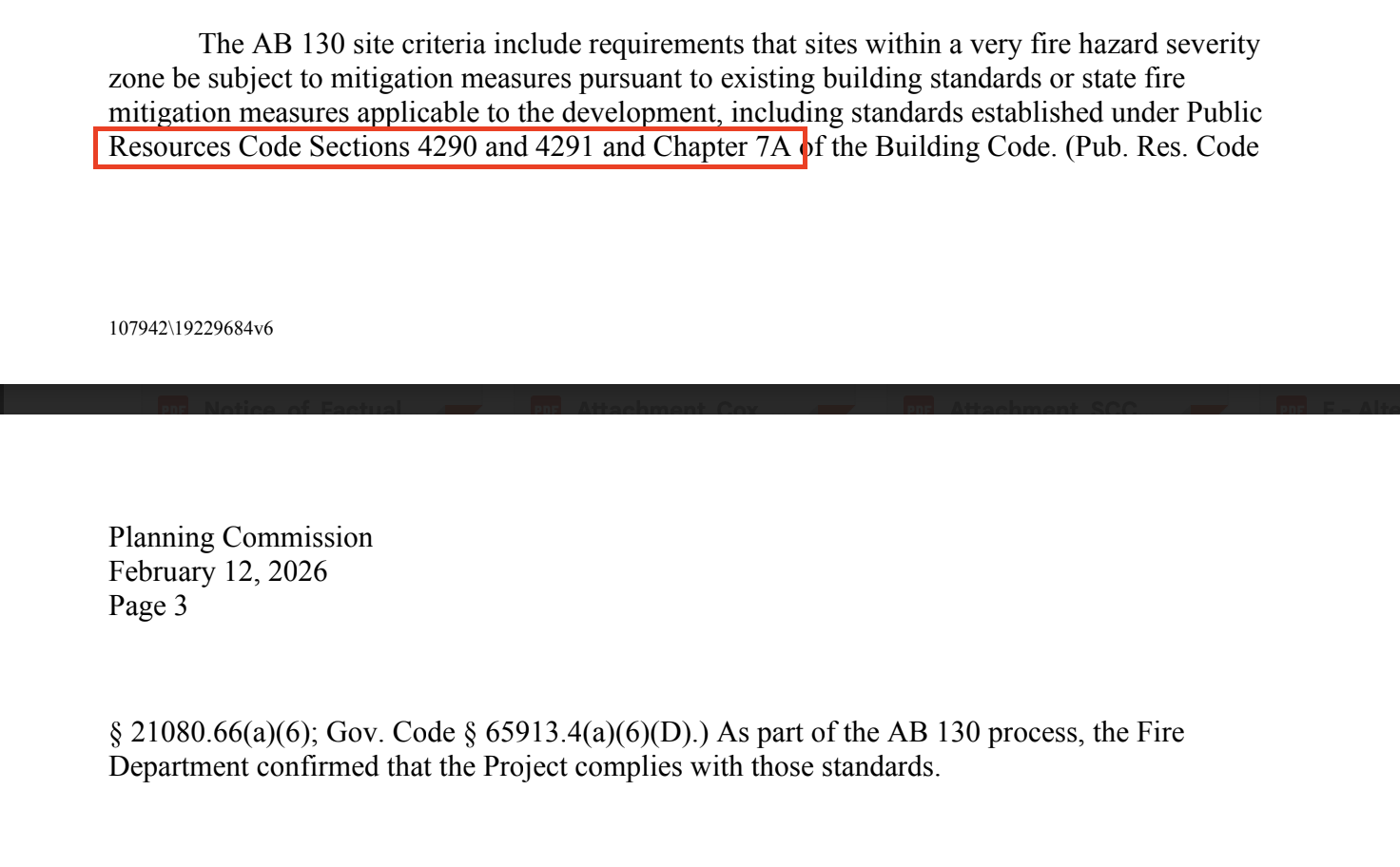
Here is how it worked. In their February 12 letter to the Planning Commission, Cox Castle stated that the Fire Department had “confirmed” the project’s compliance with PRC §§ 4290, 4291, and Chapter 7A of the Building Code. City staff then echoed these claims — without independent verification — in the Planning Commission staff report dated February 25. HCD, in turn, relied on that staff report when it wrote its March 30 letter instructing the city to “assume compliance” with local safety codes. The attorney’s unverified assertion had traveled from letter to staff report to state agency directive — gaining authority at each step while never being checked against reality.
Then residents of the Linda Vista neighborhood identified the misrepresentation: the Fire Department had never evaluated PRC § 4290 compliance and could not have “confirmed” it. Faced with this challenge, Cox Castle’s April 1 letter to the City Council quietly abandoned the original claim. Compliance was no longer “confirmed” — it “will be verified” at the post-entitlement phase. But the letter did not retract the February claim that had already been laundered through the staff report and into HCD’s directive. Instead, it cited that very HCD letter — built on the now-abandoned claim — as the basis for threatening the city with litigation under AB 712.
The claim changed, but the chain it built did not. The February assertion created a paper trail of apparent compliance. When residents forced the claim to shift, the attorney simply pointed to the end of the chain — HCD’s letter — as independent authority, even though HCD had relied on the very assertion the attorney had now walked back. This is the circular logic at the heart of the Evulich Court approval.
Stage 4: The Letter Becomes a Weapon
The final stage was the most transparent. On the morning of April 1, Cox, Castle & Nicholson submitted their 10-page letter to the City Council with the HCD letter attached as “Exhibit A.” The developer’s own claims had traveled a full circle: from the developer’s representations, into the staff report, to HCD, and back to the Council chamber, now wearing the imprimatur of an independent state agency.
The letter warned of “$10,000 per unit” fines and payment of the developer’s attorney fees. It framed approval as a legal obligation, not a policy choice. The developer’s attorneys had successfully transformed a public safety hearing into a legal compliance exercise where the outcome was predetermined.
The coercive effect was evident in the Council’s own words: Mayor Moore called the project “not a good design at all” — and voted yes. Only Council Member Wang dissented. (For the full account of the April 1 hearing and the Council vote, see Part 1.)
The Staff Omissions That Made It Possible
The developer’s legal strategy could not have succeeded without gaps in how city staff managed the flow of information. Staff did not construct the compliance narrative — but four critical omissions allowed it to move through the system unchallenged. (The full timeline of these omissions is documented in Part 1.)
The evacuation study. The city received the Fehr & Peers evacuation capacity study in the September–October 2025 timeframe. This study showed that evacuation routes serving the Linda Vista area were already at over four times their design capacity. It was not included in the Planning Commission’s agenda packet for the February 24 hearing. It was not shared with HCD. It was not presented to the Council. Meanwhile, the developer’s attorneys were repeatedly telling decision-makers that no applicable evacuation data existed. Staff had the data that refuted this claim and did not produce it.
The staff report and the missing AMMR. The February 24 staff report stated the Fire Department “has demonstrated consistency with these requirements” — language that conveyed comprehensive fire safety compliance. Staff had deferred to the Fire Department, which is common practice. But the Fire Department’s review was limited to PRC § 4290 only, with the Building Official signature left blank and no evaluation of § 4291, neighbor impact, or evacuation. The staff report did not communicate these limitations. Critically, staff did not even include the AMMR form itself in the Planning Commission’s agenda packet — the foundational document that authorized the setback reduction. Commissioners voted to recommend approval without being able to see for themselves that the review covered only § 4290, that the Building Official had not signed it, or that its scope was far narrower than the staff report implied. When the developer’s lawyers subsequently used the staff report’s language to claim full compliance, staff did not correct the record.
Planning Commissioner Tracy Kosolcharoen flagged this problem directly. In a March 17 letter to the City Council, she confirmed that the Planning Commission did not have the evacuation study during its February 24 vote. She also reported that a representative from the same environmental consulting firm that processed the Evulich AB 130 exemption had told over 100 planning commissioners at a professional academy that VHFHSZ developments “should NOT be exempt from CEQA via AB 130.” Kosolcharoen asked the Council:
Who is the final arbiter of AB 130 applications? Is it the developer’s consultant, the fire department, or the city? She warned that the decision “sets a precedent for future decisions.”
The failure to evaluate the setback justification. The AMMR regulations require “practical reasons” for a setback reduction, listing factors like parcel dimensions, topographic limitations, and other site constraints. The developer claimed the reduction from 30 feet to 10 feet was necessary for density. But a detailed analysis submitted by Linda Vista residents on March 13 demonstrated that 30-foot setbacks are achievable on this site, citing comparable projects at Vida and Westport that met density targets with code-compliant setbacks. Staff did not independently evaluate whether the developer’s justification met the regulatory standard — and the Fire Chief himself later confirmed it was “a design choice,” not a site constraint.
The failure to flag the § 4291 gap. AB 130’s CEQA exemption requires compliance with PRC § 4291. The Fire Department had not evaluated § 4291 — a fact Estrada confirmed plainly when asked. This was not a technicality; it was a threshold requirement for the specific approval pathway the developer had chosen. City staff did not flag this gap to the Planning Commission, to HCD, or to the Council. The developer’s lawyers were allowed to assert AB 130 eligibility without the statutory predicate being met.
To be clear: City staff did not create the developer’s compliance narrative. Summerhill’s attorneys did that. Staff’s role was one of omission rather than commission — they did not surface contradicting data, did not correct escalating mischaracterizations, and did not flag a missing statutory requirement.
What the Record Now Shows
The approval of the Evulich Court project was not the result of a finding that the project is safe. It was the result of a legal strategy that manufactured the appearance of compliance and used state enforcement mechanisms to ensure the City Council could not say no. The developer’s attorneys built a chain of claims that traveled from their letters to the staff report to HCD and back — gaining authority at each step while the underlying assertions were never verified and, when challenged, were quietly changed. City staff did not create this narrative, but their failure to verify the claims, surface their own contradicting data, or flag a missing statutory requirement allowed it to move through the system unchallenged. (For the full testimony of Assistant Fire Chief Estrada and the detailed timeline, see Part 1: The Paper Trail.)
The record now contains everything a reviewing body would need to understand what happened: the developer’s claims, the Fire Chief’s actual testimony, the city’s hidden evacuation data, and the HCD letter built on incomplete information. Whether that record leads to accountability depends on whether anyone with authority is willing to look at it.
Media Coverage
This story has been covered by local and regional news outlets:
- San José Spotlight: “Cupertino council approves housing in high fire risk area” (April 2, 2026)
- NBC Bay Area TV coverage
- Local news coverage
- Hoodline: “Cupertino Greenlights 51 Hillside Townhomes As Fire Fears Flare”
Read the Full Series
- Part 1: The Paper Trail — The full story, end to end.
- Part 2: The Risks Residents Face — Evacuation fiction vs. fact on Linda Vista Drive.
Previously: Who Is Responsible for Fire Safety at Evulich Court? Nobody, Apparently.