Author: webadmin

  • EVULICH COURT INVESTIGATION — PART 3 OF 3

    EVULICH COURT INVESTIGATION — PART 3 OF 3

    The Architecture of Approval: How Summerhill’s Lawyers Built a Compliance Narrative That Didn’t Exist

    The developer’s legal team stretched a limited fire safety review into claims of comprehensive compliance that went far beyond what the Fire Department had actually evaluated. City staff echoed those claims without verification, the state relied on the staff report to instruct the city to assume compliance, and the same attorneys then cited the state’s letter to threaten the City Council — even after quietly shifting their own claims once residents identified the misrepresentation.

    Cupertino Facts • April 2026

    This is Part 3 of a three-part investigation into the Evulich Court project approval.

    • Part 1: The Paper Trail — The full story of how incomplete information flowed from city staff to HCD to the developer’s lawyers, and how the Fire Chief’s straightforward testimony exposed the gap.
    • Part 2: The Risks Residents Face — Evacuation gridlock, flawed studies, and what the city’s own data says about the danger to Linda Vista families.
    • Part 3: The Architecture of Approval — The developer’s legal strategy to stretch the record, the staff omissions that enabled it, and the circular argument that silenced safety concerns. (You are here)

    The Strategy: Build the Narrative, Then Weaponize It

    The approval of 51 townhomes in a Very High Fire Hazard Severity Zone with reduced wildfire setbacks did not happen because the City Council determined the project was safe. It happened because the developer’s legal team at Cox, Castle & Nicholson LLP built a self-reinforcing chain of compliance claims that no one in city government bothered to check:

    The strategy unfolded in stages, each building on the last, each taking the Fire Department’s limited but professionally rendered review and stretching it further than the underlying work supported. It succeeded because city staff chose not to verify the attorney’s claims before passing them to the Planning Commission — and because HCD accepted the staff report at face value.

    The Rules That Were Supposed to Apply

    The regulatory framework governing the Evulich Court project is detailed in Part 1. The key point for understanding the developer’s strategy: AB 130 allows qualifying projects to bypass CEQA environmental review, but draws a hard line at wildfire zones.

    Under AB 130, projects in a Very High Fire Hazard Severity Zone are excluded from the CEQA exemption unless the developer demonstrates compliance with the state’s fire safety regulations. This is not a discretionary judgment call — it is a statutory prerequisite. Those regulations have two distinct components, each addressing a different aspect of wildfire protection:

    PRC § 4290 — State Minimum Fire Safe Regulations. These govern the structural and site design standards for new construction in fire hazard areas: road widths, water supply, signage, and critically, a mandatory 30-foot defensible space setback between new structures and adjacent property lines. The 30-foot setback is designed to prevent structure-to-structure fire spread — to ensure that if a new building ignites, the radiant heat does not reach neighboring homes, and vice versa. The regulations do allow for exceptions through an Alternative Means and Methods Request (AMMR), where a developer can propose alternative mitigations — such as enhanced sprinklers, fire-rated walls, or non-combustible materials — that provide the “same practical effect” as the standard setback. Such exceptions require approval from the fire authority and the Building Official.

    PRC § 4291 and Government Code § 51182 — Defensible Space. These statutes require up to 100 feet of defensible space clearance around structures in fire hazard areas. PRC § 4291 applies in State Responsibility Areas (SRAs — typically unincorporated wildland). Government Code § 51182 is its equivalent for Very High Fire Hazard Severity Zones in Local Responsibility Areas (LRAs — cities and counties). Since Cupertino is a city, § 51182 is the directly applicable statute for the Evulich Court site. Both statutes establish the same framework of graduated defensible space zones:

    • Zone 0 (0–5 feet): The ember-resistant zone. All materials within 5 feet of the structure must be non-combustible or ember-resistant — hardscape, gravel, concrete. This is the last line of defense against ember showers.
    • Zone 1 (5–30 feet): The lean, clean, and green zone. Flammable materials are minimized, vegetation is maintained and spaced to slow fire spread. In urban infill settings near the wildland-urban interface, this 30-foot buffer is the recommended on-property defensible space perimeter — and it aligns directly with the 30-foot safe setback required under PRC § 4290.
    • Zone 2 (30–100 feet): The reduced fuel zone. Vegetation is thinned and managed to reduce the volume of combustible material that could carry a wildfire toward structures.

    The alignment between the § 4290 setback and the Zone 1 defensible space boundary is not a coincidence — both are designed to create the same 30-foot protective buffer. This is why reducing the setback to 10 feet has consequences beyond § 4290 alone: if the setback is reduced to 10 feet at the planning stage, there is no physical way to maintain 30 feet of Zone 1 defensible space on the property.

    AB 130 specifically requires that measures under § 4291 (and by extension § 51182 in LRAs) have been “adopted” for the CEQA exemption to apply. This is not a post-approval checklist item — it is a condition precedent. The defensible space evaluation must exist at the time the exemption is claimed.

    The Evulich Court site sits in the VHFHSZ, just a few hundred feet from the Monta Vista-Shannon Fault (magnitude 6.5–7.1) — close enough that a seismic event could rupture gas and water lines serving the neighborhood.

    To qualify for the AB 130 CEQA exemption and bypass environmental review, Summerhill needed to demonstrate compliance with both the setback requirements and the defensible space requirements.

    What the developer actually obtained was something far narrower: an AMMR exception to § 4290 that reduced the 30-foot setback to 10 feet. This was not compliance with § 4290 — it was a regulatory exception to it, approved based on the Fire Department’s professional judgment that alternative mitigations provided the “same practical effect.” And the defensible space requirements — whether under § 4291 or § 51182 — were never evaluated at all.

    The developer then took this single, narrow exception and represented it as the comprehensive fire safety compliance that AB 130 requires — using it as the basis to bypass the very environmental review that would have examined evacuation capacity, seismic compound risk, neighbor impact, and every other safety concern that residents raised and that the Fire Department confirmed it had never been asked to evaluate.

    Stage 1: The Limited Review Gets a Broad Label

    The foundation of everything that followed was the Santa Clara County Fire Department’s AMMR approval, issued January 5–7, 2026. The AMMR allowed the project to reduce the mandatory 30-foot wildfire setback to 10 feet, based on alternative fire mitigations including sprinklers and fire-rated walls.

    As Assistant Fire Chief Estrada testified on April 1: the AMMR was narrow in scope. It evaluated PRC § 4290 only — the state minimum fire safe regulations related to setbacks. It did not evaluate PRC § 4291 (defensible space), did not assess impacts on neighboring homes, did not assess evacuation, and the “same practical effect” finding was based on professional judgment rather than objective quantitative standards. As Estrada put it: “The exception request application was for 4290, not 4291.”

    The AMMR form itself reflected this limited scope — the Building Official signature line, required by the regulations, was left blank.

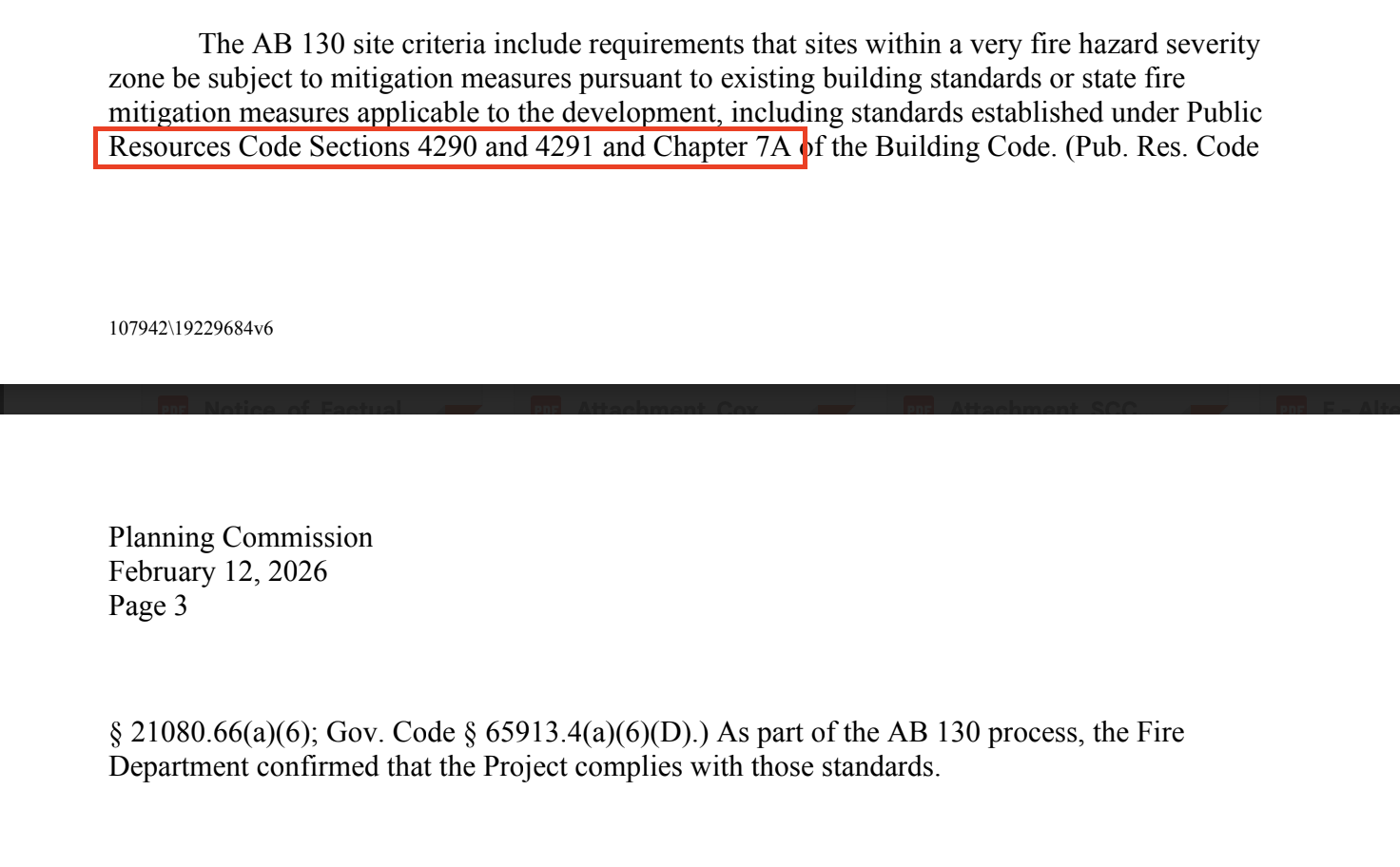
    City staff, in the February 24 Planning Commission staff report, summarized this review by stating the Fire Department “has demonstrated consistency with these requirements.” Staff had consistently deferred to the Fire Department on fire safety questions — a reasonable practice in general.

    This imprecise characterization became the seed from which the developer’s lawyers grew a much larger claim.

    Stage 2: The Developer’s Lawyers Stretch the Record

    Summerhill’s legal team took the staff report’s characterization and built an aggressive legal argument on top of it. In their February 12, 2026, letter to planning staff, and again in their April 1 letter to the City Council, Cox, Castle & Nicholson made a series of claims that went well beyond what the Fire Department had actually reviewed.

    Lawyer’s claim: “The Project is eligible for the AB 130 CEQA statutory exemption for infill housing projects.”

    The record: AB 130 requires that fire hazard mitigation measures under PRC § 4291 have been “adopted.” Estrada confirmed the Fire Department was never asked to evaluate § 4291 and did not sign off on it.

    When Council Member Wang pressed on this point, Estrada confirmed plainly that the Fire Department did not evaluate the project for purposes of the CEQA exemption the developer was claiming: “The exception request application was for 4290, not 4291.” Without a § 4291 evaluation, the statutory basis for the CEQA exemption does not exist. (See Part 1 for the full exchange.)

    Lawyer’s claim: The Fire Department found the Alternative Means provide “appropriate alternative methods to reduce the risk of structure-to-structure ignition.”

    The record: Estrada confirmed that the impact on existing neighboring homes was “outside of scope” for the evaluation. The Fire Department assessed the new structures; it did not assess whether the mitigations protected the 1950s-era homes next door.

    Lawyer’s claim: “Neither the City nor the Fire Department have identified any applicable, objective standards related to evacuation routes.”

    The record: The city’s own Fehr & Peers study, received in September–October 2025, contained detailed, quantitative evacuation capacity data showing routes at 360–420% of capacity. This data was in city files at the time the lawyer wrote these words.

    Lawyer’s claim: The project “is consistent with applicable, objective public health and safety standards” under the Housing Accountability Act.

    The record: Estrada confirmed the “same practical effect” finding was based on “professional judgment” and “experience” — not objective, quantitative standards. The HAA defines “objective” as “involving no personal or subjective judgment.” A finding based on professional judgment is, by the HAA’s own definition, subjective.

    Lawyer’s claim: The reduced setback is justified by “practical reasons” including “development density requirements.”

    The record: Estrada agreed with Vice Mayor Chao that the reduced setback is “a design choice” — not a site constraint: “I don’t disagree with anything you said. This is a design choice. This is for the applicant and the builder to answer.” Comparable projects — Vida in Sunnyvale (50 units, 53–65 ft setbacks) and Westport in Cupertino (88 units, code-compliant setbacks) — demonstrate the density can be achieved without reducing the safety buffer. The Evulich units average 2,369 sq ft with 4-bedroom luxury floor plans. The setback was reduced to accommodate unit size, not to meet density. The AMMR exception was used to backfill a safety gap created by the developer’s own design choices — not a site constraint necessitating a regulatory workaround. (See Part 1 for the full Chao-Estrada exchange.)

    A detailed analysis submitted by Linda Vista residents further documents that 30-foot setbacks are achievable on this site. The Evulich units average 2,369 sq ft, with some reaching 2,779 sq ft with 4 bedrooms and 2-car garages. The setback was reduced to accommodate luxury unit sizes, not to meet density.

    Stage 3: Obtaining the HCD Letter

    On March 30, 2026 — two days before the Council vote — HCD issued a “Letter of Support and Technical Assistance” to Community Development Director Ben Fu. (For the full context of this letter, see Part 1.) The letter’s factual basis and its enforcement implications are what matter for understanding the strategy.

    The letter’s factual foundation is traceable. Footnote 2 cites the Planning Commission staff report. Footnote 4, the critical fire safety reference, cites page 9 of that same staff report — the passage claiming the Fire Department “has demonstrated consistency with these requirements.”

    HCD’s letter advised the city to “assume compliance with local building codes” and defer verification to the “post-entitlement phase.” But this advice was predicated on the assumption that the project was undergoing a standard ministerial approval.

    The developer was actually seeking a CEQA exemption under AB 130 — which requires that fire safety compliance exist at the time of the exemption, not at some future date. HCD’s advice to defer was legally incompatible with the specific approval pathway the developer had chosen.

    Most critically, the letter informed the city that AB 712 had taken effect, creating financial penalties for jurisdictions that denied housing after being “advised in writing” of a potential violation. The letter itself was that written advice — a trigger mechanism that made denial financially punishable.

    The question HCD should be asked: Was HCD aware, at the time it issued its letter, that the Fire Department had not evaluated PRC § 4291? That neighbor impact and evacuation were “outside of scope”? That the fire safety finding rested on subjective professional judgment? That the city possessed a Fehr & Peers evacuation study showing routes at four times capacity?

    The Tell: How the Attorney’s Own Claims Built — Then Undermined — the Approval Chain
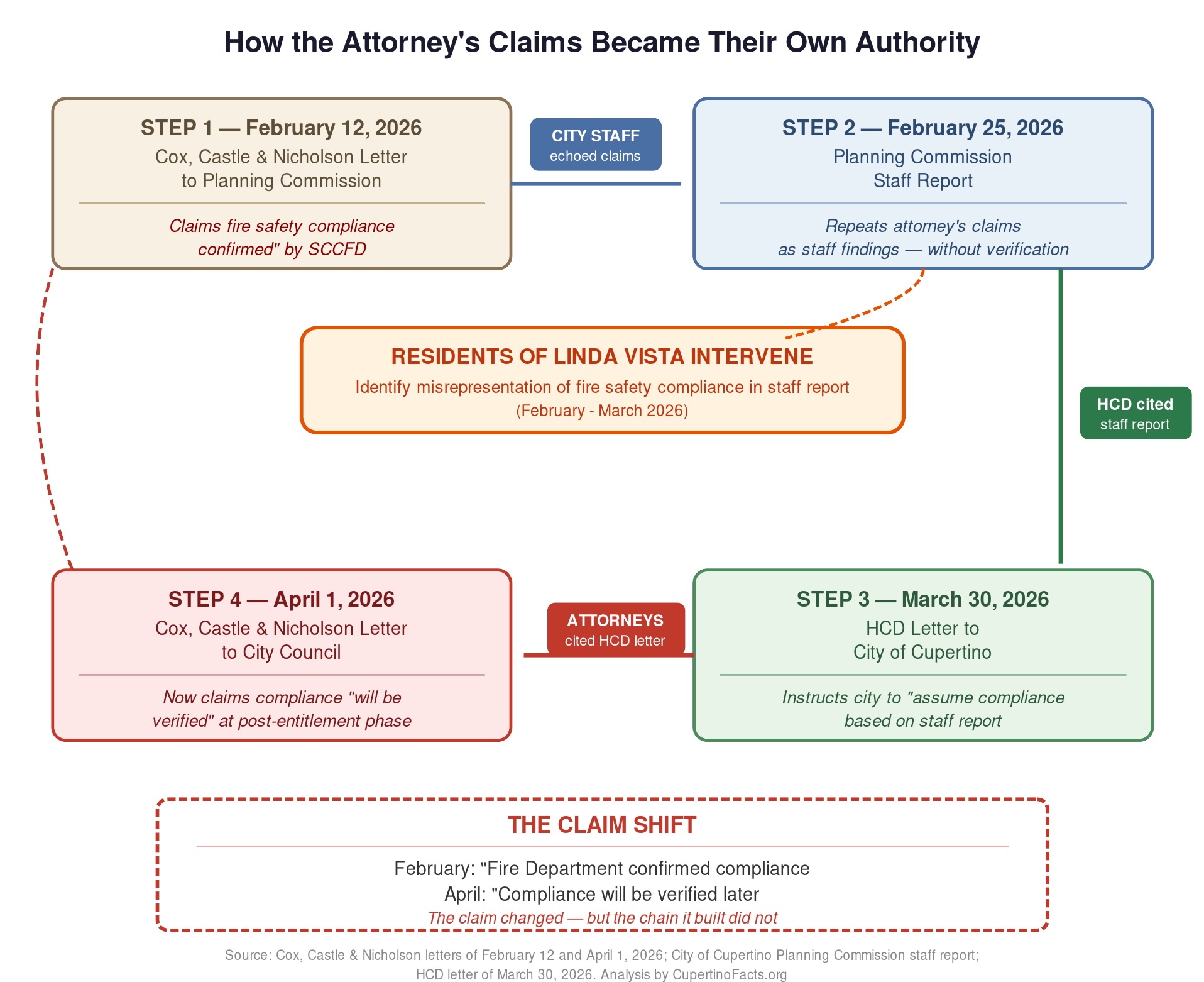
    Diagram showing how Cox Castle attorney claims traveled from their February letter to the staff report to HCD letter and back to their April letter, creating a circular dependency
    How the developer attorney’s compliance claims became self-reinforcing: their February assertions were echoed by city staff, cited by HCD, then used by the same attorneys to threaten the city — after quietly shifting the claims themselves.

    A side-by-side reading of the developer’s two Cox, Castle & Nicholson letters reveals something more than a change in legal posture. It reveals the architecture of a circular argument — one where the attorney’s own claims became the foundation for the very authority they later cited to threaten the city.

    Here is how it worked. In their February 12 letter to the Planning Commission, Cox Castle stated that the Fire Department had “confirmed” the project’s compliance with PRC §§ 4290, 4291, and Chapter 7A of the Building Code. City staff then echoed these claims — without independent verification — in the Planning Commission staff report dated February 25. HCD, in turn, relied on that staff report when it wrote its March 30 letter instructing the city to “assume compliance” with local safety codes. The attorney’s unverified assertion had traveled from letter to staff report to state agency directive — gaining authority at each step while never being checked against reality.

    Then residents of the Linda Vista neighborhood identified the misrepresentation: the Fire Department had never evaluated PRC § 4290 compliance and could not have “confirmed” it. Faced with this challenge, Cox Castle’s April 1 letter to the City Council quietly abandoned the original claim. Compliance was no longer “confirmed” — it “will be verified” at the post-entitlement phase. But the letter did not retract the February claim that had already been laundered through the staff report and into HCD’s directive. Instead, it cited that very HCD letter — built on the now-abandoned claim — as the basis for threatening the city with litigation under AB 712.

    The claim changed, but the chain it built did not. The February assertion created a paper trail of apparent compliance. When residents forced the claim to shift, the attorney simply pointed to the end of the chain — HCD’s letter — as independent authority, even though HCD had relied on the very assertion the attorney had now walked back. This is the circular logic at the heart of the Evulich Court approval.

    Stage 4: The Letter Becomes a Weapon

    The final stage was the most transparent. On the morning of April 1, Cox, Castle & Nicholson submitted their 10-page letter to the City Council with the HCD letter attached as “Exhibit A.” The developer’s own claims had traveled a full circle: from the developer’s representations, into the staff report, to HCD, and back to the Council chamber, now wearing the imprimatur of an independent state agency.

    The letter warned of “$10,000 per unit” fines and payment of the developer’s attorney fees. It framed approval as a legal obligation, not a policy choice. The developer’s attorneys had successfully transformed a public safety hearing into a legal compliance exercise where the outcome was predetermined.

    The coercive effect was evident in the Council’s own words: Mayor Moore called the project “not a good design at all” — and voted yes. Only Council Member Wang dissented. (For the full account of the April 1 hearing and the Council vote, see Part 1.)

    The Staff Omissions That Made It Possible

    The developer’s legal strategy could not have succeeded without gaps in how city staff managed the flow of information. Staff did not construct the compliance narrative — but four critical omissions allowed it to move through the system unchallenged. (The full timeline of these omissions is documented in Part 1.)

    The evacuation study. The city received the Fehr & Peers evacuation capacity study in the September–October 2025 timeframe. This study showed that evacuation routes serving the Linda Vista area were already at over four times their design capacity. It was not included in the Planning Commission’s agenda packet for the February 24 hearing. It was not shared with HCD. It was not presented to the Council. Meanwhile, the developer’s attorneys were repeatedly telling decision-makers that no applicable evacuation data existed. Staff had the data that refuted this claim and did not produce it.

    The staff report and the missing AMMR. The February 24 staff report stated the Fire Department “has demonstrated consistency with these requirements” — language that conveyed comprehensive fire safety compliance. Staff had deferred to the Fire Department, which is common practice. But the Fire Department’s review was limited to PRC § 4290 only, with the Building Official signature left blank and no evaluation of § 4291, neighbor impact, or evacuation. The staff report did not communicate these limitations. Critically, staff did not even include the AMMR form itself in the Planning Commission’s agenda packet — the foundational document that authorized the setback reduction. Commissioners voted to recommend approval without being able to see for themselves that the review covered only § 4290, that the Building Official had not signed it, or that its scope was far narrower than the staff report implied. When the developer’s lawyers subsequently used the staff report’s language to claim full compliance, staff did not correct the record.

    Planning Commissioner Tracy Kosolcharoen flagged this problem directly. In a March 17 letter to the City Council, she confirmed that the Planning Commission did not have the evacuation study during its February 24 vote. She also reported that a representative from the same environmental consulting firm that processed the Evulich AB 130 exemption had told over 100 planning commissioners at a professional academy that VHFHSZ developments “should NOT be exempt from CEQA via AB 130.” Kosolcharoen asked the Council:

    Who is the final arbiter of AB 130 applications? Is it the developer’s consultant, the fire department, or the city? She warned that the decision “sets a precedent for future decisions.”

    The failure to evaluate the setback justification. The AMMR regulations require “practical reasons” for a setback reduction, listing factors like parcel dimensions, topographic limitations, and other site constraints. The developer claimed the reduction from 30 feet to 10 feet was necessary for density. But a detailed analysis submitted by Linda Vista residents on March 13 demonstrated that 30-foot setbacks are achievable on this site, citing comparable projects at Vida and Westport that met density targets with code-compliant setbacks. Staff did not independently evaluate whether the developer’s justification met the regulatory standard — and the Fire Chief himself later confirmed it was “a design choice,” not a site constraint.

    The failure to flag the § 4291 gap. AB 130’s CEQA exemption requires compliance with PRC § 4291. The Fire Department had not evaluated § 4291 — a fact Estrada confirmed plainly when asked. This was not a technicality; it was a threshold requirement for the specific approval pathway the developer had chosen. City staff did not flag this gap to the Planning Commission, to HCD, or to the Council. The developer’s lawyers were allowed to assert AB 130 eligibility without the statutory predicate being met.

    To be clear: City staff did not create the developer’s compliance narrative. Summerhill’s attorneys did that. Staff’s role was one of omission rather than commission — they did not surface contradicting data, did not correct escalating mischaracterizations, and did not flag a missing statutory requirement.

    What the Record Now Shows

    The approval of the Evulich Court project was not the result of a finding that the project is safe. It was the result of a legal strategy that manufactured the appearance of compliance and used state enforcement mechanisms to ensure the City Council could not say no. The developer’s attorneys built a chain of claims that traveled from their letters to the staff report to HCD and back — gaining authority at each step while the underlying assertions were never verified and, when challenged, were quietly changed. City staff did not create this narrative, but their failure to verify the claims, surface their own contradicting data, or flag a missing statutory requirement allowed it to move through the system unchallenged. (For the full testimony of Assistant Fire Chief Estrada and the detailed timeline, see Part 1: The Paper Trail.)

    The record now contains everything a reviewing body would need to understand what happened: the developer’s claims, the Fire Chief’s actual testimony, the city’s hidden evacuation data, and the HCD letter built on incomplete information. Whether that record leads to accountability depends on whether anyone with authority is willing to look at it.

    Media Coverage

    This story has been covered by local and regional news outlets:

    Read the Full Series

    • Part 1: The Paper Trail — The full story, end to end.
    • Part 2: The Risks Residents Face — Evacuation fiction vs. fact on Linda Vista Drive.

    Previously: Who Is Responsible for Fire Safety at Evulich Court? Nobody, Apparently.
  • EVULICH COURT INVESTIGATION — PART 2 OF 3

    EVULICH COURT INVESTIGATION — PART 2 OF 3

    The Risks Residents Face: Evacuation Fiction vs. Fact on Linda Vista Drive

    The developer says the project adds two minutes to evacuation time. The city’s own data shows the roads are already at four times capacity. An independent engineer’s analysis says it’s even worse. Which version should families trust with their lives?

    Cupertino Facts • April 2026

    This is Part 2 of a three-part investigation into the Evulich Court project approval.

    • Part 1: The Paper Trail — The full story of how incomplete information flowed from city staff to HCD to the developer’s lawyers, and how the Fire Chief’s straightforward testimony exposed the gap.
    • Part 2: The Risks Residents Face — Evacuation gridlock, flawed studies, and what the city’s own data says about the danger to Linda Vista families. (You are here)
    • Part 3: The Architecture of Approval — The developer’s legal strategy to stretch the record, the staff omissions that enabled it, and the circular argument that silenced safety concerns.

    One Neighborhood, Two Completely Different Assessments

    When the Cupertino City Council voted on the Evulich Court project on April 1, 2026, two evacuation analyses existed for the Linda Vista corridor. They were produced using different methodologies, different assumptions about who would be evacuating, and different assumptions about road capacity. They reached conclusions so divergent that they describe what amount to two different neighborhoods.

    The developer’s analysis, produced by Hexagon Transportation Consultants at Summerhill’s request, concluded the project would add just 3.6 percent to evacuation traffic and approximately two minutes to evacuation time. It described the impact as one that “would not significantly affect traffic evacuation volumes or conditions.”

    The city’s own analysis, produced by Fehr & Peers — a nationally recognized transportation firm the city had commissioned — found something altogether different. It found that the evacuation routes serving the Linda Vista area were already operating at over four times their design capacity during a wildfire scenario. Not with the project — without it.

    How can two professional analyses of the same neighborhood reach such radically different conclusions? The answer lies in what each study chose to count — and what it chose to ignore.

    The Hexagon Study: What the Developer Didn’t Count

    The Hexagon Transportation analysis, dated February 26, 2026, was submitted by Summerhill’s own team. It was characterized by the developer’s attorneys, in their letter to city staff, as “a voluntary, non-CEQA, informational assessment prepared at the request of the applicant for internal purposes.” In other words, even the developer described it as an informal, voluntary exercise — not a regulatory analysis.

    The study’s methodology had two fundamental limitations that dramatically understated the evacuation challenge.

    First, it counted only project residents in its evacuation volume estimate. It did not account for the students at nearby Monta Vista High School or Kennedy Junior High, the hikers on the Linda Vista Trail, the commuters on local roads, or the existing residents of the broader Linda Vista neighborhood who would all be evacuating simultaneously. In a wildfire scenario, evacuation demand comes from everyone in the threat zone, not just the residents of a single development.

    Second, it assumed a road capacity of 2,700 vehicles per hour — a figure based on clear-sky, ideal driving conditions. It did not adjust for the conditions that actually accompany a wildfire evacuation: heavy smoke reducing visibility, panicked drivers, contraflow from emergency vehicles, or the well-documented breakdown in intersection efficiency that occurs during mass evacuations.

    Third, but perhaps most important:

    It ignored the capacity of Linda Vista Drive, where all the vehicles from the new development will be exiting into.

    Under these favorable assumptions, the study naturally concluded the project’s impact would be minimal — a two-minute delay on a 59-minute baseline.

    The Fehr & Peers Study: What the City Already Knew

    The Fehr & Peers study used a fundamentally different — and more realistic — methodology. It counted all evacuating populations in the area, including school populations, hikers, and commuters. And it used wildfire-adjusted road capacity of approximately 570 vehicles per hour — a figure that accounts for smoke, low visibility, and emergency panic conditions. This is less than a quarter of the capacity Hexagon assumed.

    The results were alarming.

    McClellan Road, a key evacuation route, showed a volume-to-capacity ratio of 4.2 — meaning 420 percent of the road’s realistic emergency capacity. Foothill Boulevard showed a ratio of 4.0. Stevens Creek Boulevard registered at 3.6.

    What these numbers mean in practice: A volume-to-capacity ratio above 1.0 means the road cannot handle the traffic being placed on it. At a ratio of 4.0, vehicles are not moving through the corridor — they are sitting in gridlock.

    This is the scenario that has turned fatal in wildfires from Paradise to Lahaina: not that people didn’t try to evacuate, but that the roads couldn’t carry them.

    The city received this study in the September–October 2025 timeframe. It was not included in the Planning Commission’s agenda packet for the February 24, 2026, hearing. It was not referenced in the staff report. Its unlikely to be shared with HCD before HCD issued its March 30 letter. The developer’s attorneys, in their April 1 letter, told the Council there were no “applicable, objective standards related to evacuation routes” — while this study sat in city files.

    One Neighborhood, Two Realities

    FactorHexagon (Developer)Fehr & Peers (City)
    Commissioned bySummerHill HomesCity of Cupertino
    Populations countedProject residents onlyAll residents, school populations, hikers, commuters
    Road capacity assumed2,700 vehicles/hour (clear sky, ideal conditions)~570 vehicles/hour (wildfire-adjusted: smoke, low visibility, panic)
    Conclusion3.6% increase; 2-minute delayRoutes already at 360–420% of capacity
    Study type“Voluntary, non-CEQA, internal review”City-commissioned expert analysis
    Shared with decision-makers?Yes — cited in developer’s legal letterNo — not included in Planning Commission packet, not shared with HCD

    DerChang Kau’s Independent Analysis: The Linda Vista Spine

    At the April 1 Council hearing, Cupertino resident and engineer DerChang Kau presented an independent evacuation analysis that added a critical dimension the other studies lacked: a focus on the Linda Vista corridor itself — the single-access spine that all Evulich Court traffic must use to reach the broader road network.

    Kau’s presentation, titled “Wildfire Evacuation in VHFHSZ on the Top of Active Fault,” documented the compound hazard facing the neighborhood. The site sits not only in a Very High Fire Hazard Severity Zone but just a few hundred feet from the Monta Vista-Shannon Fault, capable of producing earthquakes of magnitude 6.5 to 7.1.

    A seismic event — even independent of a wildfire — could rupture gas and water lines in the corridor. During a wildfire, loss of water pressure would cripple firefighting capacity, and a gas line break could create secondary ignition sources, compounding an already catastrophic evacuation scenario.

    Kau traced the history of how evacuation concerns were handled. In October 2025, city planning staff acknowledged in writing the need for an evacuation route assessment. In January 2026, Kau himself met with Summerhill’s leadership team for over 90 minutes, sharing detailed evacuation risk data for the corridor. Summerhill proceeded without addressing the concerns.

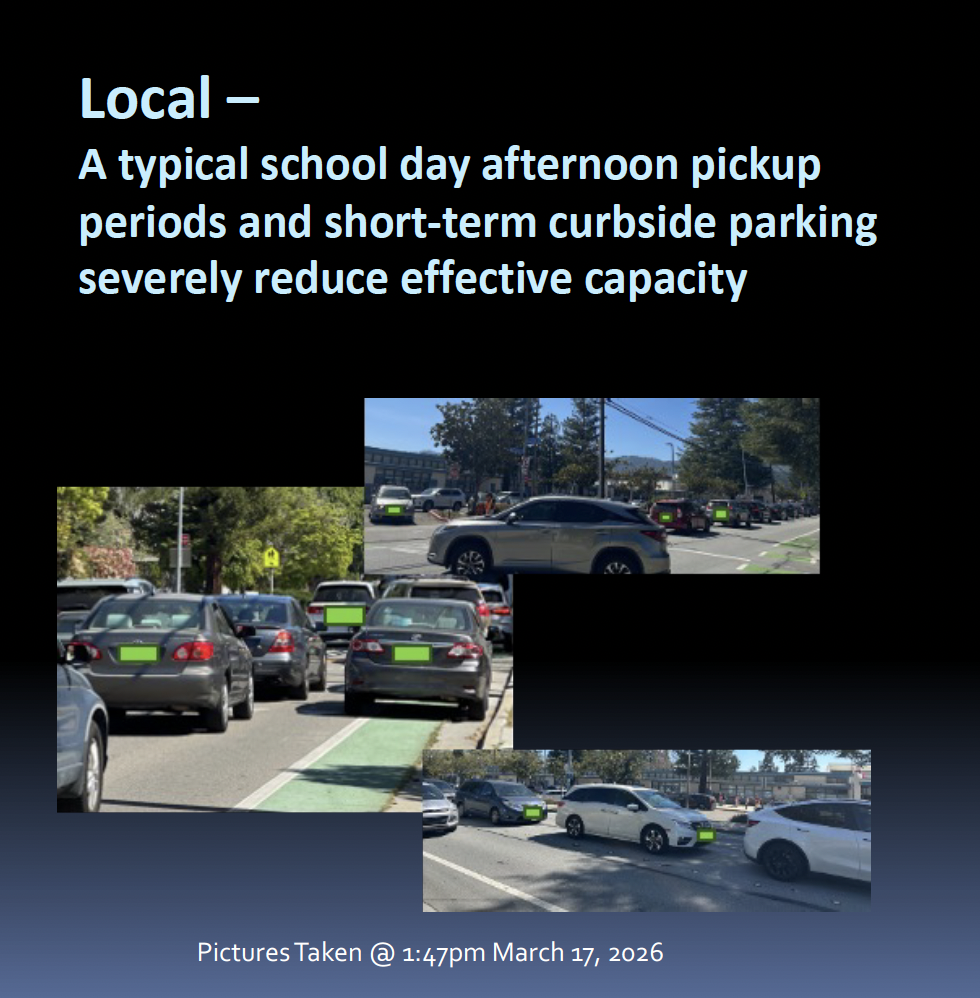
    His analysis exposed the real-world conditions that Hexagon’s clear-sky model ignored. He documented Highway 85 traffic backed up during a normal Wednesday morning commute. He showed photographs of local streets overwhelmed during school afternoon pickup periods, with curbside parking further reducing effective road capacity. These are the baseline conditions — before a wildfire adds thousands of panicked evacuees to the same roads.

    The core of Kau’s argument was that adding 51 units — generating over 100 additional vehicles — to a cul-de-sac that empties into an evacuation corridor already failing at four times its design capacity is not a two-minute inconvenience. It is a compounding failure. Every additional vehicle in a gridlocked corridor doesn’t add seconds — it adds to the cascading breakdown of the entire system.

    Kau put it plainly to the Council: you cannot plan a community’s survival based on a developer’s spreadsheet that erases its children from the map.

    The Fire Safety Gaps: What Wasn’t Evaluated

    The evacuation problem is compounded by the gaps in the fire safety review that Assistant Fire Chief Estrada identified in his testimony.

    The Fire Department’s evaluation focused on the new structures — the 51 townhomes — and specifically on PRC § 4290 setback requirements. It did not extend to the impact on existing homes in the neighborhood.

    This matters because of the physics of the proposed design. The project calls for three-story townhomes with one-hour fire-rated walls built just 10 feet from existing single-story homes constructed in the 1950s. These older homes have standard wood-frame construction with no enhanced fire rating. At a 10-foot separation, radiant heat exposure increases dramatically (9x) compared to the code-standard 30-foot setback.

    Vice Mayor Chao raised this directly with Estrada, asking how the proposed measures could provide the “same practical effect” as a 30-foot setback when the neighboring homes lack modern fire-resistant features.

    Estrada was candid that his department’s enforcement authority stops at the property line — the condition of neighboring structures, their vulnerability to radiant heat, and the adequacy of their owners’ defensible space were not within the scope of the review he was asked to conduct.

    The developer’s own third-party fire plan reviewer acknowledged as much on March 17, 2026, stating clearly that being code-compliant does not imply eliminating all hazards and risks.

    The compound risk facing Linda Vista residents:

    • Evacuation routes that are already at four times their design capacity.
    • A fire safety review that excluded neighbor impact, evacuation, and defensible space under PRC § 4291.
    • Reduced setbacks that increase radiant heat exposure to unprotected 1950s-era homes.
    • A site that sits atop an active fault line.
    • And a developer-funded evacuation study that counted only its own residents and assumed perfect driving conditions.

    What Residents Are Left With

    The families along Linda Vista Drive, Evulich Court, and the surrounding streets are left with a project that was approved based on a version of the facts that doesn’t match the city’s own data. The developer’s evacuation study — voluntary, non-CEQA, and built on assumptions that excluded most of the evacuating population and inflated road capacity by nearly five times — was the only evacuation analysis placed before decision-makers. The city’s own Fehr & Peers study, which showed a catastrophically different picture, was never surfaced.

    When Council Member Wang asked the Fire Chief whether evacuation had been considered, Estrada confirmed it was out of scope.

    When Wang asked the City Attorney about the city’s liability if a fire caused harm, the answer was that the city would likely be shielded.

    The residents, of course, have no such shield.

    Resident Ying Sosic captured the human dimension of these numbers at the hearing:

    Think about it as all of us humans, just trying to survive, just trying to get out.”

    The data exists to evaluate the risk. The city commissioned it. The question is why it was never placed in front of the people making the decision.

    Media Coverage

    This story has been covered by local and regional news outlets:

    Continue Reading

    Previously: Who Is Responsible for Fire Safety at Evulich Court? Nobody, Apparently.
  • EVULICH COURT INVESTIGATION — PART 1 OF 3

    EVULICH COURT INVESTIGATION — PART 1 OF 3

    The Paper Trail: How a Developer Used State Power to Override Fire Safety in Cupertino’s Wildfire Zone

    On April 1, Assistant Fire Chief Hector Estrada, described, without embellishment, the limited scope of his department’s review — and in doing so, exposed how others had mischaracterized that review to force approval of 51 townhomes in a Very High Fire Hazard Severity Zone. How did the state get misled — and who controlled the information?

    Cupertino Facts • April 2026

    This is Part 1 of a three-part investigation into the Evulich Court project approval.

    • Part 1: The Paper Trail — The full story of how incomplete information flowed from city staff to HCD to the developer’s lawyers, and how the Fire Chief’s straightforward testimony exposed the gap. (You are here)
    • Part 2: The Risks Residents Face — Evacuation gridlock, flawed studies, and what the city’s own data says about the danger to Linda Vista families.
    • Part 3: The Architecture of Approval — Staff misdirection, the developer’s legal strategy, and the circular argument that silenced safety concerns.

    Previously: Who Is Responsible for Fire Safety at Evulich Court? Nobody, Apparently.
    The Vote

    On the evening of April 1, 2026, the Cupertino City Council voted 4-1 to approve a 51-unit luxury townhome development by Summerhill Homes at 10857 Linda Vista Drive — a 2.53-acre site in the city’s recently designated Very High Fire Hazard Severity Zone. The proposal asked to reduce the mandatory 30-foot wildfire setback to just 10 feet along property lines shared with existing 1950s-era homes.

    The sole dissenting vote came from Council Member R. “Ray” Wang, who posed a question that hung over the chamber: “What’s the consequences if we allow 800 residents to be in a severe fire with no evacuation routes?”

    Mayor Kitty Moore, who voted to approve, offered her own assessment before casting her vote: “My frank opinion of this is that this is not a good design at all.”

    If four of five council members had misgivings about safety, why did the project pass?

    The answer lies in a paper trail that runs from Cupertino City Hall to Sacramento and back — a chain of incomplete information, legal threats, and a state agency letter that, by the time the council voted, had made the outcome all but inevitable.

    Why This Site Is Different: The Regulatory Framework

    To understand what happened, it helps to understand the laws that are supposed to govern development in wildfire zones. The California Environmental Quality Act (CEQA) requires environmental review before most development projects can be approved — an analysis of impacts including traffic, noise, air quality, and natural hazards like wildfire and seismic risk. That review is the public’s primary tool for ensuring that safety concerns are evaluated before a project breaks ground.

    AB 130, a housing streamlining law, allows certain infill projects to bypass CEQA review. But the Legislature recognized the danger of skipping environmental review in fire-prone areas: AB 130 specifically excludes projects in a Very High Fire Hazard Severity Zone (VHFHSZ)unless the developer can demonstrate compliance with the state’s fire safety regulations. Those regulations have two parts. PRC § 4290 sets structural standards including a mandatory 30-foot defensible space setback between new construction and adjacent properties. PRC § 4291 and its local equivalent, Government Code § 51182, require up to 100 feet of defensible space clearance around structures — vegetation management, fuel reduction, and maintenance of the buffer zone that gives firefighters room to work and residents time to evacuate. Critically, the most intensive defensible space zone extends 30 feet from the structure — the same distance as the § 4290 setback.

    Reduce the setback, and the defensible space becomes physically impossible to maintain.

    The Evulich Court project sits in the VHFHSZ. The law gave Summerhill a clear choice.

    • If the developer wanted to bypass CEQA under AB 130, it needed to maintain the 30-foot setbacks and demonstrate full compliance with fire safety regulations — the trade-off the Legislature struck for skipping environmental review in a wildfire zone.
    • Alternatively, if the developer wanted to reduce setbacks below 30 feet, it could seek an exception — but it would need to go through CEQA, the environmental review process designed to ensure that fire safety, evacuation capacity, and neighbor impacts are evaluated before the project is approved.

    What Summerhill got was neither path. It obtained an exception reducing the setback to as little as 10 feet and bypassed CEQA entirely.

    Reduced safety buffers with no environmental review — in a Very High Fire Hazard Severity Zone, a few hundred feet from an active fault line. The question this series examines is how.

    The Timeline: What Was Known, When, and By Whom

    March 2025 — CAL FIRE designates the Evulich Court area and the Linda Vista neighborhood as a Very High Fire Hazard Severity Zone. The site lies just a few hundred feet from the Monta Vista-Shannon Fault (magnitude 6.5–7.1) — close enough that a seismic event could rupture gas and water lines serving the neighborhood. This compound hazard — wildfire and earthquake risk in the same corridor — is exactly what the California Environmental Quality Act is designed to evaluate.

    September–October 2025 — The city receives the Fehr & Peers evacuation capacity study it had commissioned. The findings are alarming: McClellan Road operates at a volume-to-capacity ratio of 4.2 and Foothill Boulevard at 4.0 during a wildfire scenario.

    Evacuation routes are already at over four times their design capacity.

    This study is not shared with the Planning Commission till March 2026

    October 10, 2025 — City planning staff acknowledges in an email the need for an evacuation route assessment for the Linda Vista corridor.

    January 5–7, 2026 — The Santa Clara County Fire Department issues an Alternative Means and Methods Request (AMMR) approval, allowing the setback reduction from 30 feet to 10 feet. The approval covers PRC § 4290 only. The Building Official signature line is left blank.

    February 24, 2026 — The Planning Commission votes 3-2 to recommend approval. The staff report states the Fire Department “has demonstrated consistency with these requirements.”

    Neither the Fehr & Peers evacuation study nor the AMMR form, the very document that authorized the setback reduction, are included in the Planning Commission’s agenda packet.

    The Commissioners vote without seeing the foundational fire safety document or the city’s own evacuation data.

    March 13, 2026 — Residents of the Linda Vista neighborhood submit a detailed analysis demonstrating that 30-foot setbacks can be achieved on the Evulich Court site — citing comparable projects at Vida (Sunnyvale) and Westport (Cupertino) that met density requirements with code-compliant setbacks and smaller unit sizes.

    March 17, 2026 — The City Council continues the hearing. That same day, Planning Commissioner Tracy Kosolcharoen sends a letter to the City Council warning of the information gaps. She confirms that the Planning Commission did not have the evacuation study during the February 24 hearing, and reports that a representative from the same environmental consulting firm that processed the Evulich AB 130 exemption request stated at a Planning Commissioners Academy that VHFHSZ developments “should NOT be exempt from CEQA via AB 130.” Kosolcharoen raises pointed questions: “Is there a discretionary element to AB 130?” and “Who is the final arbiter of AB 130 applications?” She warns the Council that the Evulich decision “sets a precedent for future decisions.”

    March 27, 2026 — Residents of the Linda Vista neighborhood submit a letter alleging factual discrepancies in the project’s CEQA compliance claims made by the developer’s lawyers.

    March 30, 2026 — The California Department of Housing and Community Development issues a “Letter of Support and Technical Assistance” to Community Development Director Ben Fu. The letter cites the Planning Commission staff report and the developer’s representations as its factual basis. It warns of AB 712 penalties and references Attorney General enforcement. It arrives two days before the Council vote.

    April 1, 2026 — Cox, Castle & Nicholson LLP, Summerhill’s attorneys, submit a 10-page letter to the Council citing the HCD letter as “Exhibit A” and threatening fines of $10,000 per unit. That evening, Assistant Fire Chief Hector Estrada testifies under questioning and describes, without embellishment, the limited scope of his department’s review — answers that expose how both letters had mischaracterized the Fire Department’s findings.

    The Council votes 4-1 to approve.

    What the Fire Chief Actually Said

    The most consequential moments of the April 1 hearing came not during public comment, but during the testimony of Assistant Fire Chief Hector Estrada in response to questions by Council Member Wang and Vice Mayor Liang Chao.

    Under sustained questioning from the two council members, Estrada delivered a thoroughly professional testimony: direct, precise, and without embellishment, drawing clear lines around what his department had and had not been asked to evaluate.

    The problem was not his testimony, it was that his unvarnished answers revealed how others had been mischaracterizing the scope and conclusions of his department’s work for months.

    When Wang asked whether the Fire Department’s evaluation considered the fire safety impact on existing homes along the project’s southern and northern boundaries, Estrada was characteristically direct:

    Assistant Fire Chief Estrada:“Off-site improvements or off-site focus is one of those things that is outside of scope for that evaluation.”

    When Wang asked whether the Fire Department had signed off on PRC § 4291 — the defensible space requirements that AB 130 requires for a CEQA exemption — Estrada was clear about the boundaries of what his department had been asked to review:

    Assistant Fire Chief Estrada:“The exception request application was for 4290, not 4291.”

    Wang then pressed on the critical implication: under AB 130, a § 4291 evaluation is required to qualify for the CEQA exemption — so what happens without one? Estrada confirmed plainly that § 4291 compliance had not been evaluated and that the Fire Department would address it later, at the permit stage. He stated plainly that the Fire Department did not evaluate the project for purposes of the CEQA exemption the developer was claiming — a fact that went directly against the developer’s central legal argument.

    When Wang raised the city’s own Fehr & Peers data showing evacuation routes at over four times capacity, Estrada acknowledged that evacuation had never been part of the review he was asked to conduct:

    Assistant Fire Chief Estrada:“This was out of scope for this particular evaluation, and so evacuation routes were out of scope in this evaluation.”

    When Wang pressed on what analysis supported the conclusion that the mitigations would adequately protect unprotected neighboring structures, Estrada confirmed it was not based on quantitative modeling:

    Assistant Fire Chief Estrada:“This is based on… experience and our engineering staff’s credential and their experience as well.”

    And when Vice Mayor Chao asked how the reduced setback could be justified when the developer could build smaller units and maintain the 30-foot buffer, Estrada agreed it was not a site constraint:

    Assistant Fire Chief Estrada:“I don’t disagree with anything you said. This is a design choice. This is for the applicant and the builder to answer.”

    What Estrada’s testimony made clear: The Fire Department’s review was limited to PRC § 4290 setbacks. Defensible space, neighbor impact, evacuation, and the CEQA exemption the developer was claiming were all outside its scope — and the finding rested on professional judgment, not objective quantitative standards. None of this was hidden by the Fire Department. The problem is that others had characterized Estrada’s work as establishing something far broader than what he described.

    The HCD Letter: Built on Incomplete Information

    Two days before the vote, on March 30, 2026, the California Department of Housing and Community Development issued a three-page letter to Cupertino’s Community Development Director Ben Fu. Signed by Melinda Coy, Housing Accountability Unit Chief, the letter framed itself as “technical assistance” but carried unmistakable enforcement weight. It informed the city that AB 712 had taken effect, increasing penalties for local governments that had been “advised in writing” that their actions would violate housing laws. The letter itself was that written advice — a trigger mechanism that made denial financially punishable.

    But the letter’s factual foundation rested almost entirely on the Planning Commission staff report. Footnote 4 is revealing: HCD states that the project is consistent with VHFHSZ regulations, citing page 9 of the staff report, which claims the Fire Department “has demonstrated consistency with these requirements.” Estrada’s testimony two days later showed how much broader that characterization was than the limited review it described.

    The question is what HCD would have done with a complete picture — one that included the gaps Estrada identified and the evacuation data the city had but never surfaced. Part 3 of this series traces exactly how information flowed to HCD and where it broke down.

    The Developer’s Letter: Stretching the Record, Then Weaponizing It

    On the morning of April 1, hours before the hearing, Summerhill’s attorneys at Cox, Castle & Nicholson LLP submitted a 10-page letter to the City Council. The letter attached the HCD letter as “Exhibit A” and warned that denial would expose the city to “fines of a minimum of $10,000 per unit (with enhanced penalties in the event of bad faith or prior noncompliance) and payment of Summerhill’s attorneys’ fees.”

    The letter was the culmination of a strategy that had been building for months: take the Fire Department’s limited PRC § 4290 review, represent it as comprehensive fire safety compliance, present that characterization to HCD, and then cite HCD’s resulting letter as independent state authority confirming the developer’s own claims. The “independent state review” was, in effect, the developer’s arguments reflected back through a state agency. Part 3 of this series examines each specific claim in the developer’s letter against what the Fire Chief actually testified.

    The False Choice: Liability vs. Safety

    Perhaps the most revealing exchange of the evening came when Council Member Wang asked the City Attorney a direct question: if the project is approved and a fire later causes harm to residents, what is the city’s liability?

    The City Attorney could not point to any safety finding that would protect residents. Instead, she fell back on the city’s legal immunity — the city would likely be shielded from tort liability. That was the best answer available: not that the project was safe, but that the city probably couldn’t be sued for approving it. Meanwhile, the city faced immediate, concrete enforcement exposure from HCD — the AB 712 penalties, the potential Attorney General action — if it denied the project in the face of the state letter.

    The Council was not evaluating whether the project was safe. It was calculating which legal risk was more tolerable: the distant possibility of fire liability (mitigated by the city’s tort immunity) versus the immediate certainty of state enforcement (guaranteed by the HCD letter sitting in front of them). The residents, of course, have no such immunity.

    Mayor Moore said the project was “not a good design at all” — and then voted yes.

    The HCD letter had done its work. The question before the Council should have been: is this project safe? Instead, it had become: which lawsuit can we better survive?

    Who Controls the Information?

    In March, this publication asked: “Who is responsible for fire safety at Evulich Court?” The Fire Department said its review “is not a determination that the fire code has been satisfied.” The City relied entirely on that review as proof of compliance. Nobody owned the gap.

    The April 1 testimony has clarified the picture. The Fire Department was never the problem — Estrada answered every question directly, acknowledging the gaps in his department’s review without embellishment or evasion. The primary driver of the mischaracterization was the developer’s legal team, which stretched the Fire Department’s limited review into claims of comprehensive compliance.

    City staff’s role was different but still consequential:

    • they did not initiate the mischaracterization, but they failed to correct it
    • did not surface the insufficient density for setback reduction,
    • failed to surface their own evacuation data
    • and failed to provide decision-makers with the foundational documents — including the AMMR form itself — that would have revealed the gaps.

    Planning Commissioner Tracy Kosolcharoen warned the Council of exactly these information gaps two weeks before the vote, but the warning went unheeded. Part 3 of this series examines these omissions in detail.

    What Happens Now

    The question for Cupertino is no longer just about one development on Linda Vista Drive. It is whether the coercive power of the state can be activated by a developer’s legal team stretching the record beyond what it supports, aided by a city staff that failed to correct those claims or surface its own contradicting data — and then used to silence the safety concerns of an entire neighborhood, even when the city’s own Fire Chief, answering plainly under direct questioning, confirms those concerns were never part of the review he was asked to conduct.

    Parts 2 and 3 of this series will examine the specific risks facing Linda Vista residents — including the hidden evacuation data and DerChang Kau’s independent modeling — and the detailed paper trail of staff decisions and legal strategy that brought the project to this point.

    Media Coverage

    This story has been covered by local and regional news outlets:

    Continue Reading

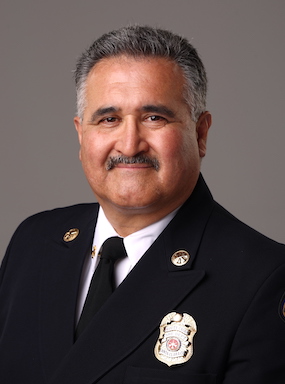
    Featured image: Assistant Fire Chief Hector Estrada, Santa Clara County Fire Department. Photo courtesy of SCCFD.

  • Who Is Responsible for Fire Safety at Evulich Court? Nobody, Apparently.
    Who Is Responsible for Fire Safety at Evulich Court? Nobody, Apparently.
    The Evulich Court project proposes 51 townhomes in a Very High Fire Hazard Severity Zone. To fit the oversized units (~2700 sf) on the site, the developer requested — and received — a reduction of the mandatory 30-foot wildfire setback to just 10 feet along the boundaries facing existing single-family homes. Somebody had to take responsibility for that decision. As it turns out, nobody did.

    The Accountability Gap

    David Yan’s op-ed in the San Jose Spotlight (March 16, 2026) highlights the evacuation side of this problem: the City of Cupertino commissioned an evacuation capacity study that found roadways in this area already exceed 200% of capacity during a wildfire event — and then never entered that study into the record for the Planning Commission hearing that approved the project.

    This article examines the other side: the fire department’s own review of the setback reduction, and the gap in accountability between the Santa Clara County Fire Department (SCCFD) and the City of Cupertino.

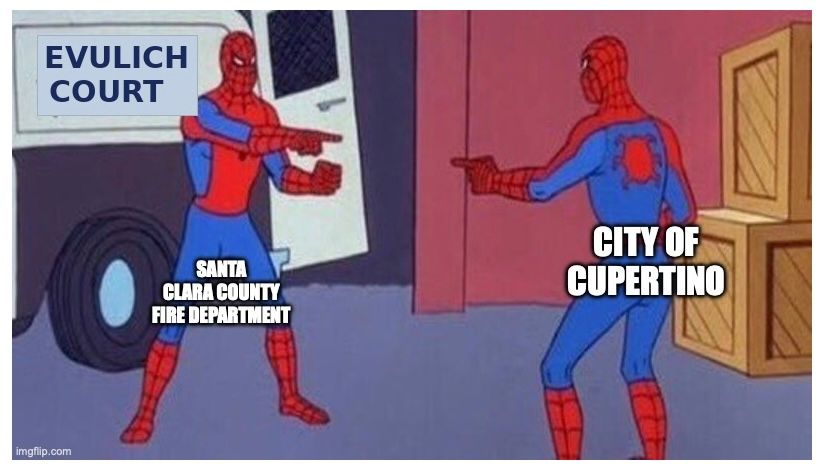
    The SCCFD says its review is not an approval of a code violation. The City of Cupertino says fire safety review is SCCFD’s domain and relies entirely on the AMMR as evidence of fire safety compliance. Neither entity has produced a documented technical analysis demonstrating that the reduced setback provides equivalent protection for the surrounding neighborhood.

    The residents — and the firefighters who will respond to this address — are the ones left in the middle.

    What Was Approved

    The project at 10857 Linda Vista Drive is a 51-unit townhome development by SummerHill Homes. The site is designated as a Very High Fire Hazard Severity Zone (VHFHSZ).

    Under the Board of Forestry Fire Safe Regulations (California Code of Regulations, Title 14, §1276.01), all parcels in a VHFHSZ must provide a minimum 30-foot setback from property lines. This is not a building code technicality — it is a wildfire safety standard designed to protect the surrounding neighborhood or community from fire spreading between structures (14 CCR §1270.01).

    SummerHill filed an Alternative Means and Methods Request (AMMR) to reduce this setback:

    • Northern property line (facing single-family homes): reduced to 10 feet
    • Southern property line (facing single-family homes): reduced to 10 feet
    • Western property line (the wildland-urban interface): reduced to 20 feet

    Filed, Accepted, and Done: The One-Day Timeline

    The AMMR was filed on January 5, 2026. It was accepted by the Fire Official on January 6. The Fire Prevention Plan Review was completed on January 7.

    The administrative record contains no documentation of what technical analysis was performed during this one-day period to support the determination that a 10-foot setback provides the same practical fire-safety effect as the 30-foot standard.

    This matters because the standard is not trivial. Research by the National Institute of Standards and Technology (NIST TN 2205) has found that intense radiant heat from a fully involved structure can ignite another structure at distances of approximately 30 feet, and that increasing spacing from 10 meters to 30 meters increases resistance to fire spread by a factor of ten. Post-disaster analysis of the 2023 Lahaina fire by the Insurance Institute for Business and Home Safety (IBHS) identified structure spacing as the single most critical factor in structure-to-structure fire spread.

    The SCCFD plan review itself describes the reduced setbacks as “deficiencies to non-conforming 30′ setback requirements” to be mitigated. This is the language of a known shortfall — not a finding that the proposed alternative achieves equivalent protection.

    SCCFD Says It’s Not an Approval. The City Treats It as One.

    This is where the accountability gap becomes clear.

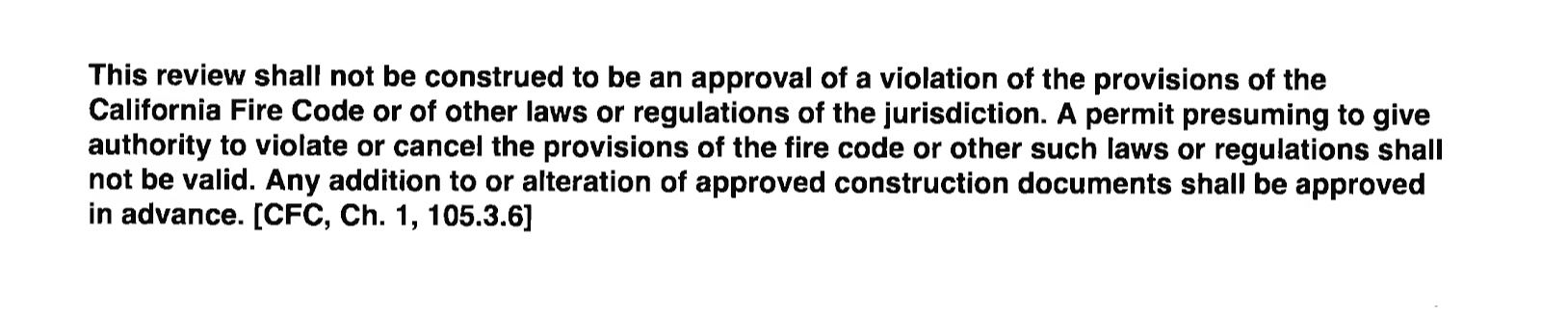
    The SCCFD’s own Fire Prevention Plan Review includes a bold-face disclaimer:

    The SCCFD disclaimer on the Evulich Court fire safety review
    The SCCFD disclaimer on the Evulich Court fire safety review — from their own approval document.

    Read that again. The fire department is explicitly saying: this document is not a determination that the fire code has been satisfied.

    Meanwhile, the City of Cupertino’s staff report and AB 130 qualification memo treat the AMMR as the definitive proof that fire safety has been addressed. The City has delegated fire-related review to SCCFD and has not conducted its own independent fire safety analysis.

    SCCFD says: “Our review is not an approval of compliance.”

    The City says: “Fire safety is SCCFD’s responsibility, and they approved it.”

    Result: No entity has taken ownership of the determination that the 10-foot setback is safe for the surrounding community.

    The Missing Signature

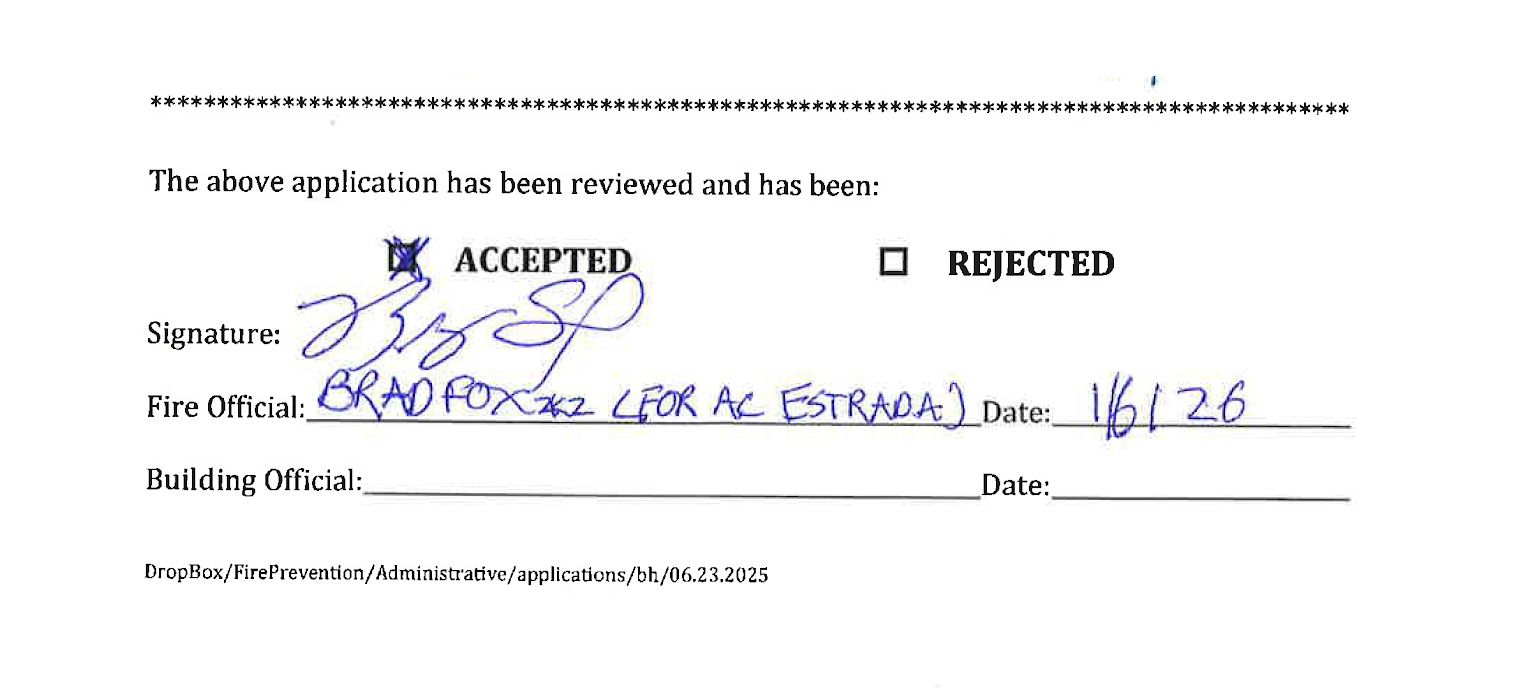
    The AMMR form requires dual review. Under the California Fire Code (CFC 104.10), the Fire Official must find that the proposed alternative is “not less than the equivalent” of the code standard. Under the California Building Code (CBC 104.11), the Building Official has the identical obligation. The SCCFD’s own AMMR form reflects this, with signature lines for both officials.

    The Fire Official — SCCFD — has signed.

    The Building Official line — which corresponds to the City of Cupertino’s building authority — is blank.

    AMMR signature lines
    The Fire Official signed. The Building Official signature line — the City of Cupertino’s building authority — remains blank.

    Without the Building Official’s evaluation and signature, the AMMR has not completed the dual review required by the fire department’s own approval form and by both the California Building Code and the California Fire Code.

    The AMMR Was Not in the Planning Commission Agenda

    The Planning Commission voted 3-2 on February 24, 2026 to recommend the project to City Council.

    The AMMR document — the entire basis for the project’s fire safety compliance claim — was not included in the Planning Commission agenda packet. The commissioners and the public were asked to evaluate the project’s fire safety without access to the fire safety determination itself.

    The document that the City relies on to demonstrate fire safety compliance was not available for public review at the hearing where fire safety was supposed to be evaluated.

    The Mitigations Protect the Developer’s Buildings — Not the Neighborhood

    The AMMR approval identifies several mitigation measures: 1-hour fire-rated exterior walls, sprinkler heads on covered patios, non-combustible landscaping extending 5 feet from structures, and code-compliant wall penetrations.

    Every one of these measures is designed to protect the new townhomes from fire. None of them address the impact on the surrounding neighborhood.

    Radiant heat exposure to existing homes. The neighboring single-family homes were built between 1947 and 1957 — decades before modern Wildland-Urban Interface (WUI) building standards. They have combustible exterior materials, older window assemblies, and minimal ember-resistant features. Fire-hardening the new townhomes does not reduce the radiant heat those neighboring homes would receive from a fully involved structure across a 10-foot gap.

    Combustible fencing at the property line. Wooden fencing along the property boundary is standard in this neighborhood. At 10 feet, a burning fence would create extreme heat flux in the corridor. SCCFD has no authority to regulate fencing on neighboring parcels. The HOA has no authority over it either.

    ADU construction on adjacent parcels. State law allows Accessory Dwelling Units to be built with setbacks as small as 4 feet from the property line. Combined with the project’s 10-foot setback, actual structure-to-structure spacing could shrink to 14 feet — less than half the required 30 feet.

    Absent defensible space zones. The project’s own Defensible Space Fire Zone Plan (Sheet L7.1) shows Zone 2 — the 30-to-100-foot fuel management band — is effectively absent along the north and south boundaries where the setback reduction applies.

    The Fire Safe Regulations define defensible space as protection for the “neighborhood or community” — not just the developer’s buildings. The mitigations do not address this standard.

    The Window Openings Contradiction

    SummerHill’s AMMR narrative claims compliance with CRC R302.1(2), the fire separation distance requirements for residential construction at reduced setbacks.

    The same narrative explicitly states: “we are not proposing modifications to the Openings (Windows) in Walls.”

    R302.1(2) is the standard that governs protected openings at reduced separation distances. You cannot invoke the standard while exempting one of its central requirements. Unprotected glazing can fail early under radiant heat exposure, allowing flame and heat transmission across the reduced 10-foot separation — precisely the scenario the 30-foot standard is designed to prevent.

    The AMMR approval does not address this contradiction. SCCFD accepted it without comment.

    The Ladder Access Problem

    SCCFD’s own Fire Prevention Plan Review (Comment 7) requires ground ladder access at a 75-degree climbing angle for second and third-floor rescue operations.

    The geometry does not work in 10 feet. A 35-foot ladder at 75° requires approximately 9 feet of horizontal clearance. The firefighter at the base needs approximately 2.5 feet of standing room. That is approximately 11.5 feet minimum — before accounting for any fence or wall at the property boundary.

    The setback is 10 feet. The site plan shows bio-retention pads in these areas — not firm, level surfaces suitable for ladder placement.

    A burning wooden fence in the 10-foot corridor would make the space untenable for firefighters, negating any possibility of ground ladder rescue from the building faces that need it most — the longest sides of the perimeter, perpendicular to the wildland-urban interface.

    The CEQA Exemption Depends on This Gap

    The project claims a CEQA exemption under AB 130 (PRC §21080.66). This exemption is available in a VHFHSZ only if the project adopts fire hazard mitigation measures “pursuant to existing building standards.”

    The City’s AB 130 qualification memo points to the AMMR as proof of fire safety compliance.

    But the AMMR is an explicit departure from the existing standard — the 30-foot setback. A departure from a standard cannot simultaneously serve as proof of compliance with it.

    This circularity enabled the project to bypass the environmental review that would have surfaced the evacuation capacity data David Yan’s article calls attention to.

    What Residents Are Asking

    The residents of the Linda Vista neighborhood are not asking to stop housing. The site was part of Cupertino’s Housing Element and they support housing here.

    They are asking a simple question:

    Where is the documented technical analysis demonstrating that the 10-foot setback provides the same practical fire-safety effect as the 30-foot standard — not only for the new development, but for the surrounding neighborhood?

    The SCCFD’s own disclaimer says the review is not an approval of compliance. The City’s Building Official has not signed the form. The AMMR was not in the Planning Commission agenda packet. The mitigations address fire spread to the new buildings but not from them.

    Both entities are pointing at each other. Neither has produced the analysis.

    The City Council votes on March 17, 2026. Before finalizing this project, the Council should be able to identify a single document in the administrative record that answers the question above.

    The firefighters who will respond to Evulich Court deserve that answer. So do the neighbors.

  • Rezoning Church Land & Misinformation about Westport

    Rezoning Church Land & Misinformation about Westport

    In this post we cover two topics:
    1. Valley Church of Cupertino land being included in the Housing Element Site without informing them
    2. Rod Sinks’ campaign misleading residents about retail at Westport
    Valley Church: Designated Housing Element Site Without their Permission
     A resident made us aware of a situation where four parcels of land owned by the Valley Church of Cupertino were put on the Housing Element Priority Site List, without ever consulting the Church! 

    The church had  to write to the city to ensure that their lands, which were being used to provide community resources like tennis courts, were not converted for private profit.

    This is illustrative of the lack of transparency and notifications about the change in zoning proposed in the housing element development process carried out by the Builder’s Controlled council since the November 2022 election. Any open space in Cupertino was at the risk of being rezoned for builders to profit from.

    Residents of Linda Vista drive have expressed similar concerns of the rezoning of Evulich Ct. site from R1 (1-5 units/acre) to R3 (20-35 units/acre), where they did not receive any notifications. In the case of the Valley Church, even the property owner was not notified or consulted about the city’s plan to add their land to the Housing Element

    Rod Sinks’ Campaign: Misinformation About Westport
    Rod Sinks’ campaign sent out text messages and email claiming that the Westport development  (Oaks Redevelopment) only provides homes, but not retail. He is also claiming he can negotiate a better deal. As usual with the politicians aligned with builders, the facts do not justify the claims.

    20,000 sq ft of Retail Space at Westport

    The Westport development has approval for 20,000 sq ft of commercial retail space, 37,601 square feet of common open space and 2,400 square feet of common retail outdoor space. For context, a typical Starbucks store is between 1500-2000 sq. ft. So the Westport development has plans for about a dozen stores of the size of the typical Starbucks.

    Westport has a combination of owner occupied townhomes, senior housing, and assisted care facilities, and the retail spaces will open as different segments are built and occupied.

    And it is important to remember that the original plan for Westport was based around giant towers with more than 800K sq ft of buildout with bulk of it as office space which would have significantly worsened the traffic at the Stevens Creek/Hwy 85/Hwy 280 junction (see picture below)

    The plan being built is traffic neutral with the previous Oaks Plaza, provides valuable senior housing which our aging population needs, and helps address the housing shortage by providing more choices at a price point lower than single family homes..

    Rods Record of Negotiation

    Rod Sinks has a record of  conceding every demand of developers, especially Sandhill Properties, in spite of massive protests by residents impacted by them. Most residents in neighborhoods near Vallco have a deep mistrust of Rod Sinks based on their bitter experiences lasting almost a decade. 

    Any successful negotiation and agreement, requires an element of trust between the parties involved. Rod simply lacks the trust of the residents most impacted by future development at Vallco, and his claims of being able to negotiate are specious at best.

  • Builders Rampage on Nextdoor!

    Builders Rampage on Nextdoor!

    One big part of the disinformation network run by the Builder-Politician complex is to stifle voices which provide an alternative perspective. They achieve that by removing content or banning users who disagree with their narrative on Nextdoor, a social media network for neighbors..

    In the lead-up to the election, the following people have had their content removed or their accounts suspended.

    1. Steven ScharfFormer Mayor of Cupertino
    2. Muni MadhdhipatlaPlanning Commissioner & former Vice Chair
    3. Vikram SaxenaFormer Vice Chair of Planning Commission
    4. Rhoda Fry: 2022 Crest Award Winner for Public Safety
    5. Seema SwamyParks & Recreation Commissioner
    6. San RSafe Route to Schools.

    7. James Murasighe: Nextdoor Lead for Inspiration Heights


    All of the people whose voices were stifled, support resident focused candidates, Ray Wang and Kitty Moore for the City Council, and Long Jiao for CUSD.

    We include some of the posts which were deleted; these posts attempt to reproduce the deleted post since the authors can not access them any more. These posts reflect the authors personal opinions and not as of any city official

    Ray Wang and Kitty Moore: Will take Vallco Forward

    Rod Sinks is highlighting his negotiating skills and saying he will make Vallco happen.

    What he does not realize is that most residents in the neighborhoods around Vallco, do not trust Rod Sinks at all. This is the result of the favors he has granted to Sandhill over the past 12 years. In fact, any agreement with his fingerprints, will automatically be suspect for a large section of the population in Cupertino.

    For those who are truly interested in the redevelopment of Vallco, Ray Wang & Kitty Moore offer a fresh start. They do not bring in the baggage of the past decade which Rod Sinks, Gilbert Wong and Barry Chang bring with them; plus their resident focus approach will help create more trust in the agreement.

    History of Builders’ Bullying in Cupertino

    Builders Cupertino bullying is at a different level: they bully the entire city

    •⁠  ⁠Using the City Manager to pressure Sears to sell to Peter Pau of Sandhill (2014)
    •⁠  ⁠Amend City’s General Plan to add 2M office space since Peter Pau asked for it (2014)
    •⁠  ⁠Removing all height limits at Vallco (2014)
    •⁠  ⁠Putting residents at risk of cancer by not revealing the toxic contamination and Cortese List listing of the Sears site (2016)
    •⁠  ⁠Not putting back height limits at Vallco when SB35 was about to become law (2017)
    •⁠  ⁠Forcing the City Attorney out when he did not agree to SB35 approval (2018)
    •⁠  ⁠Closing three schools in the middle of a 100 year pandemic when CUSD was projecting its highest ever surplus (2021)
    •⁠  ⁠Harassing city councilors and commissioners who were not aligned with their agenda (eg: Grand Jury which was tossed out by the DA) (2023)
    •⁠  ⁠Fighting City’s lobbying registration requirements with a lawsuit, and after losing it amending them to not have builder’s lobbyists to register (2022-2023)
    •⁠  ⁠Trying to upzone 1600 single family R1  lots to R3-condos to enable 5-story buildings towering over our single family homes. (2023)
    •⁠  ⁠Sending each household a hidden tax of $3500 by agreeing to waive $77M in development fees for Vallco

    You can build without destroying what already exists.

    Pro-Residents is NOT Anti Development
    There is a canard spread in Cupertino, that people who want the city council to consider the interests of residents are anti-development. The term anti-development is often used by groups backed by big-real estate to stifle discussion about sustainable development.
     
    A well-functioning city-council will balance the concerns of the residents with the developers’ right to develop their property and earn economic benefit. The developers try to maximize the square footage of what they build, but have little interest in how it impacts the people around their development. 
     
    Until the November 2018 election, the Cupertino City Council was in control of politicians who are quite close to developers. KT Urban, which was driving the redevelopment of the Oaks Plaza, a project called Westport, wanted to build more than 800K sq ft of offices. They tried to get the office allocation but were asked to wait. The City’s politicians were focussed on enabling the Vallco project and had already given almost all the allocation added to the General Plan (2 Million sq ft) to Vallco.
     
    Cupertino does not get mass transit like BART, Caltrain, Muni or Light Rail. Being a transit desert means that any new office space will lead to a direct increase in vehicular traffic which will make our commute time traffic jams even worse. 

    After the resident-focussed City Council took over, KT Urban realized that getting the office allocation was even less likely  than before because there was resident opposition to it. They decided to pivot the project to housing. 
     
    The Westport being built, was negotiated by the pro-resident council. It  consists of townhomes, senior housing, an assisted living facility and retail. It is traffic neutra and provides much needed senior housing in Cupertino, and along with a bike path.

    The transformation of Westport from giant office towers to much  needed housing is a great example of how a resident focussed city council can enable development in Cupertino in a manner which is sustainable
     
    Unlike what the developers want us to believe, pro-residents means sensible development; it does not mean anti-development.

    Giant office towers which would have worsened the traffic situation on the Stevens Creek and Hwy 85 junction

  • Disinformation: Rod Falsely Claiming Credit

    Disinformation: Rod Falsely Claiming Credit

    In this post we cover another form of disinformation used by the builder-politician complex: claiming credit for accomplishments they had little part to play in. We have two write-ups to share from community members on debunking claims made by Rod Sinks in his election website. 

    Rod Sinks Claims Credit for SV Hopper
    Refuted by ex-Mayor Darcy Paul

    “The Silicon Valley Hopper started as Cupertino’s Via Shuttle when our Mayor was Steven Scharf. It’s strange how some people like to label us the so-called ‘Better Cupertino’ City Council, and then take all the credit for things that we did while blaming us for various things that we didn’t do. 

    I was the Mayor when Via Shuttle was being voted on by the City of Santa Clara to expand to their city as well. At the same time, I was the board member for VTA representing the West Valley cities. There are twelve members of the VTA board, and the West Valley seat has five cities. 

    Well, as you would expect, VTA does not automatically support competitors to its services. However, the expansion of Via Shuttle to become the Silicon Valley Hopper did gain that support when I was on the VTA board of directors, and this happened in 2022, when I was Mayor. 

    As to the City of Santa Clara, I reached out both to their Mayor, Lisa Gilmor, as well as to her colleague Councilmember Raj Chahal to help secure their city’s unanimous support. And so, regardless of who else tries to take credit or blame us for this or that, the fact of the matter is that we did significant amounts of work on making this transit option available for the residents of Cupertino.”

    Former Mayor Darcy Paul, 
    City of Cupertino

    Rod Sinks Embellishes His Role in Reducing Pollution from the Lehigh Plant

    We are publishing a detailed rebuttal from Rhoda Fry. In 2022 she was honored by a CREST award for Public Safety for her work to change the time for garbage pickups so as not to interfere with children going to school and for providing the City with an analysis of the quarry use-permits to put an end to illegal truck traffic between the two quarries

    Rhoda Fry moved to Cupertino in 1983 after graduating from CMU to work at Tandem Computers. She became active in City affairs when she discovered that the City was about to enact an emergency illegal tax. She fought and won. Since then, she has been involved in issues related to the environment (especially Lehigh-documents from last century), public safety or fiscal accountability. This year, her efforts contributed to a new County ordinance  that protects ground-water quality from the ravages of mining. She also discovered that the City had misused funds that were intended for below market rate housing. 

    Rod Sinks Misled Public about Lehigh- by Rhoda Fry

    As many people know, I have worked on Lehigh issues for over fifteen years and was alarmed by statements made by Rod Sinks who incorrectly claimed to have reduced air pollution at Lehigh while sitting on the Bay Area Air Quality Management Board (BAAQMD). At the Diya TV candidate forum, he stated “I helped secure a deal with the Lehigh cement plant to drastically improve our air quality.”

    In 2019, a new air-pollution rule was proposed as part of a consent decree involving many states to address a 2010 EPA violation that would be implemented in 2021. In 2019, there were multiple industrial incidents at the cement plant and BAAQMD did little for us residents.  In 2020, Lehigh shut its cement plant down when it became clear that the County would not allow an expansion of its limestone mining operations referred by County Supervisor Joe Simitian as “don’t chop the top.”

    Consequently, the new air-pollution rule was never implemented. It would not have mattered because the new rule did little to protect us residents. Residents wrote letters (Consent Decree Public Comments) begging for a better rule but were not heard. Gary Latshaw, Chair of the Bay Area for Clean Environment Group wrote,

    “We do not find that the consent decree provides adequate protection for the air quality in the region. Notwithstanding the potential of the “test and set” methodology for SOx, the specified required regulations for NOx and SOx are only marginal improvements over existing conditions. Even under optimistic assumptions, the emissions would still degrade the health and longevity of Bay Area residents.”

    For example, while the maximum allowable sulfur pollution was 0.2 lbs/ton at other Lehigh cement plants, the Cupertino facility’s maximum allowable sulfur pollution was ten times more at 2.1 lbs/ton! And the so-called new sulfur limits in Cupertino represented a mere 3% reduction of only 0.07 lbs (from 2.17 lbs/ton to 2.1)!!!

    Rod Sinks claiming any credit for negotiating a deal or reducing air pollution is usurpation of credit due  to local volunteers who tirelessly worked to save our environment from excessive pollution by Lehigh for many decades.

    Lehigh History: 
    At the end of Stevens Creek Blvd, is a massive quarry and industrial site on over 3500 acres that spans three jurisdictions, Cupertino, Unincorporated Santa Clara County, and Palo Alto. The quarry has mined for limestone that is very high in naturally-occurring contaminants, such as mercury and selenium. 

    Until 2011, usable waste-rock was crushed into aggregate and sold. That operation was re-built a decade later and presently is the only commercial activity at the site. The rest of the waste-rock is spread over 200 acres of thinly vegetated moonscape.

    The limestone is the main ingredient to make cement in a giant kiln fueled by petroleum coke, a filthy  polluting fuel that is a by-product of oil refineries. Among California’s industrial air polluters, Lehigh ranked #2 for Sulfur, #3 for Hydrochloric Acid, #4 for PM 2.5, #6 for VOCs, #7 for Nitrogen, and #10 for Hexavalent Chromium.  

    With the revelation that the County would not allow Lehigh to access anymore limestone, the cement plant closed permanently in 2020. There have been hundreds of environmental and labor-safety violations at the site from both the mining operations and quarrying, some of which remain unresolved.
     
    Political Connections:

    Over the years, Lehigh has been protected by the San Jose and Cupertino Chambers of Commerce and numerous politicians. Among others, the following politicians have been employed by the quarry and cement plant: County Supervisor Tom Legan; Cupertino Council member, BAAQMD representative and aspiring County Supervisor Barbara Koppel; Cupertino council member Sandy James; and Assemblymember Jim Cuneen. 

    Many council members would not respond to resident concerns and were reluctant to even send a letter to the County. Gilbert Wong was one of those reluctant council members. Barry Chang became a Lehigh activist but lost credibility when he became overly vocal and has not been active on Lehigh issues since 2018. Strangely, current council member J. R. Fruen ran a PAC in 2018 with primary funding from Vallco which paid $10K to Ed McGovern, a Lehigh Lobbyist.
     
    Lehigh Future: 

    Moving forward, Lehigh needs to shore up the over-mined crumbling ridgeline between the quarry and Rancho San Antonio by filling the quarry. The approved 2012 plan uses onsite mining-waste to shore up our scenic ridgeline however their new proposal turns the quarry into a for-profit landfill, importing soil from construction sites at a rate of 600 trucks per day for 30 years. We need a City Council who really works for residents first to prevent this unnecessary traffic. We need to regain a resident-friendly council majority by re-electing Kitty Moore and electing Ray Wang.
     
    EPA Clean Air Act Settlement

    Consent Decree FAQ
    Consent Decree Public Comments

    Consent Decree Official Document

  • Builders Target Ray, More Questionable Behavior from Rod

    Builders Target Ray, More Questionable Behavior from Rod

    In this letter we highlight some recent events

    1. A video explaining what led to builders targeting Ray Wang
    2. A followup on the Rod Sinks-Andi Jordan Harassment Case

    A video response to malicious attack on Ray Wang

    We made a video highlighting why Ray Wang is being attacked. Please watch it below
    More Instances of Questionable Behavior by Rod Sinks
    n an earlier article we had covered how a local publication Cupertino Matters, grossly misrepresented facts to hide Rod Sinks central in Andi Jordan harassment settlement. Rod denied Andi health insurance because her husband had it which is illegal discrimination based on gender and marital status; Cupertino Matters did not even mention Rod Sinks name even once in two articles.

    A reader pointed out this in not new.


    Rod Sinks Hated him (Randy)  because he is Chinese
     
    In 2018, the builder’s proxies running Cupertino City Council decided to fire the City Attorney Randy Hom because “he voiced his opposition to the city’s illegal and unethical conduct”. In his tort claim against the City Randy Hom stated that Barry Chang told him that:


     “Rod Sinks hated him because he is Chinese. Mr. Sinks hates the Chinese and never wanted him in the City Attorney position in the first place”–  Barry Chang


    The city settled Randy Hom’s tort claim after spending more than $400K.
  • Rod Sinks’ Misogyny & “Cupertino Matters” Cover Up

    Rod Sinks’ Misogyny & “Cupertino Matters” Cover Up

    In this post, we want to cover yet another instance of disinformation carried out by Jean Bedord’s Cupertino Matters, this time to cover-up Rod Sinks’ misogyny.

    In 2022, Andi Jordan, Executive Director of the Cities Association of Santa Clara County, threatened to sue  the Association because of discrimination & harassment. One of the core pillars of her complaint was illegal discrimination based on gender and marital status, both protected categories, in the 2019 refusal of health insurance benefits by the executive committee.

    A married woman "did not need benefits because her husband had them" - Rod Sinks

    Andi further claimed, that even after her husband lost his job in December 2020, the Association refused to offer her health insurance!

    However, the coverage of this issue, by Jean Bedord’s local publication Cupertino Matters, raises serious questions about journalistic integrity and the deliberate misrepresentation of facts.

    Rod Sinks becomes Invisible

    Cupertino Matters covered the topic in two articles: the April 5, 2022 issue and the July 26, 2022 issue. Neither of the two articles made any reference to Rod Sinks or his illegal sexist and misogynist behavior. Instead, their reporting places an undue emphasis on the involvement of Councilmember Liang Chao, who joined the Association much later, after Rod Sinks termed out in Q4 2020.

    Further the articles blame Liang Chao for the city’s share of $8030 in the settlement involving 15 cities. This skewed focus not only misrepresents the core issues at stake but also misleads readers about the true nature and timeline of the controversy.

    Liang Chao’s Actual Involvement

    The facts paint a very different picture of Liang Chao’s role. Chao joined the Cities Association after Rod Sinks had termed out, well after the discriminatory events of 2019. Her participation was limited to attending quarterly board meetings; she had no role in determining Andi Jordan’s compensation, and was not part of the executive committee.
    During one of the board meetings in August 2021, Liang Chao asked for some details about the case, which could have been misconstrued as an illegal request since harassment cases are protected.

    Regarding the August 2021 board meeting incident, Chao provided the following statement:

    “That was at an open board meeting, when I had no idea Andi Jordan was even under investigation. It was all confidential, including who filed the harassment complaint. I thought it was a consultant’s attorney that filed a complaint.
    So, as I remember, I asked about something and they said it cannot be discussed but I had no idea why.
    I would have to have the prior knowledge that Andi had filed a harassment complaint in order to know it was unlawful to discuss. But since I had no knowledge about the complaint, I had no idea that it could be unlawful”

    Media Responsibility and Bias

    The stark contrast between Cupertino Matters’ extensive focus on Chao’s minor, unintentional action in 2021 and its complete silence on Sinks’ central role in the 2019 discrimination case is deeply troubling. This imbalance, maintained across two separate articles, raises serious questions about the publication’s motives and journalistic integrity.

    Exposing the Misdirection

    Cupertino Matters’ coverage completely ignores Rod Sinks’ sexism and misogyny while unfairly implicating Liang Chao. This misdirection is especially egregious considering that Chao had no involvement in Andi Jordan’s compensation decisions and was not even part of the Association when the discriminatory events took place.
    The publication’s failure to address the core issue of gender-based discrimination in health-benefits that occurred in 2019 is a serious dereliction of journalistic duty. Instead, it has chosen to focus on a peripheral issue from 2021, misleading the public about the true nature, timeline, and seriousness of the situation. And of course Rod Sinks name is not brought up even once even though the denial of health insurance because Andi was married was a clear violation of the law, and the foundation for Andi’s complaint.

    Cupertino Seniors’: Victims of Disinformation

    Many of the recipients of Jean’s newsletter are retired long-time Cupertino residents, who are committed to doing the right thing for our community. Their understanding of local issues is shaped by Jean’s regular updates. However, in an effort to serve the interests of builders, Jean deliberately misleads them.
    In this case, she placed the blame for the $8,030 fine the city incurred on Liang Chao, despite the fact that the root cause of the entire situation was Rod Sinks’ refusal to provide medical insurance to a married woman. It’s particularly disheartening that Jean, as a woman, understands the struggle for fair treatment in the workplace but still chooses to cover for Rod Sinks while scapegoating another woman, Liang Chao.

  • Ex-Mayors Make False Accusations Against Ray Wang

    Ex-Mayors Make False Accusations Against Ray Wang

    Earlier this weekend, the coterie of ex-mayors resurfaced and sent an email stealing the IP of a fellow resident. They followed that by email messages spreading disinformation about Ray Wang. Please spend a few minutes to understand the facts..
    Bloomberg, CNBC, FoxBusiness, and many other leading media orgs have Ray Wang as a guest a few times a week. All of them do background checks to not bring people with dubious history on their panels.
    Redwood City Council Person Endorses Ray’s Commitment to Residents
    The video below is from a two times Redwood City Council Women Colleen Hallinan, acknowledging how Ray worked so hard to defend residents from harm due to greedy builders and resisted harassment from builders, about 20 years ago.
    Disinformation Attacks: History & Motivations

    After JR Fruen led builders-YIMBY took over the City Council they decided to take control of the Planning Commission. As part of the process to remove Ray Wang from the planning commission, they orchestrated a disinformation campaign about an incident in Redwood City/Shores two decades ago.

    They are rehashing some of the articles they published in local outlets to denigrate Ray. Please do not fall for the disinformation. These attacks are malacious and without substance, and are being distributed because the builders are afraid Ray will resist their efforts to make Billions in profits on the back of our quality of life.

    What happened in Redwood City Two Decades Ago?

    In 2003, Ray challenged Redwood City’s decision to grant permission to a builder to use recycled, non-potable water in areas accessible to children, who may not realize that it’s not fit for drinking. Not being able to dump that non-potable water would have increased the costs and reduced profits for builders.

    One local politician, Rosanne Foust, was leveraged by the builders to sue Ray Wang. Foust has a close relationship with developers and was fined $3000 by the FPPC in 2014 for the misuse of her position as the Vice-Mayor to champion another big project.

    Ray, whose wife was pregnant with their first child at that time, decided to settle instead of going through a jury trial. He pleaded no-contest to charges of leaving an annoying message for Foust on her phone. 

    Related charges accusing him of sexual harassment were summarily dismissed. Ray has stated that he had an open wifi network (these were early days of wireless internet) and a builder’s agent may have connected to it to sign-up Foust’s email for web-sites which may deliver adult content, in order to frame him.

    Please Defend Your Rights from Builders
    After Ray was removed from the Planning Commission, the builders took control and stopped having meetings,  Out of the regularly scheduled 24 meetings, only six were held in 2023. 

    This limited transparency and opportunity for public input, while the city’s Housing Element was being redone to favor builders. That allowed the builders to hide their shenanigans like the proposal to upzone all corner lots in single family homes to R3 to allow construction  of five story condos in single family neighborhoods. Strategy HE-1.3.6 of the 2nd HE draft