Category: Housing & Development

  • 2023-2031 Cupertino Housing Element Update

    2023-2031 Cupertino Housing Element Update

    On July 25, 2023, the Cupertino City Council received an update on the 6th Cycle Housing Element, 2023-2031. The Housing Element (HE) is one of 8 required elements of every California city or town’s General Plan. Whereas, the General Plan is a kind of long-term roadmap for all kinds of development in a jurisdiction, the Housing Element is  the roadmap strictly for housing development, and it is revised and updated multiple times within a single General Plan cycle.

    Possible Revisions to the Submitted Housing Element that Might Incline HCD to Approve It
    The California Department of Housing and Community Development (HCD) reviews the HE for compliance with current State laws and conducts its own analysis as to whether each jurisdiction has identified sufficient suitable new housing locations. As Cupertino learned from HCD’s comments to the HE Cupertino submitted in February 2023, certain revisions to the draft HE submission may increase the likelihood that HCD would view the HE favorably and grant approval. Hints included:
    • Rely less on pipeline (approved but not constructed) projects to satisfy to RHNA obligations
    • Choose sites that allow for maximum housing density due to the passage of recent State laws, for example 2022 AB 2011 “Affordable Housing and High Road Jobs Act of 2022” and recent revisions affecting 2006 AB 32/2008 SB 375 (both focused on reducing greenhouse gas emissions)
    • Lean into redevelopment of developed sites that are between 0.5 and 10 acres
    According to Cupertino Assistant Director of Community Development Luke Connolly, most of Cupertino is recognized by the State as an area of “Highest Resource with Access to Opportunity” because of its proximity to high paying jobs and high performing public schools. As a high opportunity community, the State assigns the City a greater share of the region’s housing development obligation than communities perceived to offer less economic and educational opportunity.

    For the 2023-2031 HE Cycle, Cupertino is required to identify 4,588 potential housing locations to accommodate its Regional Housing Need Allocation (RHNA) assignment. Additionally, 2017 SB 166 “No Net Loss” law mandates that jurisdictions must maintain adequate site inventory to accommodate their remaining unmet RHNA by each income category (very low, low, moderate, market rate) at all times. HCD recommends that each city allocate a “RHNA buffer” of an additional 25-30% of the total RHNA obligation, especially for homes for people with low or moderate incomes to ensure that the City would not be required to update its site inventory before the next HE cycle commences. 
    Cupertino, then, is expected to identify sites for the construction of 5,735 – 5,964 new homes (4,588 RHNA + 25-30% buffer). This equates to approximately 30% of its entire existing housing inventory, to be identified by 2024 and constructed within 8 years. 

    To note, the World Population Review reports Cupertino has a 2023 population of 55,326, a decline rate of -2.85% annually and -8.31% since the most recent census (60,343 in 2020). 

    Challenges with Cupertino’s Housing Requirements
    Like most high opportunity communities in the region, Cupertino is challenged to identify so many housing sites where most lots are already developed. What sites are vacant/available, close to transit (within 0.5 mile of a bus stop), and sized between 0.5 and 10 acres?

    HCD’s comments from the 7/25/2023 Council meeting point to opening up all eligible retail and commercial locations as sites for future housing. Cupertino’s current and dwindling retail and commercial corridors will most likely become candidate sites: Homestead Rd, Stevens Creek Blvd, De Anza Blvd, and to a lesser extent Foothill Blvd, Bubb Rd, Stelling Rd, and Bollinger Rd.


    Current retail & commercial along Stevens Creek Boulevard in Cupertino


    Cupertino must add 2,635 homes for individuals and families with very low, low, and moderate incomes. However, while the political pressure shifts to cities to approve more housing development, the State and federal government have removed themselves as providers and administrators for most affordable housing. Is it reasonable to expect that the private sector will build and maintain affordable housing, which is not lucrative, when current density bonus laws require developers set aside no more than 10-20% of new multi-family dwellings for people with incomes <50-120% of the area median?

    Under current development provisions, would Cupertino need to approve between 13,175 – 26,350 new homes to assure the construction of the 2,635 below market rate homes necessary for the community and to satisfy HCD’s requirements? What if a private property owner were to accept a housing entitlement, but then decide not to build? How does Cupertino satisfy its RHNA requirements when owners of entitled properties decide not to build, or decide to build later?

    There is Another Way

    Cities are often frustrated when they rely on the private sector and non-profit organizations to build and maintain a public good. Some cities are turning to land banks and community land trusts to meet the RHNA requirements to build the homes that people need today.

    The National Housing Policy Guide describes land banks and community land trusts:

    Land Banks
    “Land banks are created by local jurisdictions – usually as a public entity but occasionally as an independent nonprofit –to hold abandoned, vacant, and tax-delinquent properties for future development. Not only does this provide local jurisdictions with land for future development, it also reduces the number of “problem properties” in a community by creating a process for management and disposition. Land banks are a powerful tool for jurisdictions faced with problems from both the hot and cold ends of the housing market spectrum. In hot markets, land banks allow jurisdictions to make development decisions with less concern about the cost of land because they already have a portfolio of parcels ready for development. In cold markets, land banks reduce blight by acquiring abandoned and/or delinquent properties, clearing title, and then putting the properties back into productive use….”

    Community Land Trusts
    “Community land trusts (CLTs) are organizations that own land and develop it through an inclusive, community-based process. CLTs develop land according to the community’s needs, which can include anything from open space to a multifamily rental project. Most often, however, CLTs are created to provide affordable homeownership opportunities to low- and moderate-income households. The United States has around 200 community land trusts, and the model has become popular in the UK, as well.

    The CLT model is structured around a ground lease. The CLT owns land which is leased to households who purchase the homes that sit on CLT land. Removing the cost of land from the cost of purchasing the home provides a significant subsidy to the households. The ground lease limits the price at which the home can be resold, passing the subsidy on from one homeowner to the next. CLTs also often retain the right to repurchase the home in the case of foreclosure. CLTs are one form of shared equity homeownership.”

    Should Cupertino wait on for-profit developers, property owners, and investors to decide what and when to build, when the community needs safe, sustainable, and affordable housing today? Why not support local funding for the development of a Cupertino land bank for the specific purpose of public investment and retention of residential land for the sole purpose of providing long-term affordable for rent and for sale homes for people who need them?

    What’s Next
    Next steps for Cupertino’s HE include the publication of a revised Draft HE and public outreach for possible zoning changes. Sign-up to receive Housing Element updates from the City of Cupertino here: https://www.cupertino.org/our-city/departments/community-development/housing/housing-element


    Note*: The 5 Santa Clara County cities with higher RHNA numbers than Cupertino also report declining populations since 2020:

    Milpitas, 2023-2031 RHNA 6,713 new homes, has a 2023 population of 76,535, a decline rate of -1.61% annually and -4.76% since the most recent census (80,363 in 2020).

    Mountain View, 2023-2031 RHNA 11,135 new homes, has a 2023 population of 79,670, a decline rate of -1.14% annually and -3.38% since the most recent census (82,455 in 2020).

    Palo Alto, 2023-2031 RHNA 6,086 new homes, has a 2023 population of 63,210, a decline rate of -2.64% annually and -7.7% since the most recent census (68,486 in 2020).

    San Jose, 2023-2031 RHNA 62,200 new homes, has a 2023 population of 930,862, a decline rate of -2.71% annually and -7.92% since the most recent census (1,010,908 in 2020).

    Sunnyvale, 2023-2031 RHNA 11,966 new homes, has a 2023 population of 145,302, a decline rate of -2.31% annually and -6.77% since the most recent census (155,860 in 2020).


    References
    City of Cupertino. Video Recording of the 7/25/2023 Special Meeting of Council, Agenda Item 1: Study Session and Staff Presentation on the 6th Cycle Housing Element Update: https://cupertino.granicus.com/MediaPlayer.php?view_id=18&clip_id=3271. Accessed August 25, 2023.

    City of Cupertino. Slides, Staff Presentation on the 6th Cycle Housing Element Update, 7/25/2023: https://cupertino.legistar.com/gateway.aspx?M=F&ID=ca20968a-4c57-4836-8958-19d88309d090.pdfAccessed August 25, 2023.

    City of Cupertino. Cupertino General Plan: Community Vision 2015-2040: https://www.cupertino.org/our-city/departments/community-development/planning/general-planAccessed August 25, 2023.

    World Population Review, Cupertino, CA: https://worldpopulationreview.com/us-cities/cupertino-ca-populationAccessed August 25, 2023.

    California Legislative Information. 2017 SB 166, “Residential density and affordability”: https://leginfo.legislature.ca.gov/faces/billNavClient.xhtml?bill_id=201720180SB166Accessed August 25, 2023.

    California Legislative Information. 2022 AB 2011, “Affordable Housing and High Road Jobs Act of 2022”: https://leginfo.legislature.ca.gov/faces/billNavClient.xhtml?bill_id=202120220AB2011Accessed August 25, 2023.

    Institute for Local Government. 2022 AB 32/SB 375, “Understanding AB 32 and SB 375: A Legal Analysis for Local Government Officials”: https://www.ca-ilg.org/sites/main/files/file-attachments/resources__Sept_8_AB32-SB375_Webinar_Slides.pdf?1442270849Accessed August 25, 2023.

    California Legislative Information. 2006 AB 32, Amended 2022, “Energy: general plan: building decarbonization requirements”: https://leginfo.legislature.ca.gov/faces/billTextClient.xhtml?bill_id=202120220SB32Accessed August 25, 2023.

    California Legislative Information. 2008 SB 375, “Transportation planning: travel demand models: sustainable communities strategy: environmental review”: https://leginfo.legislature.ca.gov/faces/billTextClient.xhtml?bill_id=200720080SB375Accessed August 25, 2023.

    United States Census. “Urban vs Rural”: https://www.census.gov/programs-surveys/geography/guidance/geo-areas/urban-rural.htmlAccessed August 25, 2023.

    National Housing Conference. Land Banks and Community Land Trusts: https://nhc.org/policy-guide/land-based-solutions/land-banks-and-community-land-trusts/Accessed August 25, 2023.
  • Simple Explanation of RHNA and Housing Mandates

    By Amy Kalish
    Marin Post & Citizen Marin

    https://marinpost.org/blog/2023/6/10/rhna-and-housing-mandates-made-easy

    WHAT IS RHNA?

    RHNA is the Regional Housing Needs Assessment — the number of housing units (a place for at least one person to live) assigned to an area by the state. This happens in eight-year housing cycles, and the allocation numbers are determined by the California Department of Housing and Community Development (HCD).

    WHERE DOES IT COME FROM?

    The total number is supposed to represent California’s current and projected housing needs over the next eight years. This is the 6th RHNA cycle, covering 2023-2031. The HCD says California is short 2.5 million housing units. (Walked back from Governor Newsom’s unsubstantiated campaign assertion of 3.5 million). The numbers have been questioned. 

    Note from Cupertino Facts: In the 6th Cycle Housing Element update (2023-2031), Cupertino must plan for 4,588 new housing units.

    DID RHNA FAIL AN AUDIT?

    Yes. The 2.5-million-unit requirement was not in line with projected population growth even before the pandemic. An emergency state audit was requested. The result of the audit: The California State Auditor found that the numbers were not reliable or reproducible, and the methodology was opaque. All documentation is available at citizenmarin.org on the AUDIT page. The audit result was ignored by HCD, and the 2.5 million wasn’t adjusted. It was chunked out into regions. Ours — the Bay Area — was assigned 441,000 new units to be distributed over each city and the unincorporated area.

    IS THIS HOUSING CYCLE DIFFERENT?

    Yes. The 6th cycle is NOT like other cycles. The numbers are huge. For example, Marin County’s total RHNA went from 2,298 (5th Cycle) to 14,405 (6th Cycle). 

    DID CITIES APPEAL?

    Yes. Cities were shocked by the huge rise in their RHNA, and many across the state appealed based on “changed conditions” including drought, fire, lack of evacuation access, flood zones and other hazards, infrastructure issues, lack of buildable land, environmental concerns, etc. All appeals were denied without comment. 

    WHAT IS A HOUSING ELEMENT?

    Each locality, by law, must create a Housing Element plan and document showing where the RHNA units can be accommodated and submit it to the state for approval. In the past, these reports were not too difficult to create and were done by in-house staff. This cycle, the numbers were so overwhelming, and the Housing Element added so many new required reports, that cities had to hire consultants to write them. This has been taking time and energy away from our city governments for a couple of years now.

    WHO BUILDS THE HOUSING?

    Except for a few affordable projects that are built on donated city/county land with a small amount of grant money made available, the state expects private, for-profit developers to build the housing. Market-rate (luxury) housing has greater profit margins, so developers’ interests are focused there, and not on affordable housing. They add the fewest number of below market rate units as possible to each project. This creates an explosion in expensive units, not the affordable housing that is actually needed.

    WHY SO MANY NEW HOUSING LAWS?

    The state declared a housing crisis in 2018. Cities were blamed for lack of affordable housing and for not producing enough housing, even though cities do not build. The state ended its redevelopment agency programs in 2012. So, the legislature passed new laws to speed up approvals for multi-family developments by forcing local authorities to rezone for greater density, and approve projects swiftly, often without public input or environmental review.

    The three things that are literally demonized by the state as holding up construction are zoning, CEQA, and public input. (Those are also called city planning, the environment, and local voice/democracy.) Some of these have sometimes slowed the process, but more often produce community/developer/city compromise.

    ARE THERE PENALTIES FOR CITIES?

    New laws speed up approvals for multi-family developments by forcing local authorities to rezone for density, and approve projects swiftly, without CEQA or public input. Attorney General Bonta’s office has a special housing Strike Force to strictly enforce new laws and policies. Besides fines, most punishments are designed to give developers more power, and cities less. Fines can bankrupt cities, put them into receivership, and require cities to cede all zoning control to the state.

    The state can then decide which public lands will be donated or sold for housing projects. Private lawsuits have been brought against cities “not complying fast enough.” the Housing Accountability Act, Builder’s Remedy, and by-right development are all looming punishments based on annual HCD reviews.

    DOES THIS CREATE LOW INCOME HOUSING?

    The laws are sold that way, but what they mostly do is create luxury and market-rate housing along with a very few less expensive units for low-income households. Since developers typically lose money on the low-income units, many of these new laws offer density bonuses and other incentives to developers to add 10-20% of “affordable” units in their projects. This is supposed to “trickle down” and result in lower rents and housing costs.

    DOESN’T THAT JUST RESULT IN MORE EXPENSIVE HOMES?

    Yes. RHNA is broken into categories, each of which needs to be fulfilled exactly, or the locality is declared out of compliance and is subject to streamlining and ministerially approved projects, which further restricts any ability to regulate development.

    IS THE CITY DONE WHEN THE RHNA NUMBER IS BUILT?

    No. In a better system it might be, but RHNA is divided into four major income categories, and each must be met exactly. The laws make it advantageous to developers to add the minimum (10-20%) affordable units, no matter how large the project is. Making RHNA requires many more units.

    DOES THE CITY GET CREDIT ONCE THEY APPROVE THE UNITS?

    No. The state doesn’t measure success by entitlement (approval) of projects, but by the numbers of permits pulled and housing units completed. Once they’ve entitled a project, the city has done its job and rest is out of their control. They cannot compel development. Cities do not build, developers build, but the penalties to cities are based on developer performance.

    There are many reasons approved projects never begin — or start and stall: High costs and scarcity of labor and supplies, high interest rates, and inability to get fire insurance are among them. The state has not let these or any other factors reduce or excuse the RHNA. California’s largest property insurers have halted new home policies due to wildfire risk, rising costs. There has been no acknowledgement that this will affect RHNA.

    IN SUMMARY:

    The state has shifted power away from local governments and given it to for-profit developers who are incentivized to prioritize multi-family developments that are 80-90% market rate, regardless of the effects on communities. Because state laws encourage a low percentage of affordable units per project, not in line with RHNA percentages, much more market-rate housing is built than moderate, low, or extra-low units.

    Working from an incorrect assumption about need and growth creates problems. There are shortages of “affordable” housing throughout the state, but there is no crisis regarding luxury homes, and until the state decouples housing mandates from private, for-profit development, we’re going to see a surge in production in the wrong direction.

    Note: This is an excerpt from the full article published to Marin Post. Please visit their site for additional resources and information regarding RHNA.


  • Cupertino: It is a Lot More Than Vallco!


    This is going to be our last email before the elections.

    1. The Vallco Obsession

    2. Opt-In Email List


    The Vallco Obsession


    The coterie of ex-mayors sent out another email showing the Vallco lot. We wanted to set the record straight.


    Vallco SB35 Plan: Stuck due to Toxic Contamination


    The SB35 plan approved by the previous city council (Rod Sinks, Barry Chang and Savita Vaidhyanathan) after firing the City Attorney is still valid


    However, the Vallco site is contaminated, and the County of Santa Clara Department of Environment Health (SCC-DEH) is supervising the cleanup. The City of Cupertino or the City Council is not involved. The city will issue the permits after SCC-DEH gives clearance.


    The developer knew of the contamination as far as 2016, but neither they, nor the previous City Councils listened to the residents who expressed concern about the potential impact on the workers who are working on the  contaminated site, and nearby residents, without adequate mitigation efforts.


    No Height Limits: The Empire State Building


    We also wanted to reiterate that the previous councils removed height limits at Vallco in 2014 and refused to put them back in 2017 when Steven Scharf and Darcy Paul requested them, due to the upcoming  SB35 legislation. In principle, the developer could have built something as high as the Empire State Building at that development since there were no restrictions in place. 

    The resident focused city council, in place after the 2018 election, put reasonable limitson the development for any future plans which come up.


    Cupertino Top Issues:


    We feel that the top issues facing Cupertino are the CUSD school closures and the potential of 14 units being permitted on a single lot in our single family neighborhoods under SB10.


    While we would all like to see Vallco developed, it is up to the developer to clean up the site, and start construction on the SB35 plan or discuss an alternative with the City if they prefer.

    VOTE WISELY


    To save our schools and preserve home values, please VOTE for Govind Tatachari, Liang Chao, and Steven Scharf for Cupertino City Council, and Darcy Paul, Satheesh Madhathil & Jerry Liu for CUSD Board. They have taken a public stand to keep school closure off the table and roll back past mistakes. These city council candidates are opposed to SB10 becoming a law in Cupertino.  They are not funded by external special-interests and will keep the interests of residents foremost.


    Please do NOT vote for JR Fruen, Sheila Mohan for Cupertino City Council, and Ava Chiao (CUSD).  They have been supportive of school closure and giving the land to developers, and have strong endorsements from the three CUSD trustees who closed the schools.  They have also received extensive funding from construction interests, who covet the land our schools stand on, and have not signed the City of Cupertino voluntary spending limit on election expenses.

    .

    Sign up for our Email List


    With the election season coming to an end, we are going to move to an opt-in subscription list. Our goal would be to send quarterly or as needed (without exceeding once a month) updates on issues of importance to our fellow residents, and also dispel any new FUD (Fear, Uncertainty, Doubt) being shared by vested interests.


    You can also contribute to help us inform our residents. The financial declaration about us is available here


    We end with a video showing how the previous council gave the Vallco owner a carte-blanche to build as high as they want at Vallco; a reminder of what can happen if the investors backed candidates take control again.

  • Balanced vs Unbalanced Development: Contrasting Visions


    Article was updated in September 2024 to add more pictures of the original proposal for Westport which was negotiated down by the resident oriented council to have one third square footage of the original proposals. Many of the concerns expressed in the article have unfortunately come true after JR Fruen's election in 2022. The city is dealing with many plans for large multi-story condo/townhome complexes in the middle of single family neighborhoods.

    This email is about two different visions about new development in Cupertino


    The balanced approach which considers the impact on the residents, the city infrastructure especially traffic & schools, and the viability of the project.

    – The unbalanced approach which focuses on maximizing investors’ profits without regards to impact on the quality of life of residents.


    What Balanced Development Looks Like

    Westport is the name of the redevelopment of the Oaks Plaza on the corner of Hwy 85 and Stevens Creek Blvd opposite De Anza College. The project had been in the pipeline since 2016, and the original proposal was to build a mixed-use gateway with office, hotels and some homes or a large mixed use residential.


    The two drawing below are visualizations of the two proposals which were under consideration.


    The resident oriented city-council elected in November in 2018, collaborated with the developer to redo the project to a combination of market rate homes, senior care, affordable homes and retail. You can see renderings of the project on the developer, KT Urban’s website.


    The density of the approved project is less than one third of the original proposal, and it is traffic neutral. 


    Another mixed-use redevelopment project is Canyon Crossing on the corner of McClellan Rd and Foothill Blvd which is a mixture of housing and much needed retail.  The developments approved by the resident oriented council elected in 2018, balance various competing goals and many are in the process of being constructed..You can read more about the new developments approved by the city here

    What Unbalanced Development Looks like


    The contrast with the coterie of ex-mayors approach could not be more stark. Lets consider the the Vallco project which they often refer to while denigrating the resident oriented city-council the voters chose.

    What the coterie of ex-mayors fails to mention is that the Vallco SB35 plan was approved when the coterie (or their proteges) were a majority in the city-council (2018) over the objections of the City Attorney whom they fired.


    Or how they scuttled efforts by councilmen Paul & Scharf to add some height limits (November 2017) right before SB35 became law. 

    Or how they amended the City General Plan to add 2M sq. ft of office space, right after SHP bought the mall, while removing height limit (2014) in spite of overwhelming resident opposition.

    The Vallco project needs site-cleanup to remove toxic waste and contaminants which is being supervised by the County of Santa Clara. The builder sponsored council (Rod Sinks, Barry Chang, Savita Vaidyanathan) ignored residents’ pleas on this topic even though the developer was aware of the contamination as early as 2016, two years before the approval of the plans (2018)


    Hopefully, you now have a better idea of what balanced vs unbalanced development looks like.


    Unbalanced Development: 14 unit buildings on Single Family Lots (SB10)


    A new state law, authored by Sen. Scott Wiener (real-estate industry favorite), SB10 gives local city councils the authority to permit the building of 14 housing units (10 + 2ADU/2JADU) on a single family lot, as long as the home is in a transit priority area, 


    A transit priority area is defined as the region within one-half mile of a major transit stop that is existing or planned. In the map below, the blue circles represent the current areas in Cupertino which would become eligible for 14 unit buildings on single family lots under SB10. In the future, more areas can be included due to a change in the route of the existing VTA bus-lines or a new route being added (even if it is just planned). 

    For example, Rainbow/De Anza, Stelling/McClellan, Stelling/De Anza or Foothill/Stevens Creek can be the centers of new half a mile circular zones (red circles) which will then permit 14 unit homes on single family lots if an eligible service is planned connecting De Anza College to Los Gatos via 85/Prospect or De Anza College to Foothill College via Foothill Expressway/280.


    The silver lining is that local city councils can decide whether to allow such construction under SB10. Unlike other state laws like SB35 or SB9 (lot-split) the law is not mandatory for cities.
    JR Fruen: Endorsed by SB10 Author, Sen. Scott Wiener


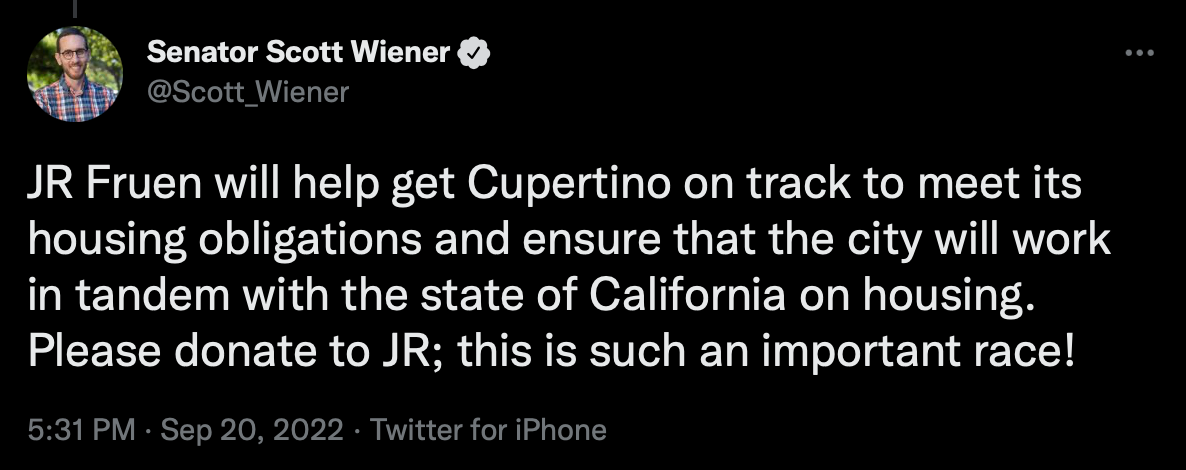
    One of the candidates for Cupertino City Council, who has the strong financial and endorsement support of the coterie of ex-mayors, endorsements by the three CUSD trustees who shut down CUSD schools, and a long association with construction related interests is JR Fruen. JR has been endorsed by Sen. Scott Wiener, the author of SB10, on his twitter feed.


    For residents who are interested in preserving the character of their single family homes, a vote for JR Fruen would be a step in the wrong direction, increasing the chances of SB10 approval.


    Vote SmartTo preserve home values and our suburban life, please VOTE for Govind Tatachari, Liang Chao, and Steven Scharf for Cupertino City Council, and Darcy Paul, Satheesh Madhathil & Jerry Liu for CUSD Board. They have taken a public stand to keep school closure off the table and roll back the past decisions. They are not funded by special-interests and will keep the interests of residents foremost, supporting balanced growth.


    Please do NOT vote for JR Fruen, Sheila Mohan for Cupertino City Council, and Ava Chiao (CUSD).  They have been supportive of school closure and giving the land to developers, and have strong endorsements from the three CUSD trustees who closed the schools.  They also receive extensive funding from construction interests, who covet the land our schools stand on. 


  • Whose Interests does JR Fruen Represent?

     JR Fruen is running again as a candidate for Cupertino City Council. The questions for voters to ask is:

    Whose Interests does JR Fruen Represent?

    This election is primarily a battle between

    • Those who want to preserve their neighborhood, and vote out those who support school closures
    • Those who want to serve investor’s interests which include closing schools to free up land for construction.

    Who Funds JR’s Campaign?

    JR has had close ties with the investor community. In 2018 he ran a PAC which received tens of thousands of dollars from investors and construction related entities:
    • Vallco owners $29,000.00
    • Plumbers / Steamfitters Union $10,250.00
    • Electrical Union $10,250.00
    • Sheetmetal Union $10,000.00
    • Sprinklers Union $10,700.00
    His 2022 campaign contributors include:
    Construction Related Entities:
    CREPAC (California Real Estate PAC) $2500
    IFTPE 21 (Worker’s Union PAC) $2000
    Plumbers Steamfitters & Refrigeration Fitters (Worker’s Union PAC) $1000
    Real Estate Broker (Milpitas) $1000
    People who advocated for School Closures:

    Richard Lowenthal who sponsors and nurtures a lot of the anti-resident candidates  ($4900)

    Hung Wei the Cupertino Council Member who opposed the City Council writing to CUSD to reconsider school closure ($4900)
    Rod Sinks who made a U-Turn to not put height limits on Vallco ($1000)
    Lorien Cunningham the CUSD Trustee who spearheaded the campaign to close schools
    Sheila Mohan who is standing for the Cupertino City Council because others asked her to un

    Ava Chiao the CUSD candidate who wants to shut down more schools and construct over the land

    Who is Endorsing JR’s Campaign?

    JR is endorsed by all the three CUSD trustees who voted to close CUSD schools in spite of strong opposition by the residents.

    SB10: Scott Wiener endorses JR!

    Senator Scott Wiener who authored SB10 which gives cities the choice to allow up to 14 units on a single family lot, has endorsed JR Fruen. JR is much more likely to to support SB10 than resident oriented candidates. Learn more about SB10 here.

    What is JR’s Past Record?

    As part of the Citizens’s Advisory Committee he was supportive of closing schools (and hence endorsed by all the three CUSD trustees who led the campaign to close schools)
    He runs an organization called Cupertino For All, which endorsed Prop-16, the proposition which was soundly defeated by the voters of California, and would have led to more discriminatory practices against Asian students.

    Please do not vote for JR Fruen if you do not want more schools to be shut down
    Please do not vote for JR Fruen if you do not want investors to control your city and SB10 construction permitted


    Please vote for Govind Tatachari, Steven Scharf & Liang Chao for Cupertino City Council


    Please vote for Darcy Paul, Satheesh Madhathil & Jerry Liu for CUSD Board.

  • Responsible Governance in Action: Cupertino City Council on SB9

     What is SB9?

    SB9 is a California state law that allows single family homeowners to split their residential lot into two separate lots. Further it permits the construction of up to two new housing units on each of the separate lots.

    SB9 requires all cities to comply with the law.

    How did the City Respond?

    In order to respect the letter and the spirit of the law the City of Cupertino has taken steps to define objective standards to govern lot splitting and the building of new units on them.

    Interim Urgency Ordinance

    The first step was to issue an Interim Urgency Ordinance 21-2235. The city followed the following principles. (Page 4 of Staff Report [2])
    The key guiding principles in development of the Interim Urgency ordinance were to: 

    1. Preserve neighborhood character while accommodating increased density; 
    2. Maintain privacy protection for existing residents; 
    3. Minimize pedestrian, motor vehicle, and bicyclist conflicts from changes to sidewalk and roadway infrastructure necessary to accommodate increased density; and 
    4. Protect environmental resources while maintaining the ministerial level of review required by State law. 

    This ordinance was temporary and is going to expire by the end of the year, 2022

    Public Comments & Feedback

    In September 2022, the City conducted multiple sessions to gather community feedback about the interim ordinance and what changes the residents’ preferred before it became final. 
    One specific area of feedback was on flag lots: many residents expressed that the city permit the creation of flag logs when the existing lot is larger than a typical lot. As a result the City is now proposing a revised draft which clearly defined rules on when the lot split could be used to create flag lots (Pages 6-7 of Staff Report [2])

    Transparency & Objective Standards

    While the city does not control what laws are passed at the state-level, we do have influence on how the laws are interpreted. The objective standards allow for clear guidelines, which reduce uncertainty both for the property developers and the residents.
    The City also demonstrated how the residents have a say on how the objective standards are set by incorporating the suggestions on flag lots.

    Thank You, City Council!

    Laws which bring objectivity and reduce discretion enable a level playing field, for all developers and property owners. That transparency ensures that special interests are not able to exert influence to get undue favors for themselves, without incorporating the interests of the residents, especially the neighbors of the property under redevelopment.
    [1] https://www.myhomestead.com/sb9-handbook-for-homeowners
  • Responsible Governance in Action: Cupertino City Council on SB9

     What is SB9?

    SB9 is a California state law that allows single family homeowners to split their residential lot into two separate lots. Further it permits the construction of up to two new housing units on each of the separate lots.

    SB9 requires all cities to comply with the law.

    How did the City Respond?

    In order to respect the letter and the spirit of the law the City of Cupertino has taken steps to define objective standards to govern lot splitting and the building of new units on them.

    Interim Urgency Ordinance

    The first step was to issue an Interim Urgency Ordinance 21-2235. The city followed the following principles. (Page 4 of Staff Report [2])

    The key guiding principles in development of the Interim Urgency ordinance were to: 


    1. Preserve neighborhood character while accommodating increased density; 
    2. Maintain privacy protection for existing residents; 
    3. Minimize pedestrian, motor vehicle, and bicyclist conflicts from changes to sidewalk and roadway infrastructure necessary to accommodate increased density; and 
    4. Protect environmental resources while maintaining the ministerial level of review required by State law. 

    This ordinance was temporary and is going to expire by the end of the year, 2022

    Public Comments & Feedback

    In September 2022, the City conducted multiple sessions to gather community feedback about the interim ordinance and what changes the residents’ preferred before it became final. 

    One specific area of feedback was on flag lots: many residents expressed that the city permit the creation of flag logs when the existing lot is larger than a typical lot. As a result the City is now proposing a revised draft which clearly defined rules on when the lot split could be used to create flag lots (Pages 6-7 of Staff Report [2])

    Transparency & Objective Standards

    While the city does not control what laws are passed at the state-level, we do have influence on how the laws are interpreted. The objective standards allow for clear guidelines, which reduce uncertainty both for the property developers and the residents.

    The City also demonstrated how the residents have a say on how the objective standards are set by incorporating the suggestions on flag lots.

    Thank You, City Council!

    Laws which bring objectivity and reduce discretion enable a level playing field, for all developers and property owners. That transparency ensures that special interests are not able to exert influence to get undue favors for themselves, without incorporating the interests of the residents, especially the neighbors of the property under redevelopment.

    [1] https://www.myhomestead.com/sb9-handbook-for-homeowners

    [2] Staff Report 22-11472 (Planning Commission)

  • SB10: 10 (+4) Units on Single Family Lot

    What does SB10 Permit?

    The SB10 law allows a 10 unit apartment building (upto 14 units including ADUs/JADUs) [1] on a single family lot located within half a mile of transit. Most of Cupertino is within half mile of public transit (VTA) on Stevens Creek Blvd, De Anza Blvd, Foothill Blvd etc.
    Unlike other laws like SB9 and SB35, SB10 is not mandatory. Local cities can chose to implement it or not.

    City Council Ordinance

    To permit the construction of 14 unit buildings on single family lots, all the City Council needs to do is to pass an ordinance permitting such construction. The ordinance will override any restriction due to voter approved resolutions.

    SB10 effectively allows the City Council to enable construction of multi-story, 14 unit buildings in a lot currently occupied by a single family home. [2]

    Flashback: Height Limits at Vallco

    During the Fall of 2017, Cupertino Council Members Darcy Paul and Steven Scharf had proposed that the city enact height limits on buildings in commercial areas. The proposal was welcomed by Rod Sinks.

    However, when it came to vote two weeks later Rod, Savita & Barry voted against it.
    You can watch the video below to understand how, in November 2017, the City Council ignored residents’ interest to permit buildings without height limits.

    That failure to not put any height limits, allowed Vallco investors to propose a design with 26 story high towers in their SB35 proposal. [3]

    Why does it Matter: History Can Repeat Itself

    Like the Vallco case, an investor friendly council can also relax height and Floor Area Ratio limits in our  single family neighborhoods, 

    That would allow the construction of multi-storied buildings with 14 residential units, on the lot next to your single family home!
    For investors buying a lot for $2M and building up to 14 units, each selling for $1-$1.5M+ is a windfall.

    JR Fruen: Whose Interests do you think he will represent?

    Endorsed by the Author of SB10
    Senator Scott Weiner, who gets the highest amount of funding from real estate interests, and is the author or co-author of SB9, SB10 and SB35 bills has endorsed JR Fruen.
    Note that Cupertino is well ahead of most nearby cities when it comes to housing obligations; something  Scott Wiener failed to mention.

    Funded by Vallco

    J R Fruen, used to run a PAC which received $29,000 [4] from Vallco investors in 2018. He represents the same investor interests’ who influenced the city to not put any reasonable height limit on the Vallco property.


    Cupertino For All: Support for SB Laws

    JR Fruen is the co-founder of Cupertino for All.

    Cupertino For All is very supportive of state laws like SB9/SB35 which take away local control. How do you think he will vote on SB10 approval related ordinances?


    Please do not vote for candidates like JR Fruen, who will be inclined to permit SB10 projects; it can mean the end of Cupertino’s Single Family Home Districts.