Author: Cupertino Facts

  • Lehigh Update: 600 Trucks a Day on Foothill for 30 Years

    Lehigh Update: 600 Trucks a Day on Foothill for 30 Years

    On March 27, 2024 outgoing County Supervisor Simitian hosted his ninth and last Lehigh Southwest Cement Plant and Permanente Quarry Public Meeting at Cupertino Community Hall. The forum provided current status, future plans, and anticipated impacts to residents. The following story expands upon information from the meeting.

    Meeting Draws Regional Interest with Diverse Panel

    Officials from a number of cities were present including Cupertino’s Mayor Mohan, Councilmember Moore and Councilmember Wei. Also in attendance were representatives from Los Altos, Los Altos Hills, Los Gatos, Mountain View, Saratoga, Sunnyvale, Senator Cortese, Senator Becker, Congressman Khanna (via Zoom), FUHSD, and Foothill / De Anza Board Member Ahrens.

    The panel included representatives from the San Francisco Regional Water Quality Management District, Valley Water, Bay Area Air Quality Management District, and various Santa Clara County personnel from Planning, Counsel, and Department of Environmental Health.

    Quarry Expansion Withdrawn

    Supervisor Simitian reminded attendees that in 2019, Lehigh applied for a major expansion of the Permanente Quarry that would “chop the top” off of the ridgeline between the Quarry and Rancho San Antonio. The ridgeline is protected by the 1972 Ridgeline Protection Easement Deed. In 2021, the Midpeninsula Regional Open Space District and the Board of Supervisors agreed to share enforcement of the deed, intended to protect the crumbling ridgeline. The quarry expansion proposal was subsequently withdrawn.

    In December 2023, Lehigh submitted a new Reclamation Plan application to repair the quarry land for other beneficial uses. However, the County deemed Lehigh’s 2023 application incomplete. Amongst many needed clarifications, the application was insufficient in addressing an interim need to stabilize the over-mined ridgeline between the quarry and Rancho San Antonio. Now it is up to Lehigh and its parent company, Heidelberg Materials, to respond to the County’s requests for clarification.

    Cement Kiln Closed

    In 2023, Supervisor Simitian brokered a deal with Lehigh to permanently shut down the cement kiln. As part of that effort, the County Counsel surveyed Lehigh’s egregious history of violations across numerous regulatory agencies. Lehigh intends to file an application to demolish structures relating to the cement kiln this year.

    To note: the cement kiln has been shut down since 2020 following multiple polluting industrial incidents. However, Lehigh continues to vehemently protect its right to manufacture cement.

    Truck Traffic

    Supervisor Simitian paused his discussion with County Planner Salisbury to repeat that reclamation is expected to take 40 years. Additionally, the quarry would be filled with imported “clean fill” at a rate of 600 trucks per day over 30 years, rather than using materials onsite. Supervisor Simitian concluded that this would be “a lively debate for the next Board of Supervisors.”

    The source of quarry truck traffic on Foothill Expressway is operations for both Lehigh’s new aggregate plant and existing Stevens Creek Quarry. The source of cement truck traffic is the company’s new business of distributing cement manufactured elsewhere.

    Other Panel Highlights:

    • Lehigh is required to reclaim the land toward a secondary beneficial use and to post a bond to ensure the work is completed, under SMARA (Surface Mining and Reclamation Act), a State Law. County Planner Salisbury lamented that the Financial Assurance Cost Estimate (FACE) of $67M is unlikely to cover the reclamation expenses.
    • Land heavily used for a variety of industrial uses such as cement, aluminum, metals, fertilizer, plaster made with asbestos, and incendiary bombs might fall under the jurisdiction of the County Department of Environmental Health.
    • The Permanente Creek Restoration Area permitting timeline is underway to resolve a 2015 consent decree with the Sierra Club.
    • Lehigh must restore a PG&E service road that it widened illegally (some of the grading occurred in Cupertino).
    • Supervisor Simitian clarified for audience members that Lehigh receives money for selling aggregate. It would receive money for “importing” clean fill and for scrapping structures and equipment. In 2019, Lehigh’s proposal to turn the quarry into a for-profit landfill also drew criticism from the Open Space District and neighboring cities.
    • Other questions included Valley Water’s rejection of turning the quarry pit into a water reservoir, future uses of Union Pacific’s rail spur, groundwater quality, and the decision of the County not to purchase the property.

    The future of Lehigh’s 3,500 acres of land remains uncertain, as Lehigh could still apply for uses that are not allowed under current zoning rules. Cupertino Facts will provide more information as it becomes available.

    Additional Resources:

    Link to Meeting Recording on YouTube:
    https://www.youtube.com/watch?v=wO47PK-CYwA

    Link to County Lehigh Documents
    https://plandev.sccgov.org/policies-programs/smara/permanente#3925188384-320845100

    Link to Permanente Creek Restoration Plans
    https://plandev.sccgov.org/permanente-creek-restoration-plan-draft-supplemental-eir
    Link to Meeting Recording on YouTube:
    https://www.youtube.com/watch?v=wO47PK-CYwA

    Link to County Lehigh Documents
    https://plandev.sccgov.org/policies-programs/smara/permanente#3925188384-320845100

    Link to Permanente Creek Restoration Plans
    https://plandev.sccgov.org/permanente-creek-restoration-plan-draft-supplemental-eir
  • March 2024 Newsletter: Outcry Over FUHSD Trustee Areas, Cupertino’s Zero-Interest Bank Account, and MoreMarch 2024 Newsletter

    What’s in this issue:

    • Development News: More Retail Replaced by Hotels and Housing
    • Local Parent Outcry over FUHSD Transition to Trustee Areas
    • Cupertino’s Zero-Interest Bank Account Raises Questions

    Development In and Around Cupertino: Retail Land Replaced by Hotels and Housing

    Two more housing projects expected to build 113 new homes are under review in Cupertino’s Planning Department. They include 55 homes near Wolfe and Stevens Creek Blvd. and 58 homes along Stevens Creek Blvd. These were submitted under the State Law SB330, which streamlines housing approvals. Two hotel projects, which have been on hold for years, also applied to renew their development agreements.

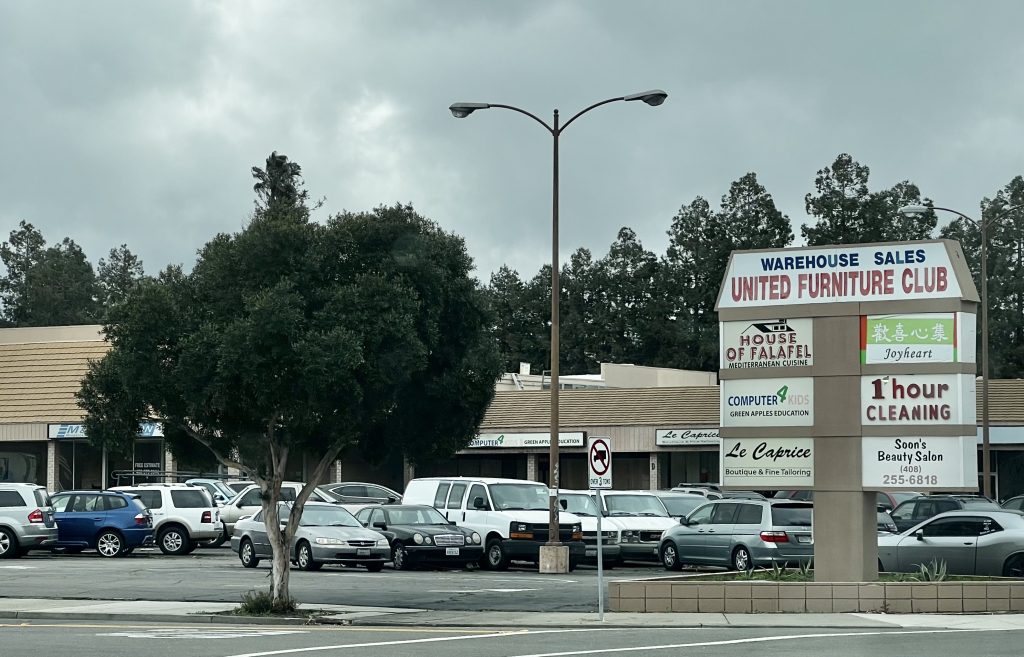
    United Furniture Club site

    In west San Jose adjacent to southern Cupertino, there are plans for a hotel and multifamily housing (S. De Anza between Hwy 85 and Prospect Road). Separately, in June 2023, Cupertino City Council approved a 34-home mixed-use project just across the road at 1655 S De Anza Blvd.


    Local Parents Protest FUHSD Transition to Trustee Area Voting

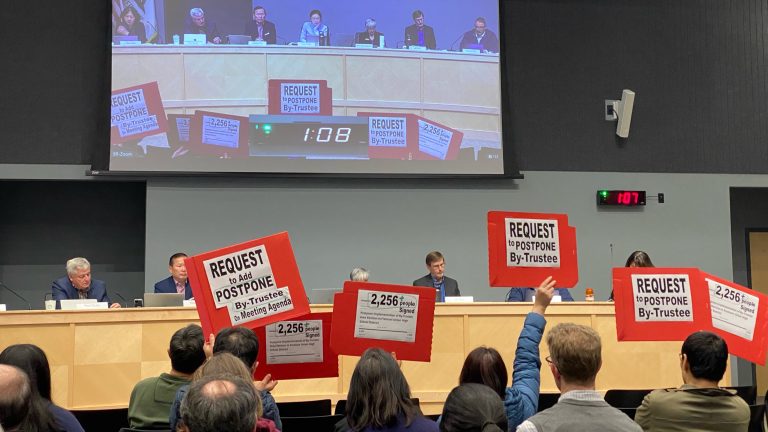
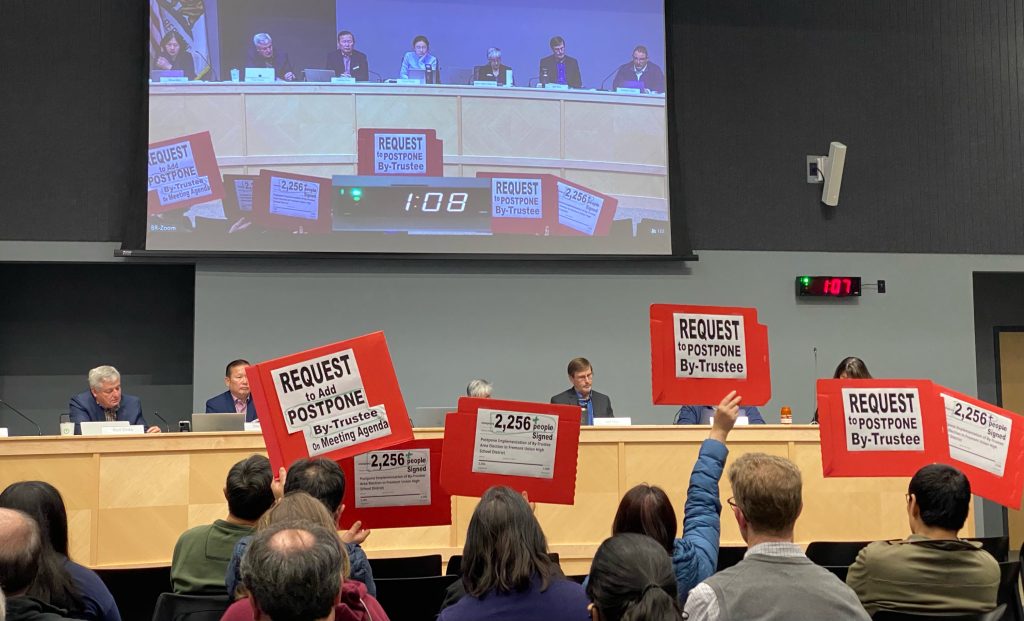
    Over 2,200 residents from the Monta Vista and Lynbrook High School attendance areas have expressed opposition to the Fremont Union High School District’s transition from At Large to By-Trustee Area elections. Residents have spoken out at board meetings, community meetings, and signed a petition.

    Feb. 13, 2024 FUHSD Board Meeting

    With the previous at-large voting system, residents were able to elect all five FUHSD Board Trustees. With the new Trustee Area voting system, residents will only be allowed to elect one trustee in their designated Trustee Area. Read the full article to find out why many local residents oppose the change.


    Should Cupertino Hold $48M in a Bank Account with Zero Interest?

    As Cupertino continues to face a budget deficit and cut services, a growing number of residents are questioning why approximately $48M in city funds are being held in an account earning zero interest. Councilmember Kitty Moore flagged the account to staff, who confirmed it does not earn interest.

    Assuming the city leaves $3M in the account for liquidity purposes, the remaining $45M could be earning up to $2.25M per year simply by moving it into a 5% interest CD or Money Market.

  • Cupertino’s 0% Interest Bank Account Raises Questions

    Cupertino’s 0% Interest Bank Account Raises Questions

    As Cupertino continues to face a budget deficit and cut services, a growing number of residents are questioning why approximately $48M in city funds are being held in an account that earns zero interest.

    Councilmember Kitty Moore flagged the account to staff, who confirmed that it does not earn any interest. Cupertino uses its Wells Fargo checking account to handle day-to-day transactions. The account is regularly referenced in Treasurer’s Reports, with a stated balance $49M as of December 31, 2023. A recent Public Records Request shows all of the latest transactions in this account, with a slightly different balance of $48.4M as of December 31, 2023. 

    Checking accounts serve as an important source of liquidity for cities to fund regular operations. However, residents are now questioning whether it is appropriate to hold such a large amount in zero-interest checking. Assuming there is $48M in cash, if the city leaves $3M in the account for liquidity purposes, it could be earning up to $2.25M per year simply by moving the remaining $45M into a CD or Money Market bearing 5% interest. 

    Considering Cupertino’s proposed drastic measures to close the budget gap, the millions in lost interest income are meaningful. For example, the City recently explored tax increases to generate $1M-$5M per year, raising fees on residents, and reducing costs by requiring residents to maintain sidewalks and street trees.

    Residents are always welcome to express their opinion by emailing:

    City Manager: [email protected]
    City Council: [email protected] 

  • Development In and Around Cupertino: Retail Land Replaced by Hotels and Housing

    Development In and Around Cupertino: Retail Land Replaced by Hotels and Housing

    Two more housing development projects that expect to build 113 new homes are under review in Cupertino’s Planning Department. These have been submitted under the State Law SB330, which streamlines housing approvals.1

    • 10065 E Estates Dr: 55 townhomes at the “United Furniture” site at, near Wolfe and Stevens Creek Blvd. There is PCE (tetrachloroethylene) contamination at the site from the One Hour Dry Cleaner that is currently above residential screening levels.2 PCE is heavier than water, sinks to the groundwater and spreads rapidly, and its vapors then rise through the soil and enter indoor air spaces. 
    10065 E. Estates Dr.
    • 20840 Stevens Creek Blvd: 58 homes, 12 of which will serve the needs of people with “moderate” incomes at the old Fontana’s Restaurant, adjacent to Staples.

    Two hotel projects, which have been on hold for years, have applied to renew their development agreements.

    • 10801 N Wolfe Rd: The Cupertino Village Hotel project at the Duke of Edinburgh pub in the Cupertino Village shopping center at Homestead Road. The 185-room hotel application was initiated in 2017 and approved by City Council in 2019. More information is available here.
    • 10931 N De Anza Blvd: The De Anza Hotel project at the Goodyear Auto Service, adjacent to the Cupertino Hotel at the 280 interchange. The 155-room hotel application was initiated in 2018 and approved by City Council in 2020. More information is available here.

    In nearby San Jose on S De Anza between Hwy 85 and Prospect Road are plans for a hotel and multifamily housing. The City of Cupertino is behind and across the road from these properties.

    1655 S. De Anza Blvd.

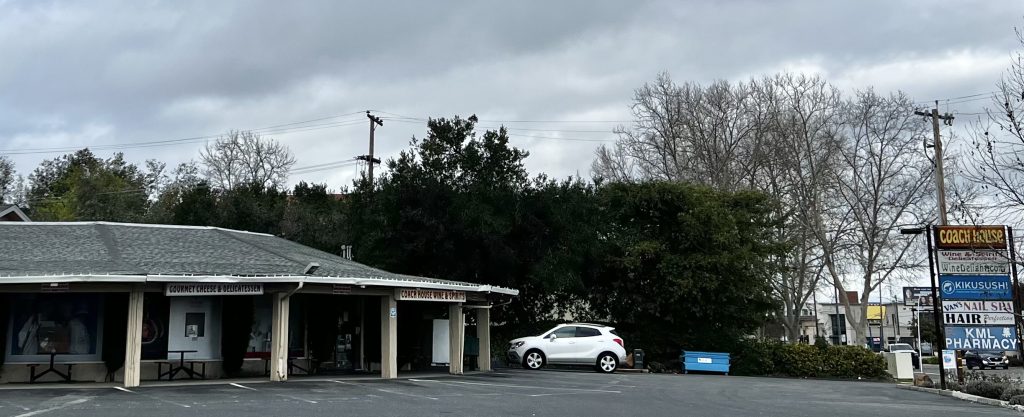
    Separately, in June 2023, Cupertino City Council approved a 34-home mixed-use project just across the road on the nearly 8-acre shopping center with the Kikusushi Restaurant at 1655 S De Anza Blvd.3

    • 1510 S De Anza Blvd: The 4-story 132-room hotel with a roof-top deck and underground parking on a 0.86 gross acre site was approved in 2020. It is located at the old Kelly-Moore Paints Store.4
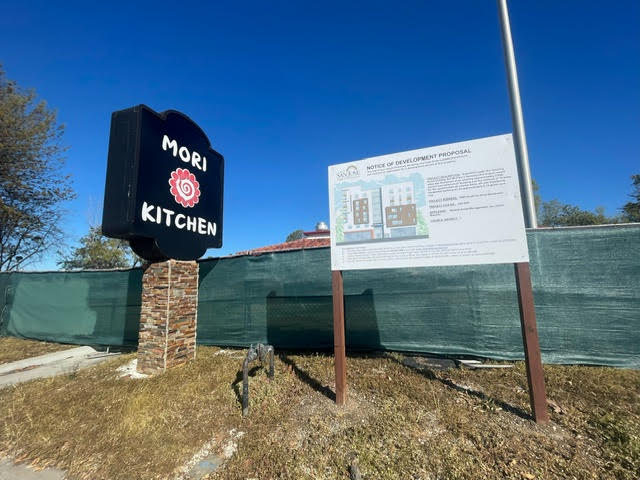
    • 1000 S De Anza Blvd: The seven-story 99-unit multifamily residential building on a 0.72-gross acre site is located at the closed Mori Restaurant. This project has been submitted under the “Builder’s Remedy,” which is a method by which developers can obtain ministerial project approval when a City has failed to obtain its Housing Element. It is unknown as to whether the City of San Jose has accepted this project under the provisions of the “Builder’s Remedy.”5
    1000 S. De Anza Blvd.

    Sources:
    (1) Cupertino Online Permit Services  https://aca-prod.accela.com/CUPERTINO/Default.aspx Accessed March 5, 2024.
    (2)  ONE-HOUR DRY CLEANERS. Geotracker. https://geotracker.waterboards.ca.gov/profile_report.asp?global_id=T10000021095 Accessed March 9, 2024.
    (3)   1655 S. DE ANZA BLVD., City of Cupertino. https://www.cupertino.org/our-city/departments/community-development/planning/major-projects/1655s-de-anza-blvd. Accessed March 5, 2024.
    (4)  1510 S. DE ANZA BLVD., City of Cupertino. https://www.sanjoseca.gov/your-government/departments-offices/planning-building-code-enforcement/planning-division/environmental-planning/environmental-review/negative-declaration-initial-studies/1510-s-de-anza-hotel-project  & Site Development Permit. City of San Jose, 18 November 2020. https://www.sanjoseca.gov/home/showpublisheddocument/66859/637406168452370000. Accessed March 5, 2024.
    (5)   Geha, Joseph. San Jose spurns developers, sparking possible legal fight. San Jose Spotlight, 6 February 2024. https://sanjosespotlight.com/san-jose-spurns-developers-sparking-possible-legal-fight-lawsuit-builders-remedy/. Accessed March 5, 2024.

  • Local Parents Protest FUHSD Transition to Trustee Area Voting

    Local Parents Protest FUHSD Transition to Trustee Area Voting

    Over 2,200 residents from the Monta Vista and Lynbrook High School attendance areas have expressed opposition to the the Fremont Union High School District’s transition from at-large to by-trustee area elections. Residents have spoken out at board meetings, community meetings, and signed a Change.org petition.

    Feb. 13, 2024 FUHSD Board Meeting

    A Controversial Move

    With the previous at-large voting system, residents were able to elect all five FUHSD Board Trustees. But with the new Trustee Area voting system, residents will only be allowed to elect one trustee in their designated Trustee Area. See our previous article for more background. 

    FUHSD’s stated reason for transitioning from At Large to Trustee Area Elections is to avoid scrutiny under the California Voting Rights Act (CVRA). The CVRA, passed in 2002, helps minority groups more easily challenge At Large elections, on the grounds that they cause racially-polarized voting. However, to date, FUHSD has not done any analysis to determine whether there is racially-polarized voting in its district.

    Cupertino Councilmembers Question FUHSD Plan

    At the February 13th FUHSD Board Meeting, Cupertino City Councilmember Liang Chao, representing herself only, stated, “In the unanimous decision by the Supreme Court in August 2023, the Supreme Court raised the bar for the CVRA challenge. It specifically said alternatives could be ranked-choice voting and cumulative voting.” 

    Chao called for the FUHSD Board to immediately add an agenda item to consider other voting methods, and also “consider fiscal impacts of going through the lengthy redistricting process every 10 years with by-trustee area elections.”

    Cupertino Councilmember Kitty Moore, whose children attended FUHSD schools, also spoke out representing herself only. Moore stated, “I am very concerned about the profound lack of data concerning redistricting, especially considering that we are a high school district known for our academics. This could potentially expose the district to various risks.”

    Supporters of By-Trustee Areas

    According to the FUHSD presentation delivered by Superintendent Graham Clark, the switch helps North Sunnyvale residents. Historically, most FUHSD trustees have come from South Sunnyvale and Cupertino. North Sunnyvale has not had any trustees. With the transition, North Sunnyvale would always be guaranteed one board member. 

    One of the decision’s biggest advocates is an organization called Sunnyvale Equity in Education (SEE). SEE has stated in a Facebook post that its goals include achieving equal representation on the board, and, in the long term, opening its own North Sunnyvale school.

    Current and former Sunnyvale City Councilmembers are also proponents of the move. “No taxation without representation,” stated Sunnyvale’s Councilmember of District 5, which includes North Sunnyvale. “In the past 50 years, there has never been a Latino or a North Sunnyvale resident on this board. In the 40 years since the closure of Sunnyvale High School, North Sunnyvale residents have not enjoyed the same access or quality of high school educational resources as the rest of this district. Our residents deserve the same access to educational resources as South Sunnyvale, Cupertino, Los Altos, and San Jose residents.”

    Opponents of By-Trustee Areas

    Many Monta Vista and Lynbrook area parents expressed frustration with Trustee Areas, across multiple FUHSD meetings. Numerous public comments showed concern that the change would put Monta Vista or Lynbrook at risk of being closed, in order to make way for a Sunnyvale school. FUHSD currently has five high schools; it is unlikely to be able to afford six. During public meetings, several parents stated that it takes only three out of five board members to close a school. With the Trustee Area system, Southern FUHSD would be at risk of not having enough board members to vote against such a move, if it ever arose. 

    Many parents also stated that the change to Trustee Areas was made without their consent. All community outreach meetings occurred after the decision was made, asking residents to “choose a map” for Trustee Areas, rather than provide input on the Trustee Area decision itself. “By-Trustee Area will undercut the ability of every voter to have an impact, since we can only vote for one trustee every four years,” stated Councilmember Liang Chao. 

    Next Steps

    FUHSD now faces the challenging task of managing the needs of multiple parent groups. The District continues to reassure parents that it “has no plans to close schools”. However, it also refuses to definitively state that it “will not close schools.” Ultimately, this lack of certainty is leaving many questioning the district’s motives.

    How To Get Involved

    There are many ways local residents can share their opinions on the move to Trustee Areas. Most immediately, there are two remaining Map Hearing Schedules. These are held during the regular board meetings at the District Office (589 W. Fremont Avenue, Sunnyvale, CA 94087).

    • March 20, 2024 (6 P.M.)
    • April 24, 2024 (6 P.M.): This is the final map hearing where the board will approve a final map of Trustee Areas, as well as which areas will be up for election.

    Attend an FUHSD Board of Trustees meeting.

    View the presentation made during the Monta Vista High School Community Outreach meeting.

    Email:
    DO STAFF: [email protected] 
    BOARD & DO STAFF: [email protected]

    Those opposing the transition can sign the Change.org petition.

  • January 2024 Newsletter: Cupertino Gets Sued, March 5th Primary Elections, and More

    Cupertino Attempts to Trim Budget

    The January 17, 2024 City Council meeting to discuss potential budget cuts (“Service-Level Reductions (SLRs)”) revealed a bloated budget and long-standing accounting errors. Remarkably, over $2.2M of the proposed Service Level Reductions were actually just accounting adjustments. These changes are now being presented as “Potential Service Level Reductions,” when there are no associated service reductions.

    Council did advise on a few service reductions that may impact residents: Sidewalk and tree maintenance may now be the responsibility of the property owner. Community events, including concerts, movies, and festivals, will also have reduced funding. There were no significant staffing reductions or cutbacks for City employees.


    Cupertino, We Can Do Better: Register to Vote and Vote Regularly

    The Santa Clara County Registrar of Voters commits to sending vote-by-mail ballots for the March 5, 2024 Presidential Primary Election to all county voters no later than Monday, February 5.

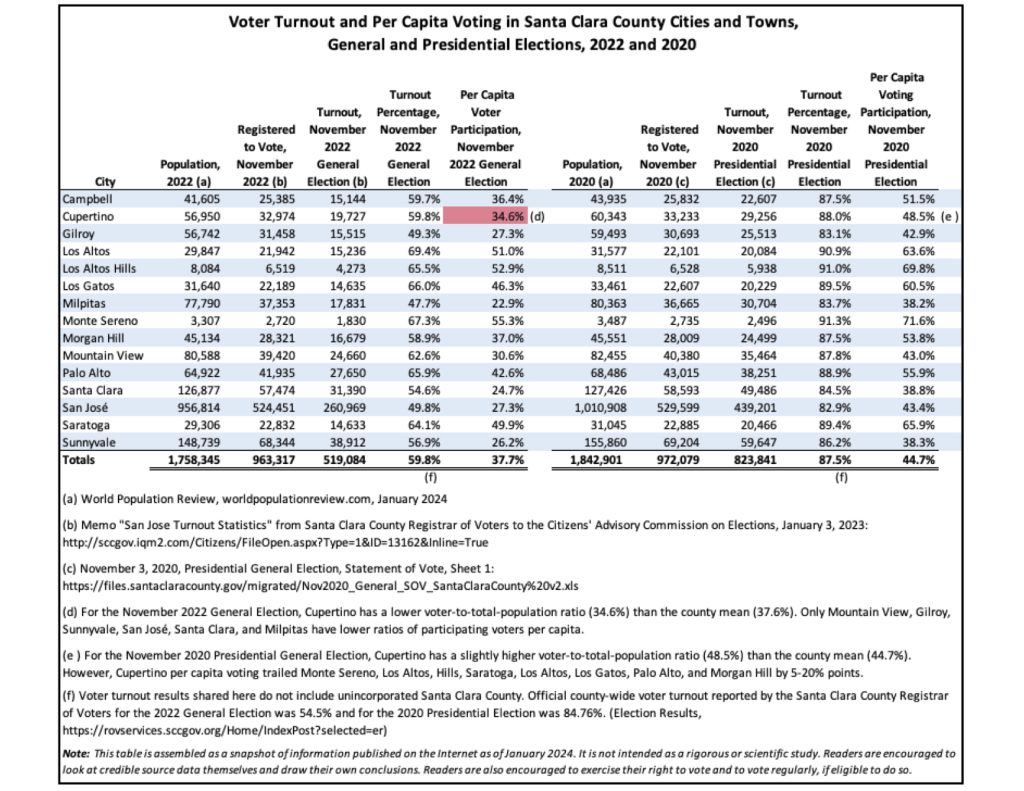
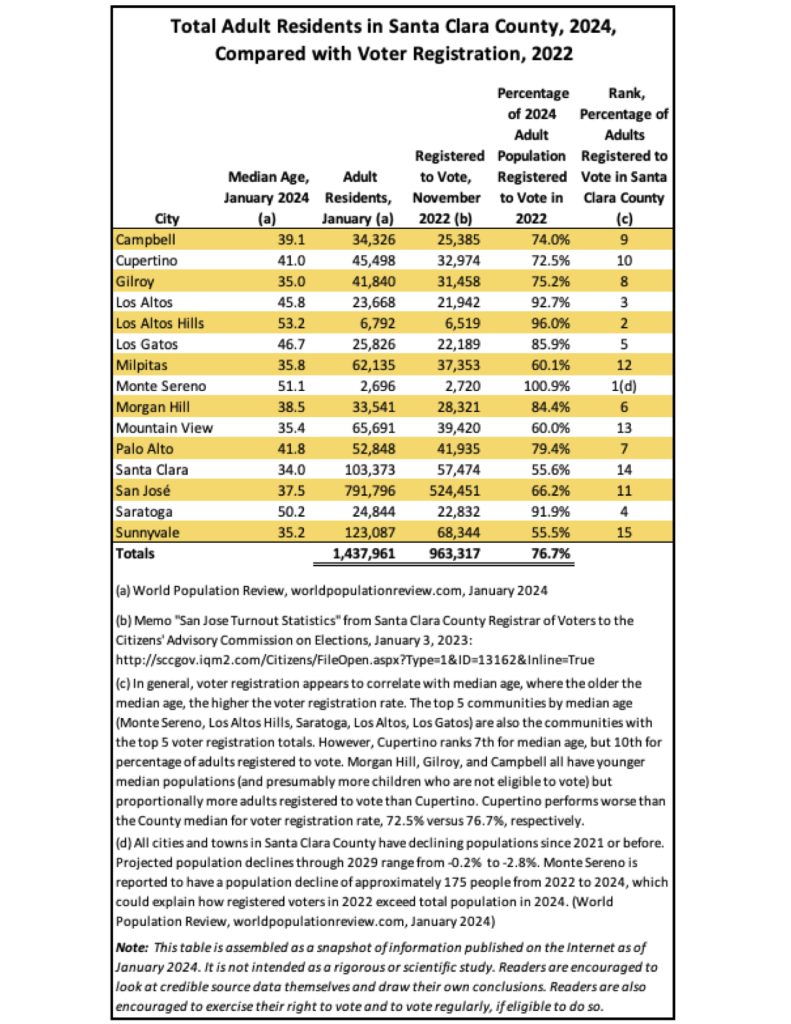
    In Cupertino, approximately 73% of all adult residents are registered to vote. Of the 73% registered, only 60% cast ballots in the November 2022 General Election. Cupertino had a better showing for the November 2020 Presidential Election, with 88% of registered voters returning ballots. However, relative to several nearby communities, Cupertino residents are registered to vote at much lower rates.

    Find out more about the upcoming March 2024 Primary Election, and why you should vote.


    YIMBY Lawsuit Costs Cupertino

    On January 10, 2024, Cupertino settled a lawsuit filed by California Housing Defense Fund and Yes In My Back Yard (YIMBY) for missing its state-mandated Housing Element deadline. According to YIMBY Law, whose slogan includes “Sue the Suburbs,” about a dozen Bay Area jurisdictions have been sued for missing their housing-element deadlines, including Palo Alto, Burlingame, and the County of Santa Clara. Their complaint against Palo Alto drew the ire of residents who commented that the lawsuit is a scam used to raise money by organizations that are “backed by investment firms, developers and real estate lobbies.”

    Read more about what the lawsuit’s settlement means for Cupertino.


    Browse Previous Cupertino Facts Issues:

  • YIMBY Lawsuit Costs Cupertino

    YIMBY Lawsuit Costs Cupertino

    On January 10, 2024, Cupertino settled a lawsuit filed by California Housing Defense Fund and Yes In My Back Yard (YIMBY) for missing its state-mandated Housing Element deadline. According to YIMBY Law, whose slogan includes “Sue the Suburbs,” about a dozen Bay Area jurisdictions have been sued for missing their housing-element deadlines, including Palo Alto, Burlingame, and the County of Santa Clara.

    YIMBY Law claims that nearly half of Bay Area cities remain out of compliance. Their complaint against Palo Alto drew the ire of residents who commented that the lawsuit is a scam used to raise money by organizations that are “backed by investment firms, developers and real estate lobbies.”

    Total Cost Unknown

    To settle the lawsuit, Cupertino paid YIMBY Law and California Housing Defense Fund, $6,000 and $9,000 respectively. The cities of Cupertino, Palo Alto and Burlingame also hired the law firm Goldfarb & Lipman for their defense. Cupertino has paid its contract attorney tens of thousands of dollars in 2023, but it is unknown as to how much was spent on this lawsuit because the City uses the firm for other housing-related issues. Santa Clara County appears to have used its in-house counsel to defend itself from a similar lawsuit filed by Californians for Homeownership, an organization that is “financed and controlled by the California Association of Realtors.”1

    Environmental Consequences

    As part of the settlement with YIMBY Law and CalHDF, Cupertino agreed to exempt its entire Housing Element from the California Environmental Quality Act (“CEQA”). This saves time and expedites development projects, but silences the public’s environmental concerns. 

    In spite of the financial and environmental costs to the City, Vice Mayor J.R. Fruen, who has been endorsed by YIMBY organizations and represented them in legal cases, was positive about the lawsuit. Via the Mercury News, Fruen stated, “the city is right to welcome the result.” 

    Via San José Spotlight, Councilmember Kitty Moore countered “CEQA involves the public with public disclosure of environmental impacts to mitigate those impacts as possible, and to ultimately keep workers and residents informed and safe.” According to the New York Times, due to semiconductor manufacturing, “Santa Clara County is riddled with 23 toxic Superfund sites, more than any county in the country.” Notably, Councilmember Moore, who uncovered toxic waste at the former Vallco site, championed to have the site remediated in order to protect human health. Her actions spurred the County Department of Environmental Health to force a cleanup. 

    Moore emphasized, “This exemption from CEQA is not a win for anyone.”

    Sources:

  • Latest Cupertino Budget Updates: January 2024

    Latest Cupertino Budget Updates: January 2024

    The January 17, 2024 City Council meeting to discuss potential budget cuts (“Service-Level Reductions (SLRs)”) revealed a bloated budget, long-standing accounting errors, and further confirmed out-of-control spending. There were no significant staffing reductions or cutbacks for City employees.

    A Closer Look at Service Level Reductions

    Remarkably, over $2.2M of the proposed Service Level Reductions were actually just accounting adjustments. For example, Councilmember Kitty Moore expressed concern over calling a $160,000 reduction in extra library hours a “service level reduction”. The City has not had to pay for extra Library hours for years, as the costs are funded by the County. Other changes to the Sheriff’s Office, Public Works, and  City Attorney budget were also accounting adjustments to “align the budget with the actual hours provided.” These changes are now being presented to the community as “Potential Service Level Reductions,” when there are actually no associated service level reductions.

    Council did advise on a few service reductions that may impact residents: Sidewalk and tree maintenance may now be the responsibility of the property owner. Community events, such as concerts, movies, and festivals, will also have reduced funding (most notably, the elimination of July 4th fireworks in 2024). And the Cupertino Scene will now be mailed quarterly instead of monthly.

    While Cupertino attempts to cut costs, its proposed changes to employee headcount remain insubstantial. The latest budget report states that the city plans to eliminate only “3-4 vacant positions annually” over the next decade, “until the City reaches a staffing level of 180 positions, which is consistent with the levels in FY 2015-16”. The January 17th proposed service level reductions included elimination of an undisclosed number of part-time roles, for an undisclosed amount of savings. As of September 2023, the city had 195 full-time equivalent employees. Most notably, in the past five years, the budgeted headcount for Administration and Administrative Services ballooned from 30 to 40 employees.1 Meanwhile, as the City struggles with its finances, its finance head was paid nearly $300K in 2022.2

    Questionable Budget Reduction Target

    Currently, Cupertino has a $10M financial deficit. During the January 17th City Council Meeting, Councilmember Moore questioned why staff was attempting to make $15M in expenditure reductions or revenue generation efforts. Moore noted that the $15M financial deficit was anchored to a 2033 forecast, 10 years in the future, while for the next 4 years, the deficit was only anticipated to hover around $10M.

    A Need for Greater Fiscal Accountability

    Once again, City Council met behind closed doors on January 29, 2024 to discuss its appeal to the California Department of Tax and Fee Administration (CDTFA). As previously reported, the CDTFA has questioned whether Apple should direct all California online sales tax revenues to Cupertino. This lucrative arrangement accounts for about 63% of Cupertino’s sales tax revenue. The potential loss of this revenue, and repayment dating back to mid-2021, has shined a spotlight on Cupertino’s budgeting practices.

    Meanwhile, last November, Staff acknowledged that it had stockpiled over $80M in unassigned funds. Currently, the unassigned fund balance sits at $47M, with an additional $56M set aside as a sales tax repayment reserve for Apple. Cupertino also has $149M sitting in an investment account with Chandler Asset Management.4 This begs the question of whether raising taxes, eliminating community services, or partnering with developers to turn City-owned land into housing, such as the Sports Center, is the appropriate course of action.

    Particularly when it comes to evaluating the use of public funds, the role of our publicly-elected representatives is to make decisions based upon what is good for the community. Meanwhile, the current majority of Councilmembers Wei, Fruen, and Mohan have actively discouraged other Councilmembers, such as Moore, who spends her time on the dais pushing for transparency and accuracy regarding Cupertino’s true financial situation, and highlighting accounting errors.

    Now, as Council considers tax increases and elimination of resident services, it is imperative that it makes decisions with a long-term community benefit, rather than simply rubber-stamping staff recommendations. And without true fiscal accountability, it is unclear whether residents will support a sales tax hike that is expected to be on November’s election ballot.

    References

    1 – Staffing Report. City of Cupertino’s Financial Reporting Platform. (n.d.). https://cupertino.opengov.com/transparency/#/33189/accountType=fteCount&embed=n&breakdown=28459e6a-563e-4695-97d4-8a0d97d881e1&currentYearAmount=cumulative&currentYearPeriod=years&graph=bar&legendSort=desc&proration=true&saved_view=103397&selection=3B47265EDAEBBD4AA92D700FE18A69B7&projections=null&projectionType=null&highlighting=null&highlightingVariance=null&year=2024&selectedDataSetInddex=null&fiscal_start=earliest&fiscal_end=latest. Accessed January 29, 2024.

    2 – Salary information for Kristina Alfaro. Transparent California. (n.d.). https://transparentcalifornia.com/salaries/2022/cupertino/kristina-alfaro/. Accessed January 29, 2024.

    3. Staffing Report. City of Cupertino. (19 December 2023). https://cupertino.legistar.com/LegislationDetail.aspx?ID=6475868&GUID=B089ABAD-726F-44B5-9596-A946A765AA0B&Options=&Search=. Accessed January 29, 2024.

    4. FY 2023-24 Adopted Budget. City of Cupertino. (6 June 2023). https://apps.cupertino.org/pdf/FY_2023-24_Adopted_Budget.pdf. Accessed January 29, 2024.

  • Cupertino, We Can Do Better: Register to Vote and Vote Regularly

    Cupertino, We Can Do Better: Register to Vote and Vote Regularly

    In a recent article published in The.Ink, Anand Giridharadas interviews Daniel Ziblatt, a scholar and co-author (with Steven Levitsky) How Democracies Die (2018) and Tyranny of the Minority (2023). The interview is thoughtful and worth the read, but the salient point is addressed in the headline, “Want to Save Democracy? Watch Less Cable News; Attend More Town Meetings”. 1

    One to add to the Strengthen Democracy To Do list: vote regularly.

    Why should Cupertino residents vote?

    In Cupertino, approximately 73% of all adult residents are registered to vote. Of the 73% registered to vote, only 60% cast ballots in the November 2022 General Election. Cupertino had a better showing for the November 2020 Presidential Election, with 88% of registered voters returning ballots. However, relative to several nearby communities, Cupertino residents are registered to vote at much lower rates. Residents of Campbell, Gilroy, Palo Alto, Los Altos, Morgan Hill, Saratoga, and others have better voter registration rates than Cupertino.

    When we choose not to vote, we lose our voices. In 2024, the rest of Cupertino joins the small sliver of the city that is part of California Senate District 13. CA SD-13 is centered in San Mateo County, where 84% of eligible adults were registered to vote for the November 2022 General Election.2 As Cupertino joins CA SD-13, we participate at a reduced capacity when our residents cannot be counted on to deliver votes or other campaign support for candidates on par with other CA SD-13 communities.3

    Your vote makes a difference!

    In 2018, 45 votes separated two candidates in Cupertino with very different political platforms and bases of support: one was elected to Council and the other was not. In 2022, the race for the Sunnyvale District 3 Council Member seat was decided by a draw by the County Registrar of Voters after two recounts confirmed a tie between the two candidates.

    When we vote, we support democracy by ensuring that the winning candidates or measures are the ones with the broadest possible support. When voters sit out an election, we risk the total number of “non-voting” registered voters will be greater than the actual votes received by winning candidates, especially for local elections that do not have a primary.

    March 5, 2024 Primary Presidential Election

    The Santa Clara County Registrar of Voters commits to sending vote-by-mail ballots for the March 5, 2024 Presidential Primary Election to all county voters no later than Monday, February 5.

    The March 5, 2024 election includes:4

    Proposition 1, added by the Legislature, that if passed would “[Authorize] $6.38 Billion in bonds to build mental health treatment facilities for those with mental health and substance abuse challenges, [provide] housing for the homeless”

    Primary voting for:

    • US President
    • US Senator
    • US Congressional Representative
    • State Senator (odd numbered districts)
    • Member of the Assembly, including AD-26
    • Judgeships and County Central Committees

    If you or someone close to you are eligible to vote, but not yet registered to vote, the last day to register to vote in the March 5, 2024 election is Tuesday, February 20, 2024 (postmarked registration or electronic submission). You may also register on election day by completing a form at a polling location; however, your vote will not be counted until your information is verified.

    Find voter registration information here.

    Not sure if you are registered to vote? Check your registration status, including the name you are registered under, here. You can also sign up to receive notifications from the Registrar of Voters when your completed ballot is returned.

    Take steps in 2024 to strengthen democracy in our community. Step away from the screen and step forward to in-person, community meetings whenever possible. Register to vote or investigate options to become eligible for US citizenship. If already registered to vote, learn about candidates and ballot measures and take time to vote!

    References

    1 – “Want to Save Democracy? Watch Less Cable News; Attend More Town Meetings,” by Anand Giridharadas, The.Ink, 1/11/2024: https://the.ink/p/want-to-save-democracy-watch-less

    2 – “Report of Registration as of October 24, 2022, Registration by County,” Office of the California Secretary of State, accessed 1/24/2024: https://www.sos.ca.gov/elections/report-registration/15day-general-2022

    3 – “Final Maps Report,” We Draw the Lines, 12/26/2021: https://wedrawthelines.ca.gov/final-maps/final-maps-report/

    4 – “March 5, 2024 Presidential Primary Election, List of Offices.” County of Santa Clara, accessed 1/24/2024: https://files.santaclaracounty.gov/2023-10/list-of-offices-03.05.pdf

  • Cupertino Considers Increasing Sales Tax Rate

    Cupertino Considers Increasing Sales Tax Rate

    On December 5, 2023, City Council voted to explore raising Cupertino sales taxes by 0.25% (to a total of 9.375%). The decision follows staff recommendations, and would poll the business community to understand whether they would be willing to vote for a 0.25% tax hike on the November 2024 ballot.

    Background

    Presently, Cupertino receives approximately $0.65 for every $100 of products purchased from Apple online in California. However, the State recently decided to rescind Apple’s practice of directing online sales tax revenue to Cupertino. 

    The City has contemplated the loss of its lucrative Apple deal since at least 2006. The annual budget cautioned:

    ‘Our largest sales tax producer, Apple computer, comprises 26% and given the volatility of the high tech industry, this fact alone has put this revenue source in an “at risk” situation. To add to this concern, the State is continuing its efforts to change the way Internet sales are reported and, if they are successful, will dramatically affect the amount of sales tax revenue currently received from Apple.’

    When online sales surged during the height of COVID-19, so did Cupertino’s net sales tax income, which peaked at $42.6M in fiscal year 2020/21. The average sales tax income was $23.3M in the fiscal years 2015/16 through 2018/19. If the State nullifies Apple’s agreement with the City, sales tax income is estimated to plunge from $11.4M to $9M in 2023. While the City appeals this decision, it is finally preparing for the worst-case scenario. 

    Muddy Messaging

    In May 2023, the City anticipated a $31M or 73% decline in sales-tax revenue. Recently, the budget gap was reduced to a more realistic $15M. However, with the exception of some smaller cuts, such as cancelling 4th of July fireworks next year, the City has not significantly curbed spending since receiving its first warning letter from the California Department of Tax and Fee Administration (CDTFA) in December 2021. To the contrary, the current annual budget has increased to $113M, from an actual spending of $89M in 2018/19. 

    Accordingly, subsequent budgets listed various “budget-balancing” strategies, among them, taxes on sales (Transaction and Use Tax), hotel stays (Transient Occupancy Tax), parcels, and businesses (Business Operations Tax).

    City Staff Pushes for Sales Tax Increase

    At the December 5, City Council Study Session, staff asked Council to provide “direction to staff regarding exploring the feasibility of one or more potential revenue tax measures – Transaction and Use Tax, Transient Occupancy Tax, Parcel Tax, and/or Business Operations Tax-through opinion research for the November 2024 election.” City Staff and Urban Futures Inc (UFI) presented these four options, but the Transaction and Use Tax was the pre-determined winner: as of October 2023, the City had already entered into a $170K contract with TeamCivX for sales tax revenue measure polling and consulting services.

    The following list describes the new tax proposals and compares them with information from the 2020/21 Budget.

    1. Transaction and Use Tax (TUT): A new 0.25% Transaction and Use Tax would increase the Cupertino sales tax rate from 9.125% to 9.375%, meaning that a purchase of $100 in taxable goods would cost $0.25 more. This tax is estimated to raise $5.4M, a significant increase from the 2020/21 Budget estimate of $3M to $4M. This tax would be levied on taxable purchases made in and/or delivered to Cupertino and would not be shared with County tax pools. Only three of Santa Clara County’s fifteen cities have a tax rate this high, Campbell, Milpitas, and San Jose. Some Bay Area cities have higher rates.
    2. Hotel Tax: The City’s Transient Occupancy Tax (TOT) of 12%, imposed on Hotel stays and Airbnbs, could be increased to 15% (for an estimated $1.875M in revenue). A hotel representative balked at the proposal, leaving Council Members mystified as to why neither the Chamber of Commerce nor Cupertino hotels had been consulted. The 2020/21 Budget did not consider a tax this high and estimated that an increase from 12% to 14% would raise an additional $1.7M.
    3. Parcel Tax: A parcel tax would add $250 to each parcel in the City, regardless of whether it is a small single-family home or an immense industrial complex. A flat tax was considered more straight forward than the more equitable graduated rates of $27 to $613. The graduated rates seem to have been selected so that the amount of money raised for the City would be about the same, $3.7M.
    4. Business Operations Tax: A revised Business License Tax would raise $4.3M, less than half of the $10M estimate in the 2020/21 Budget. No details were provided on how the tax would be calculated. The staff report confirmed that Cupertino has a “notably low business license tax rate compared to neighboring cities on a per capita basis” and warned that a tax-increase could deter existing and future businesses.

    Next Steps

    In January and February, the City will poll the business community for its opinions on a higher sales tax. Outside of the limited poll, it is unclear what communications the public will receive around a potential sales tax ballot measure. A majority vote on the November 2024 ballot would be needed to enact a new 0.25% sales tax. 

    City staff will also discuss budget cuts. Just after the December council meeting, City Staff contracted with Voler Strategic Advisors (VSA) for $42K to “Develop a media strategy on key issues such as the budget or major developments.” As such, the public can potentially expect to receive professional messaging around the budget cuts.